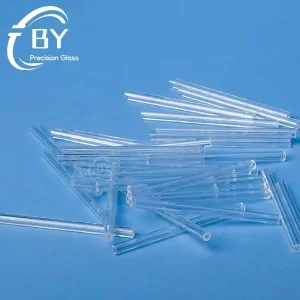
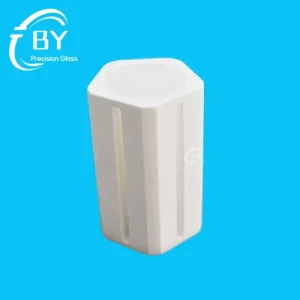
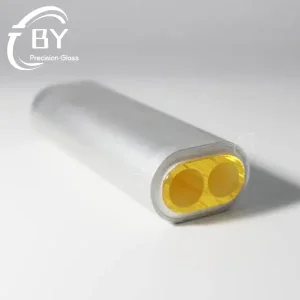
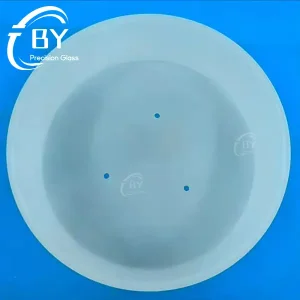
Featured Precision Optical & Laser Cavity Components
High-precision cold and hot-processed optical glass, quartzware, and laser filtration solutions manufactured to your custom engineering tolerances.
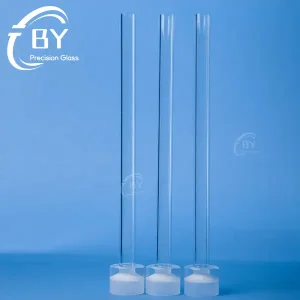
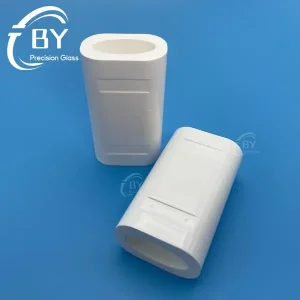
Industrial White Paper: Engineering Cerium-Doped Flow Tubes for Solid-State & Aesthetic Lasers
In high-power, flashlamp-pumped solid-state lasers (such as Nd:YAG, Er:YAG, Alexandrite, and ruby systems) and intense pulsed light (IPL) platforms, managing spectral energy dissipation is paramount. Xenon and krypton arc lamps emit wideband radiation across ultraviolet, visible, and infrared spectra. However, shortwave ultraviolet radiation below 380 nm initiates severe photochemical solarization of synthetic fused silica components and crystal host lattices. Unfiltered UV photons generate color centers within YAG or sapphire matrices, degrading laser slope efficiency, distorting beam wavefronts, and generating massive parasitic heat that induces crystal fracture.
Cerium-doped quartz glass (often designated as Ce-doped quartz or yellow quartz) acts as an essential optical bandpass barrier and fluid conduit. Cerium in its Ce³⁺ and Ce⁴⁺ oxidation states provides deep, sharp-edge cut-off absorption within the ultraviolet spectrum (typically cutting off completely between 380 nm and 400 nm) while maintaining superior transmission exceeding 90% across the critical optical pumping bands (750 nm to 900 nm). Furthermore, Ce³⁺ ions absorb high-energy UV radiation and re-emit fluorescence within the visible green-yellow spectral range via Stokes shift, recycling parasitic UV into excitation-compatible photons and demonstrably enhancing total laser wall-plug efficiency.
Material Matrix Comparison: Cerium Doped vs. Samarium Doped vs. Pure Fused Silica
Optical cavity engineers must strictly match the doping profile to the target active medium and resonator scheme. The following data matrix outlines technical benchmarks for pump-cavity flow tubes manufactured at BY Photonics:
| Physical & Optical Parameter | Cerium Doped Quartz (Ce:Quartz) | Samarium Doped Glass (Sm:Glass) | High Purity Fused Silica (JGS1) |
|---|---|---|---|
| Primary Optical Function | UV Blocking (Solarization Inhibition) + Stokes Re-emission | Parasitic 1064 nm Suppression + ASE Damping | Maximum Broadband Transmission (UV-VIS-NIR) |
| UV Cut-off Wavelength (T < 1%) | 380 nm – 400 nm (Customizable via Ce conc.) | ~350 nm - 380 nm | < 185 nm (No internal UV filtering) |
| 1064 nm Laser Absorption | Negligible (< 0.5% attenuation) | Extremely High (> 99% suppression at 1064 nm) | Negligible (< 0.1%) |
| Softening Point (°C) | ~1680 °C | ~650 °C (Silicate/Phosphate Matrix) | ~1730 °C |
| Coefficient of Thermal Expansion | 5.5 × 10⁻⁷ /°C (Exceptional Thermal Shock) | ~95 × 10⁻⁷ /°C (Requires gradual cooling) | 5.4 × 10⁻⁷ /°C |
| Typical Laser Cavity Roles | IPL Flashlamp Tubes, Alexandrite/Ruby Cavities | High-Energy Nd:YAG Amplifiers, Military Systems | Eximer, Fiber Coupling, Standard Viewports |
Global OEM Procurement Demands & Sourcing Friction
Laser head manufacturers and medical system OEMs require components that mitigate high-duty thermal failure while maintaining supply chain continuity.
Cavity Degradation & Solarization
Global laser OEMs face warranty claims caused by rapid degradation of flashlamps and laser rods. Standard quartz solarizes under intense UV bombardment, shifting spectral output, accelerating deionized coolant breakdown, and creating micro-fractures.
- Dopant Homogeneity: Uniform Ce³⁺/Ce⁴⁺
- Coolant Stability: Prevents DI Water Breakdown
Hydraulic Pressure & Tolerancing
Flow tubes operate within closed-loop liquid-cooling systems handling continuous turbulent flow. Dimensional wall-thickness variations or eccentricity induce localized hydrodynamic hot-spots, thermal lensing, and catastrophic mechanical failure.
- Concentricity Control: ≤ 0.02 mm Total Runout
- Hydrostatic Proof: Up to 1.5 MPa Tested
Batch-to-Batch Optical Consistency
For regulated medical equipment (FDA / CE-MDR registered aesthetic platforms), variation in spectral cut-off shifts output fluence, compromising patient safety and clinical efficacy during hair removal, tattoo removal, and dermatological surgery.
- Spectral Traceability: Spectrophotometer Traces
- Lot Consistency: Delta Cutoff ≤ 2 nm
China Factory Supply Chain: The BY Photonics Advantage
Integrated cold and hot working under one roof in Tianjin, providing high yield, vertical raw material access, and rapid delivery schedules.
Raw Ingot Sourcing
Direct partnerships with domestic high-purity synthetic quartz crucibles ensure steady access to high-purity fused silica and specialized cerium oxide dopants free of trace transition-metal impurities.
Vertical CNC Redrawing
Our Tianjin redrawing towers utilize automated laser OD/ID gauges, dynamically compensating draw speeds to maintain wall uniformity, precision circularity, and tight chamfer angles across large wholesale batches.
B2B Cost Efficiency
By eliminating multiple tiers of European or North American middleman distributors, BY Photonics passes on 30% to 50% tooling and unit cost advantages directly to global system integrators.
Rapid Turnaround Prototypes
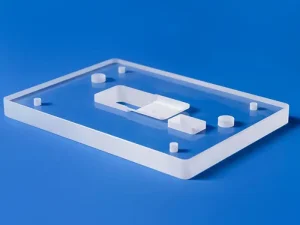
Our in-house oxyhydrogen flame glassblowing and precision ultrasonic drilling shops deliver fully customized single-bore, double-bore, or flow-plate samples within 7-10 working days.
Localized Application Scenarios & Global Industry Trends
Adapting Cerium Doped glass flow tubes across evolving medical aesthetics, aerospace lidar, and heavy industrial processing sectors.
Medical Aesthetics & Dermatology
In hair removal and vascular lesion treatment (IPL and Alexandrite 755 nm / Nd:YAG 1064 nm dual-wavelength systems), our Ce-doped tubes isolate the xenon flash tube, protecting the internal fluid channels and shielding patients from carcinogenic UVC/UVB radiation.
Industrial Laser Cladding & Marking
Lamp-pumped solid-state lasers operating in harsh metallurgical and factory environments require high mechanical strength to handle continuous coolant cycling without devitrification or thermal crack formation.
Aerospace, Defense & LIDAR
Solid-state laser rangefinders and airborne LIDAR cavities demand weight-optimized, high-durability Ce-doped envelopes capable of withstanding extreme thermal oscillations without degrading spectral pump efficiency.
Next-Generation Industry Trends: Multi-Bore Geometries & Eco-Friendly Coolants
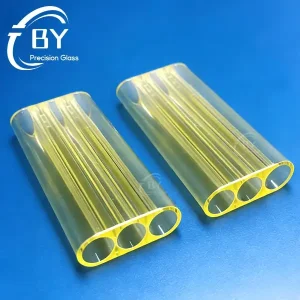
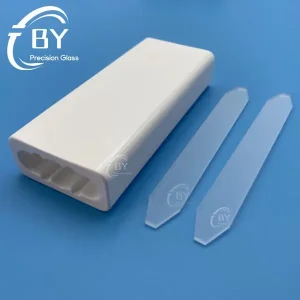
The laser pump chamber sector is shifting rapidly toward compact, integrated configurations. Conventional cylindrical flow tubes are frequently replaced by multi-bore quartz blocks (double-bore, triple-bore, and quadruple-bore arrangements). In these advanced architectures, the flashlamp and laser rod run through parallel integrated channels within a single monolithic cerium-doped quartz body. This maximizes mechanical rigidity, aligns cooling passages precisely, eliminates assembly misalignments, and minimizes pump cavity footprints.
Furthermore, stringent environmental legislation across North America and Europe (e.g., REACH, RoHS) is phasing out toxic corrosion inhibitors previously added to laser deionized water loops. Cerium-doped quartz flow tubes from BY Photonics prevent UV-induced water photolysis and radical generation, reducing acidification of the deionized coolant loop and enabling environmentally benign cooling chemistries.
Global Compliance, Inspection Protocol & Quality Control
Rigorous quality verification processes guaranteeing seamless qualification for ISO 13485 medical and ISO 9001 industrial supply chains.
Spectrophotometric Lot Testing
Every melt batch of cerium-doped quartz undergoes UV-VIS-NIR spectrophotometric analysis (PerkinElmer Lambda standard) to verify cutoff sharpness, 100% UV-C absorption, and NIR transmission curves before glass drawing starts.
Polariscopic Stress Analysis
Following high-temperature oxyhydrogen flame cutting, precision fire-polishing, or edge grinding, all flow tubes undergo controlled furnace annealing. Residual birefringence is measured via polariscope to prevent in-service thermal fracture.
Custom Cleanroom Packaging
To eliminate particulate contamination inside micro-channels, all tubes undergo ultrasonic multi-stage detergent wash, deionized water rinsing, cleanroom drying, and vacuum sealing in antistatic, shockproof packing for international transit.
Frequently Asked Questions (FAQ)
Technical, manufacturing, and operational considerations for cerium-doped glass flow tube procurement.
Why is Cerium Doped Quartz yellow in appearance?
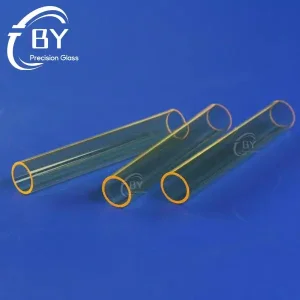
The characteristic yellow hue results from the selective absorption band of Ce³⁺/Ce⁴⁺ rare-earth ions located in the ultraviolet and near-violet portion of the electromagnetic spectrum (up to ~380-400 nm). The glass allows longer wavelengths—green, yellow, red, and infrared—to transmit uninhibited, giving it its visible yellow appearance.
Can you manufacture customized multi-bore or elliptical flow tubes?
Yes. In addition to standard concentric cylindrical flow tubes, we machine and draw double-bore, triple-bore, square outer/round inner, and custom elliptical geometries based directly on your 2D/3D technical drawings (STEP, DWG, PDF).
How does Cerium doping enhance laser efficiency via Stokes shift?
When high-energy UV photons strike Ce³⁺ ions, they are absorbed and dissipate a portion of their energy non-radiatively before re-emitting fluorescence in the 400–550 nm band. These re-emitted photons align more closely with laser crystal absorption bands (e.g., ruby, Alexandrite), recycling useless UV energy into functional pump light.
What dimensional tolerances can BY Photonics maintain on drawn tubes?
Our standard production tolerances for redrawn and CNC-machined tubes are Outer Diameter (OD) ±0.05 mm, Inner Diameter (ID) ±0.03 mm, and wall thickness uniformity within 0.02 mm. For ultra-demanding laser cavities, precision diamond grinding and polishing achieves dimensions down to ±0.01 mm.
Explore Complete Flow Tubes, Cavities & Quartzware Solutions
Explore our full line of wholesale laser cavity reflectors, samarium-doped filters, capillary tubing, and vacuum components.