
High-Power Optical Fiber End Caps & Laser Substrates
Explore precision-fabricated end caps, triple-bore laser flow tubes, and diffuse pump cavities machined to micro-radian tolerances with high LIDT thin films.
-
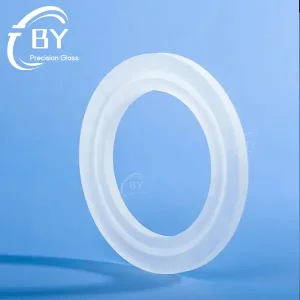
High-Quality Precision Custom Quartz Glass Components for Semiconductor Manufacturers, Supplier
Source Component -
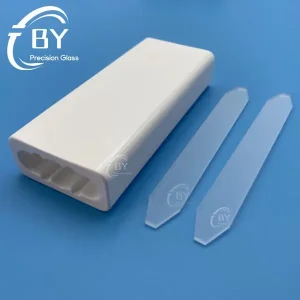
Wholesale Ceramic Cavity Reflector use for DEKA Laser Manufacturers, Supplier
Source Component -
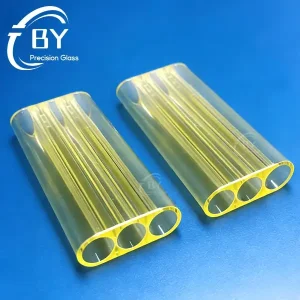
Wholesale Samarium-doped Quartz Triple Bore for Medical Laser Manufacturer, Supplier
Source Component -
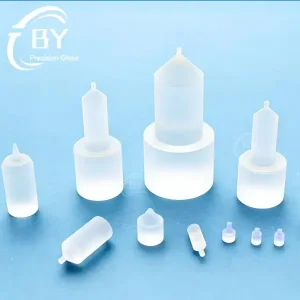
High-Quality Customized Quartz Fiber End Caps for QBH Manufacturer, Factory
Source Component -
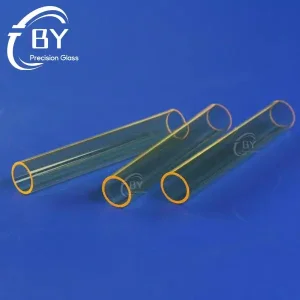
Custom UV Block Yellow Quartz Tube for IPL Lamp Flow Handle Manufacturer, Factories
Source Component -
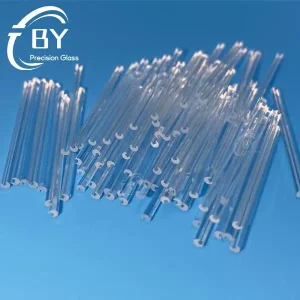
High-Quality Quartz Substrate Groove Use For Optical Fiber Coupler Suppliers, Factories
Source Component -
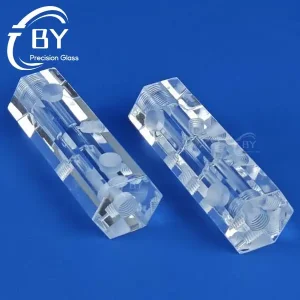
High-Quality Custom Fabrication of Quartz Glass Precision Components Supplier, Factory
Source Component -
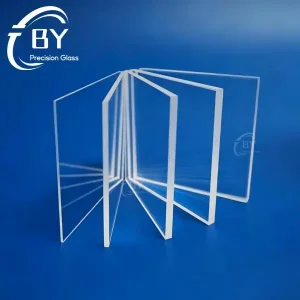
High-Quality JGS1 UItraviolet (UV) Grade Fused Silica Plate Supplier, Factory
Source Component
Fiber End Cap Technology Evolution in Multi-Kilowatt Laser Resonators
Analyzing optical power density mitigation, thermal lensing, and fusion splicing dynamics at extreme power thresholds.
The Physics of Power Density Reduction: From Core to Glass Interface
In high-brightness fiber lasers, power density within standard fiber cores (e.g., 10 to 50 μm) frequently surpasses tens of megawatts per square centimeter (>20 MW/cm²). Without an expansion medium, direct termination of such fibers into an air interface triggers catastrophic optical surface damage (COSD), caused by ambient particulate accumulation, photochemical degradation, and dielectric breakdown of the ambient interface.
Fiber end caps solve this physical barrier by splicing a coreless, high-purity synthesized fused silica block (typically JGS1 or suprasil-grade silica) directly onto the fiber end-face. As the guided laser mode exits the core, it diverges freely within the homogenous bulk glass medium according to its numerical aperture (NA). By expanding the beam area by a factor of 100× to 1,000× before it encounters the anti-reflective (AR) coating and ambient atmosphere, the surface power density drops exponentially below the Laser Induced Damage Threshold (LIDT), ensuring sustained gigawatt-scale pulse and multikilowatt continuous-wave (CW) beam handling.
| Parameter Metric | Standard Fiber Core Interface | Spliced Quartz Fiber End Cap | Performance Gain Factor |
|---|---|---|---|
| Effective Beam Area | ~78.5 μm² (10 μm core) | ~7,068,000 μm² (3 mm expanded facet) | > 90,000× Expansion Factor |
| Facet Power Density (at 3 kW CW) | 3.82 GW/cm² (Immediate COSD) | 42.4 kW/cm² (Safe Margin Operating State) | 99.998% Surface Flux Relief |
| LIDT Performance @ 1064nm, 10ns | < 5 J/cm² (Contaminated Core End) | > 45 J/cm² (IBS Magnetron Coating Facet) | 9× Damage Threshold Surge |
| Thermal Expansion Matching | Discontinuous at connector air gaps | Zero thermal mismatch (All-Silica Fusion) | Near-zero thermal wavefront distortion |
Ultra-Low Absorption Bulk Material
Fabricated using synthetic high-purity JGS1/corning fused silica with hydroxyl (OH) levels below 1 ppm to virtually eliminate 940 nm, 976 nm, and 1064 nm parasitic absorption, avoiding catastrophic thermal runaway.
Sub-Nanometer Precision Polishing
CMP (Chemical-Mechanical Polishing) processes achieve surface roughness Ra < 0.5 nm, Scratch-Dig 10-5, and flatness < λ/10 @ 632.8 nm, suppressing backscatter and phase wavefront errors in coherent beam combining.
IBS Sputtered High-LIDT Coatings
Ion Beam Sputtered (IBS) anti-reflective coatings deliver ultra-dense stoichiometric crystal lattices with residual reflection R < 0.1% and verified LIDT ratings greater than 45 J/cm² @ 1064 nm 10 ns pulses.
Enterprise Procurement Criteria: Mitigating Vulnerability in Tier-1 Supply Chains
Industrial laser integrators and medical system OEMs demand verified stability, end-to-end metrology reports, and rapid prototyping workflows.
Dimensional Tolerance Control
Fiber end-cap outer diameters held within ±0.005 mm; end-face perpendicularity < 15 arcminutes, ensuring frictionless automatic alignment into fusion splicers (Vytran, 3SAE).
Extreme Thermal Stability
Low thermal expansion (α = 5.5 × 10⁻⁷ / °C) preserves thermal lens focal lengths in multi-kilowatt CW lasers, averting spot distortion and focal shift in laser welding optics.
Full Lot Traceability
Material spectroscopy, raw ingot OH data, and Zygo interferometer wavefront interferograms are archived for 10 years per production batch, delivering medical/aerospace compliance.
Turnkey Custom Geometries
Standard cylindrical, wedge-faceted, flared flange, and stepped end-cap profiles compatible with industry-standard QBH, QCS, and custom collimator interfaces.
Integrated Optical Glass Solutions Across Strategic Industries
Supplying fused silica components, flow-tubes, and beam delivery optics to high-precision laser OEMs worldwide.
Automotive & Heavy Fabrication
Multi-kilowatt sheet-metal cutting and laser-wire welding heads require zero-defect end-caps capable of resisting intense thermal back-reflections during processing of copper, brass, and aluminum.
Surgical & Dermatological Systems
Holmium (Ho:YAG) and Thulium (Tm) fiber lasers operating at 1.94 μm – 2.1 μm depend on hydroxyl-depleted JGS3 infrared-grade end caps to prevent explosive water-peak thermal loading in endoscopic surgery.
Directed Energy & Defense
Single-mode coherent beam combination (CBC) systems require ultra-flat λ/10 end-cap surfaces and thermal lensing compensation to combine dozens of fiber outputs into a single diffraction-limited wavefront.
Metrology Infrastructure & Quality Compliance
Precision-controlled fabrication backed by laser interferometry, spectrophotometry, and cleanroom packaging.
Metrology Pipeline & Environmental Cleanliness
Optical end-cap failure is overwhelmingly linked to subsurface micro-fissures and surface contaminants that carbonize under multikilowatt laser irradiation. At BY Photonics, all end-cap substrates undergo rigorous multi-step inspection:
1. Sub-Surface Damage (SSD) Screening: Non-destructive confocal microscopic and chemical etching inspections verify complete removal of subsurface fracture zones created during initial sawing and rough grinding.
2. Laser Wavefront Distortion Assessment: Zygo GPI-XP Phase Shift Interferometers quantify optical path difference (OPD), transmitted wavefront distortion (< λ/10 @ 632.8 nm), and wedge angle tolerances (< 3 arcseconds).
3. Class 100 (ISO Class 5) Packaging: Splicing prep requires immaculate end-caps. Final ultrasonic cleaning with multi-solvent neutralization is conducted inside Class 100 cleanrooms, vacuum-sealed in static-dissipative carrier trays.
Fiber End Cap Technology Roadmap (2026–2030)
Anticipating the requirements of next-generation ultra-fast lasers, spatial division multiplexing, and direct megawatt-scale output.
Phase 1: Structured Micro-Optics
Monolithic integration of diffractive beam-shaping optical elements (DOE) directly into the output facet of the fiber end cap, eliminating secondary collimating lenses and shrinking laser head footprints.
Phase 2: Ultrafast Dispersion Tuning
Engineered multi-layer composite end-caps with tailored group delay dispersion (GDD) compensating coatings to deliver femtosecond and picosecond industrial laser pulses without non-linear self-phase modulation.
Phase 3: Active Monolithic Cladding Dump
Integrated coreless quartz terminations featuring micro-machined, chemically etched light stripping grooves to strip residual high-power cladding pump light natively inside the end cap, preserving connector integrity.
Frequently Asked Questions
In-depth engineering answers addressing high-power fiber end-cap selection, splicing, and handling.
Why is synthetic fused silica (JGS1) preferred over natural fused quartz (JGS2)?
Synthetic silica (JGS1) is synthesized from silicon tetrachloride (SiCl4) via flame hydrolysis, yielding virtual zero metallic impurity content (< 0.1 ppm Fe, Cu, Ni) and ultra-high homogeneity. Natural quartz contains trace micro-inclusions that absorb 1064 nm light, producing localized micro-explosions in multi-kilowatt laser terminations.
How do you calculate the optimal length for a fiber end cap?
The length depends on the fiber core numerical aperture (NA), mode field diameter (MFD), and the desired beam expansion diameter at the exit facet. The equation L = (D_out - D_core) / (2 × tan(θ)) ensures the beam expands sufficiently to keep the fluence (J/cm²) below the coating's LIDT limit.
What is the standard wedge angle on fiber end caps, and why is it used?
Standard wedge angles range between 1° and 8° (typically 3°–5° for QBH cables). The wedged facet directs residual Fresnel reflections (∼0.1% off AR coatings) safely into cladding mode strippers or beam dumps, preventing retro-reflections from re-entering the fiber core and destroying seed oscillators.
Can BY Photonics fabricate customized shapes (stepped, tapered, flanged)?
Yes. Our precision 5-axis ultrasonic CNC grinding machines and oxyhydrogen glass-working lathes produce cylindrical, stepped, conical, and flared designs with custom tolerances down to ±0.005 mm, compatible with custom QBH, QCS, or proprietary laser delivery housings.
High-Purity Laser Cavities, Substrates & Precision Optics
Integrating synthetic silica components, UV-grade plates, and specialized pump reflectors across mission-critical photonic architectures.
-
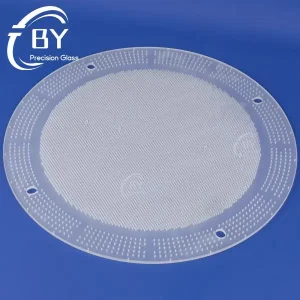
Custom Custom Optical Quartz Gas Distribution Plate Manufacturer, Suppliers
Source Component -
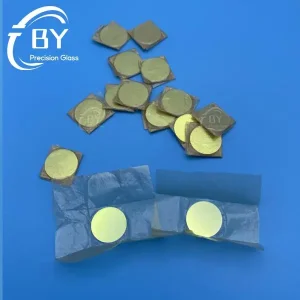
High-Quality Candela Laser Distance Gauge Slider Windows With coating 755 and 1064nm Suppliers, Factories
Source Component -
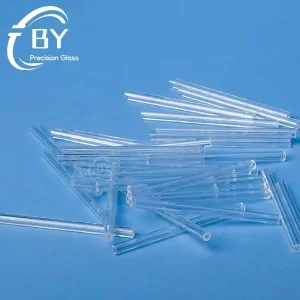
High-Quality Custom Precision Quartz Capillary Tubes Manufacturers, Suppliers
Source Component -
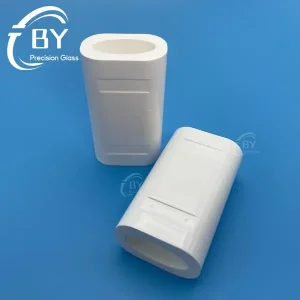
High-Quality Ceramic Cavities For Nd YAG Laser Supplier, Factories
Source Component -
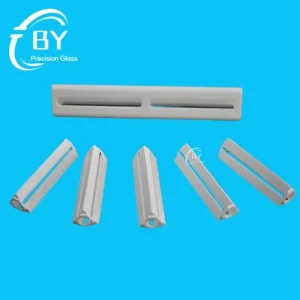
High-Quality Diode‑Pumping Chamber Diffuse Reflectors PTFE‑based Supplier, Suppliers
Source Component -
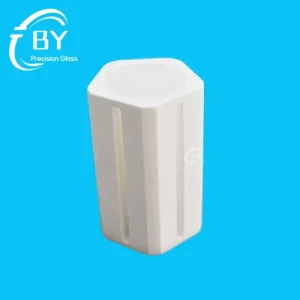
Wholesale Diffuse High‑Reflectivity PTFE Reflectors for Diode‑Pumping Chambers Suppliers, Factory
Source Component -
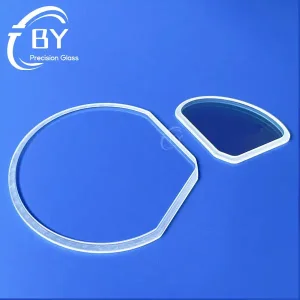
High-Quality Sapphire Viewing Plates for Harsh Chemical Environments Suppliers, Factories
Source Component -
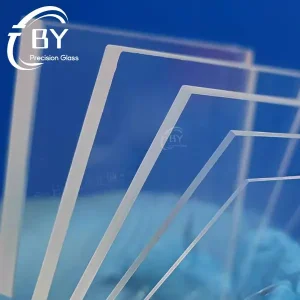
High-Quality Borosilicate Windows and Plates for Viewports Suppliers, Factory
Source Component