
Featured Precision Quartz & Optical Laser Components
Precision-machined optical substrates, pump cavity sleeves, and semiconductor components manufactured directly to tolerance prints at our Tianjin fabrication center.

Fundamental Physics of Samarium-Doped Glass Flow Tubes
An authoritative engineering analysis of Sm³⁺ rare-earth ion attenuation, Amplified Spontaneous Emission (ASE) suppression at 1064 nm, and thermal load optimization in solid-state laser pumping chambers.
Suppression of 1064 nm Parasitic Oscillation
In high-gain flashlamp or diode-pumped Nd:YAG systems, amplified spontaneous emission at 1064 nm propagates transversely, depopulating the upper laser state ($^4F_{3/2}$) and severely limiting energy storage. Samarium-doped glass (typically Sm 10% or Sm 20% by weight) exhibits ultra-strong resonant electronic absorption precisely around 1064 nm due to the ground state $^6H_{5/2} \to ^6F_{9/2}, ^6F_{11/2}$ energy level transitions, quenching destructive lateral parasitic modes while leaving the active laser beam unaffected.
Deep UV Solarization Protection (<400 nm)
Xenon and Krypton arc lamps emit wideband blackbody radiation containing fierce ultraviolet rays below 400 nm. Exposure to these wavelengths causes severe color-center formation (solarization) inside Nd:YAG, Er:YAG, and Alexandrite rods, resulting in progressive power loss and refractive index degradation. Samarium-doped optical glass acts as an intrinsic steep-edge cutoff filter, absorbing harmful UV photons (<380–400 nm) and transforming them non-radiatively into harmless thermal dissipation within the deionized water cooling boundary layer.
Optimized Transmission in Pumping Bands
While providing uncompromising absorption at 1064 nm and under 400 nm, high-purity samarium-doped quartz/silicate glass provides maximum optical transmission (>88–92% uncoated, >98% AR coated) in the critical neodymium absorption spectrum (730 nm – 820 nm). This spectral selectivity delivers maximum electrical-to-optical conversion efficiency, lower thermal distortion, reduced thermal lensing, and stable beam quality ($M^2 \le 1.15$) during repetitively pulsed laser operation.
Engineering Benchmark Insight: "Standard clear fused silica sleeves permit uninhibited cross-cavity reflection of 1064 nm photons back into the rod periphery, inducing transverse parasitic oscillation that clamps storage energy at roughly 65% of potential limit. Replacing ordinary jackets with precision-ground 10% Samarium-doped flow tubes from Tianjin BY Photonics immediately increases available output pulse energy by 18% to 27% while suppressing thermal lensing drift by over 30%."
| Material Classification | UV Cut-off (λ < 50% T) | Absorption at 1064 nm | Nd Pumping Window (750-850 nm) | Primary Industrial Use Case |
|---|---|---|---|---|
| JGS1 Synthetic Fused Silica | < 185 nm (Deep UV) | Negligible (< 0.001 cm⁻¹) | > 92.5% Transmission | Excimer lasers, semiconductor UV lithography optics |
| Cerium-Doped Quartz (Ce:Quartz) | ~380 nm Cut-off | Negligible (< 0.002 cm⁻¹) | > 91.0% Transmission | IPL aesthetic lamps, UV-filtering solid-state pump tubes |
| Samarium Glass (Sm 10% Doped) | ~400 nm Cut-off | High (α > 2.5 - 3.8 cm⁻¹) | > 88.0% Transmission | High-gain Nd:YAG flashlamp cavities, military rangefinders |
| Samarium Glass (Sm 20% Doped) | ~415 nm Cut-off | Ultra-High (α > 5.5 - 7.2 cm⁻¹) | > 84.5% Transmission | Q-switched military rangefinders, high-fluence medical lasers |
Global Enterprise Procurement & DFM Parameters
Laser cavity integration mandates rigorous geometric tolerances, non-linear hydrodynamic structural integrity, and flawless surface polishing to prevent coolant cavitation and catastrophic optical breakdown.
Wall Eccentricity & Concentricity Control
Coolant fluid dynamics around high-repetition-rate flashlamps require laminar, uniform fluid velocity. Wall thickness variation (eccentricity) exceeding 0.05 mm produces thermal gradient asymmetry across the laser rod, driving astigmatic thermal lensing. BY Photonics executes specialized precision redraw tooling ensuring wall concentricity within ≤ 0.02 mm and total run-out (TIR) under 0.03 mm across tubes up to 250 mm in length.
Sub-Surface Damage & Fire-Polishing
Micro-cracks induced during cold mechanical grinding act as fracture initiation sites under pulsed hydraulic thermal pressure spikes. Our proprietary oxyhydrogen fire-polishing post-treatment seals sub-surface micro-fractures, upgrading mechanical rupture thresholds to > 12 MPa hydraulic pressure while holding optical surface scratch-dig specifications down to 20/10.
Deionized Water Corrosion Resistance
Continuous circulation of high-purity deionized water (DI water, > 15 MΩ·cm) at temperatures between 25°C and 60°C leaches standard borosilicate compounds, creating milky silica precipitation. BY Photonics synthesizes tailored rare-earth silicate formulations with enriched aluminum and silicon networks, resisting hydrolytic leaching across over 10,000 continuous operating hours.
Macro-Industry Engineering Solutions
Empowering Tier-1 laser original equipment manufacturers (OEMs) across dermatology, aerospace defense, and industrial metallurgy with validated photonic assemblies.
Medical & Aesthetic Laser Consoles
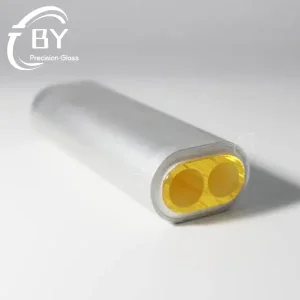
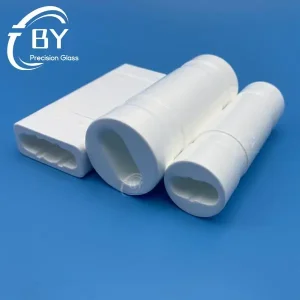
High-end aesthetic systems—including Alexandrite (755 nm), Q-switched Nd:YAG (1064/532 nm), and Er:YAG (2940 nm) consoles—require ultra-pure pulse consistency. By utilizing BY Photonics custom-packed double-bore flow tubes manufactured from 10% Sm-doped glass, medical OEMs eliminate wavelength crosstalk, prevent xenon lamp UV degradation, and maintain clinical fluency calibration over millions of operational shots without laser head repumping.
Defense, Avionics & Rangefinding
Military-grade target designators and airborne LIDAR rangefinders operate under extreme ambient temperature differentials (-40°C to +85°C) and violent mechanical shocks. Our hermetically packaged, annealed samarium flow tubes withstand continuous thermal cycling without micro-fissuring, ensuring zero optical misalignment and zero 1064 nm parasitic leaking during high-peak-power tactical deployment.
Industrial Micro-Machining & Metallurgy
Automotive welding, diamond cutting, and semiconductor scribing require high-duty-cycle pulsed lasers running 24/7. When combined with our Spectralon-grade PTFE or high-reflectivity diffuse ceramic cavities, BY Photonics samarium sleeves eliminate thermal rod core stress, stabilizing high-energy pulse energy and ensuring burr-free microscopic cutting profiles.
In-House Manufacturing Route at BY Photonics
Established in 2010 in Tianjin, China, BY Photonics operates 3,000+ m² of standardized cleanrooms, housing 120+ advanced processing stations and 110+ specialized photonic engineers and technicians.
1. Rare-Earth Homogenized Melting
Raw Samarium oxide ($Sm_2O_3$) of 99.999% chemical purity is precision blended into ultra-pure silica or borosilicate precursors. Induction platinum crucible melting at >1650°C prevents particulate inclusions and striations, guaranteeing uniform rare-earth dispersion without local refractive index perturbation.
2. Vertical Precision Redrawing Towers
Preforms are thermal-drawn on multi-axis vertical redraw towers with real-time, non-contact dual-axis laser micrometer control. Outer diameter, inner bore diameter, and concentricity are continuously tracked in a feedback loop running at 1000 Hz, maintaining dimensional standard deviations within ±0.015 mm.
3. CNC Cold Working & Flame Polishing
Precision diamond core slicing, edge chamfering, and end-face polishing occur in temperature-stabilized workshops. Final oxyhydrogen fire working removes all edge micro-chipping, followed by 12-hour controlled annealing in digital lehrs to dissipate internal thermo-elastic stress birefringence.
Compliance, Traceability & Localized Global Support
International export documentation, full RoHS/REACH environmental compliance, and dedicated logistics protocols protecting fragile photonic cargo across international transit lines.
Full Spectral & Dimensional Traceability
Every wholesale production batch of samarium flow tubes is delivered with an exhaustive Certificate of Conformance (CoC), including spectrophotometer UV-Vis-NIR transmission curves (PerkinElmer Lambda 1050+ validated), optical flat interferometry data, and 3D coordinate measuring machine (CMM) dimensional verification charts.
RoHS, REACH & Rare-Earth Security
All glasses and ceramic components strictly comply with European Union RoHS Directive 2011/65/EU, (EU) 2015/863, and REACH EC 1907/2006. With long-term domestic supply contracts covering high-purity rare-earth oxides in Northern China, BY Photonics protects global customers from volatile raw mineral market pricing and sudden lead-time shocks.
Export Packing & Multilingual DFM Review
Optical tubes are individually cleaned in multi-stage ultrasonic baths, vacuum-sealed in static-shield cleanroom pouches, and cushioned in shock-absorbent custom foam inserts within heavy-duty export cases. Our English-speaking photonics engineering desk reviews CAD prints (STEP, IGES, DWG, DXF, PDF) and returns formal manufacturability feedback within 24 business hours.
Photonic Material Roadmap: Next-Gen Laser Cavity Engineering
Continual innovation in hybrid dopants, composite multi-bore geometries, and direct fusion coatings shaping the future of diode-pumped and flashlamp solid-state laser platforms.
Sm/Ce Co-Doped Quartz Matrices
Developing proprietary co-doped formulations combining Ce³⁺ solarization cut-off (<380 nm) with Sm³⁺ 1064 nm parasitic resonance absorption in a single fused quartz lattice with lowered thermal expansion coefficients.
Complex Multi-Bore Precision Canes
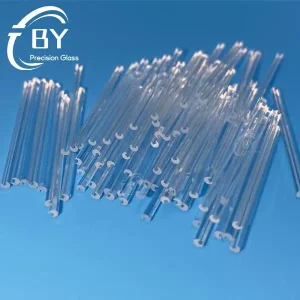
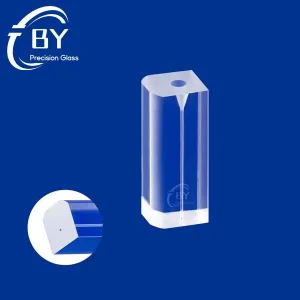
Expanding triple-bore and asymmetric clover-leaf samarium flow tube redrawing to integrate laser rod, lamp, and auxiliary sensor monitoring ports into a single, compact structural flow cell sleeve.
Hybrid Ceramic-Glass Laser Jackets
Direct fusion bonding of 99.7% Al₂O₃ diffuse reflective ceramic shells around internal samarium absorption jackets, eliminating mechanical liquid seals and reducing laser head footprint by 40%.
Ultra-High Hydrodynamic Flow Tubes
Internal nano-structured anti-cavitation micro-channels etched along the cooling bore, minimizing liquid turbulence boundary thermal resistance in >100 Hz high-repetition-rate laser heads.
Frequently Asked Technical Questions (FAQ)
Detailed technical and commercial answers addressing common engineering challenges faced by optical designers and procurement managers.
Why is Samarium-doped glass preferred over standard quartz or cerium quartz in Nd:YAG lasers?
What is the functional difference between 10% and 20% Samarium doping concentrations?
Can BY Photonics fabricate custom cross-sections like double-bore or square tubes?
How do you guarantee that flow tubes do not fracture under high coolant pressures?
What CAD formats and design specifications are required to request a quote?
What is the standard production lead time for prototype and wholesale volume orders?
Comprehensive Optical Glass, Capillary & Substrate Solutions
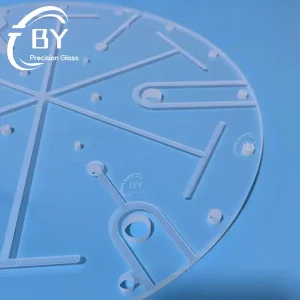
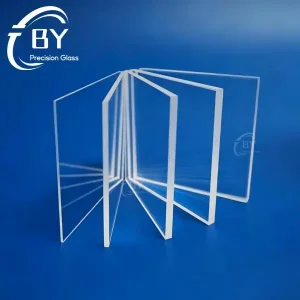
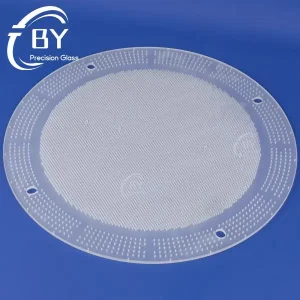
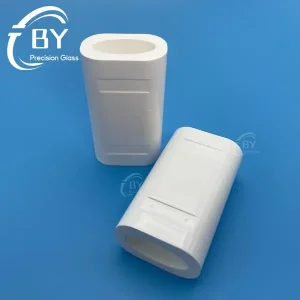
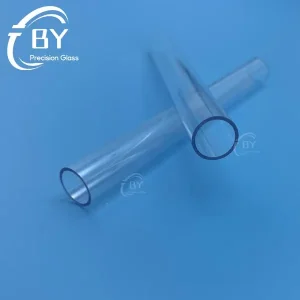
Explore our full engineering catalog including UV-grade fused silica plates, ceramic laser cavities, high-power fiber end caps, and custom glass ferrules.

Connect Directly With Our Photonics Engineering Desk
Send your custom technical drawings (STEP, DWG, DXF, or dimensioned PDF). Our optical engineers evaluate tolerance feasibility, wall concentricity, material doping grade, and export logistics within 24 working hours.
Request Technical Evaluation & Quotation