
Engineered Quartz Glassware & Optical Substrates
Explore high-demand laboratory apparatus and micro-engineered fused silica components manufactured via hot-flame fusion and 5-axis CNC machining.
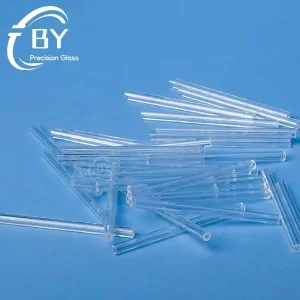
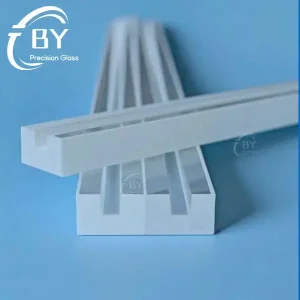
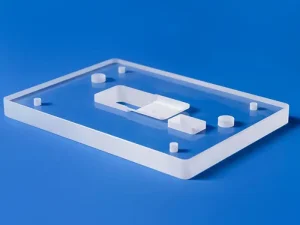
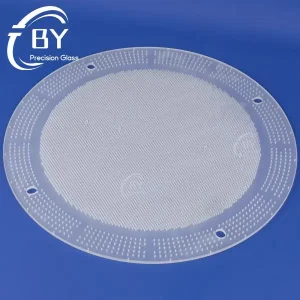
Material Science of Vitreous Silica: Why Laboratory Quartz Glassware Outperforms Borosilicate
A rigorous metallurgical and optical assessment of amorphous silicon dioxide (SiO2) in critical analytical chemistry, semiconductor cleanroom synthesis, and photonics instrumentation.
In high-purity laboratory research and industrial microfabrication, standard borosilicate glass 3.3 faces catastrophic physical and chemical failure modes when exposed to extreme thermal gradients, aggressive volatile reagents, or deep ultraviolet excitation. Vitreous silica (laboratory quartz glassware) represents the gold standard in thermodynamic stability. Fabricated from natural crystalline quartz sands or synthetic silicon precursors (SiCl4), quartz glassware consists of an unbroken, continuous tetrahedral matrix of silicon and oxygen with virtually zero network-modifying alkali ions such as sodium, calcium, or boron.
Because quartz glassware features an extremely low coefficient of thermal expansion (approx. 5.5 × 10⁻⁷ /°C between 20°C and 320°C), it exhibits near-total immunity to thermal shock. A quartz test crucible or digestion vessel can be heated to 1100°C in an induction furnace and quenched instantly into ice-cold water without structural cleavage or mechanical fracturing. Furthermore, in trace elemental analysis (such as ICP-MS and ICP-OES sample preparation), standard glassware leaches significant trace metallic contaminants (boron, sodium, iron, and aluminum). In contrast, Tianjin BY Photonics high-purity JGS1 and synthetic quartz vessels guarantee less than 15 parts per million (ppm) total metallic impurity, preventing analytical artifacts and sample drift.
| Material Category | Transmission Bandwidth | Strain Point / Softening Point | Thermal Shock Gradient (ΔT) | Trace Metal Impurity | Common Laboratory Applications |
|---|---|---|---|---|---|
| JGS1 Synthetic Fused Silica UV Grade | 185 nm – 2500 nm | 1070°C / 1730°C | > 1100°C (Quench Safe) | < 5 ppm total | UV-Vis Spectrophotometer Flow Cells, Photochemical Reactors, Excimer Laser Windows |
| JGS2 Fused Quartz Optical Grade | 220 nm – 2500 nm | 1020°C / 1683°C | > 1000°C (Quench Safe) | < 20 ppm total | Distillation Columns, Kjeldahl Flasks, High-Temp Sight Glasses, Sight Manifolds |
| JGS3 Fused Quartz Low-OH IR Grade | 260 nm – 3500 nm (OH < 2ppm) | 1020°C / 1680°C | > 1000°C (Quench Safe) | < 25 ppm total | FTIR Analytical Cells, Pyrometry Viewports, Infrared Digestion Quartz Tubes |
| Borosilicate 3.3 Glass Standard Lab | 310 nm – 2200 nm | 510°C / 820°C | approx. 150°C Max | > 5000 ppm (B, Na, Al) | Routine volumetric flasks, standard beakers, ambient liquid transfer |
China Factory 4.0: Supply Chain Resilience, Vertical Integration & Cost Leadership
Eliminating middleman markups and mitigating supply chain vulnerabilities through Tianjin BY Photonics integrated cold-processing and hot-flame production facility.
Full In-House Cold & Hot Processing
Unlike regional distributors who outsource glass blowing, BY Photonics operates 3,000+ m² of standardized clean workshop facilities in Tianjin. We house high-temperature oxyhydrogen glassworking lathes, precision 5-axis CNC diamond grinding centers, optical flat polishing machines, and automatic capillary redrawing towers under one managed roof.
Direct Raw Ingot Sourcing & Traceability
By securing direct ingot allotments from verified ultra-pure silica crucibles, we hedge against raw material price volatility. Every production run is mapped to a raw material batch certificate guaranteeing strict OH content thresholds, minimal bubble inclusions (DIN ISO 10110 Class 0), and strict refractive index uniformity.
Strict Zero-Stress Annealing Protocols
Flame-welded quartz assemblies naturally build internal mechanical stress along joint contours. Our production incorporates computer-controlled programmed electric annealing kilns running at 1150°C with automated ramp-down cycles, completely dissipating residual stress and preventing spontaneous cracking during vacuum or thermal cycles.
Macro Industry Solutions: Mission-Critical Applications of Laboratory Quartz
Serving world-class research institutes, semiconductor fabs, biopharma laboratories, and industrial laser integrators worldwide.
1. Semiconductor & Photovoltaic Wet Benches
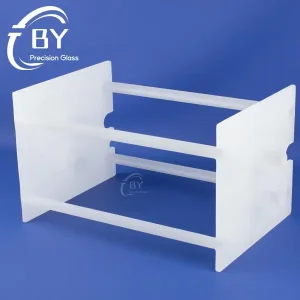
In wafer etching, RCA cleaning, and wafer diffusion processing, high-temperature aggressive acids (such as boiling aqua regia, nitric acid, and sulfuric-peroxide mixtures) quickly degrade inferior vessels. We supply custom quartz diffusion boats, slotted wafer carriers, LPCVD quartz tubes, and quartz tanks with wall thickness tolerances controlled within ±0.1 mm.
2. Analytical Spectroscopy & Chromatography
High-sensitivity HPLC, capillary electrophoresis, and UV-Vis spectrophotometry require zero baseline absorption. We produce flame-fused, non-glued quartz spectrophotometer cuvettes, macro and micro flow cells, and square/round capillary columns that eliminate adhesive-induced solvent contamination across deep UV bands (190–260 nm).
3. Solid-State, Fiber & Aesthetic Lasers
Laser gain media rely on pristine pump cavities. BY Photonics fabricates triple-bore laser head flow tubes, Samarium-doped (Sm) quartz filters that absorb unwanted 1064 nm amplified spontaneous emissions (ASE), Cerium-doped UV-blocking tubes for IPL dermatological lamps, and ultra-high-reflectivity ceramic cavity reflectors.
4. Chemical Synthesis & Ashing Pyrolysis
High-temperature pyrolysis, rotary evaporation of corrosive media, and microwave-assisted acid digestion require quartz glassware able to withstand sustained 1000°C internal reaction kinetics without devitrification. We manufacture custom boiling flasks, condensers, Schlenk lines, and digestion tubes with custom ground taper joints.
5. Aerospace & High-Temperature Viewports
From vacuum chamber viewports to spaceflight sensor windows, optical fused silica provides supreme optical transmission, low outgassing under ultra-high vacuum (UHV), and zero mechanical degradation under fluctuating cosmic radiation and severe cryogenic-to-pyrogenic thermal swings.
6. Microfluidics & Bio-MEMS Devices
Biomedical genomics and microfluidic diagnostics require chemically inert chips with micro-channels. Using diamond micro-milling and sub-micron laser etching, we manufacture silica glass microreactors that maintain smooth channel sidewalls, preventing cell adhesion and ensuring laminar microfluidic flow.
Global Enterprise Sourcing Strategy: Minimizing Total Cost of Ownership (TCO)
How supply chain executives, lab directors, and OEM system engineers balance unit pricing, dimensional reliability, batch reproducibility, and transit logistics.
Beyond Initial Purchase Price: The True Cost of Precision Glass
For international laboratory glassware distributors and OEM equipment builders, procuring custom quartz components often entails hidden friction: catastrophic transit breakage, loose dimensional tolerances resulting in chamber vacuum leaks, batch-to-batch chemical leaching, and lengthy engineering revision cycles.
Tianjin BY Photonics addresses this via an integrated OEM/ODM workflow. Within 24 hours of receiving your CAD model or 2D technical drawing (STEP, IGES, DXF, or PDF), our senior optical-mechanical engineers provide a comprehensive Design for Manufacturability (DFM) review. We optimize draft angles, wall thicknesses, and flame-weld radius geometries to lower machine cycle times, reduce thermal stress, and deliver 35% to 50% cost savings compared to North American or European glassblowing shops—without compromising precision.
- Class 100/1000 Cleanroom Cleaning: Ultrasonic degreasing, acid etching, and ultrapure DI-water rinsing prevent organic residue.
- Engineered Multi-Tier Packaging: Multi-layer shock-absorbing PE foam, vacuum blister sealing, and heavy-duty export wood casing guarantee < 0.1% international shipping attrition.
- Flexible Scale: Rapid prototype turnaround in 7–10 business days; full container batch volume support with dedicated buffer stocking programs.
Procurement Value Checklist
Global Standards Compliance & Rigorous Metrology Infrastructure
Ensuring complete audit readiness for medical device OEMs, pharmaceutical research laboratories, and semiconductor foundries.
ISO 9001:2015 Quality Management
From initial raw quartz ingot inspection to final packing, every workstation operates within documented ISO 9001:2015 standard operating procedures. Complete material batch traceability and non-conformance logging guarantee consistent physical properties across multi-year reorders.
ASTM E438 & DIN ISO Standards
Our laboratory quartz vessels are manufactured in compliance with ASTM E438 Type I, Class A requirements for laboratory glass apparatus. Dimensional tolerances, ground joint tapers (standard taper joints 14/20, 19/22, 24/40, 29/42), and stopcock bores strictly follow DIN 12242 international standards.
RoHS, REACH & Conflict-Free Materials
All quartz, fused silica, optical glasses, and laser ceramics supplied by BY Photonics are certified fully compliant with EU RoHS (Restriction of Hazardous Substances) Directive 2011/65/EU and REACH Regulation (EC) No 1907/2006. Zero heavy metals (lead, mercury, cadmium, hexavalent chromium) are utilized.
Technological Roadmap: The Next Decade in Advanced Quartz Machining
Strategic manufacturing investments in ultra-short pulse laser processing, additive quartz printing, and sub-angstrom optical polishing.
Ultrasonic-Assisted 5-Axis Milling
Deployment of high-frequency ultrasonic spindle vibration technology during CNC diamond grinding, reducing cutting forces by 40%, eliminating subsurface micro-cracks, and extending component fatigue life in high-vacuum environments.
Selective Laser Etching (SLE)
Integrating femtosecond laser 3D internal writing combined with chemical etching, enabling the creation of true 3D enclosed micro-channels, buried microfluidic nozzles, and monolithic optical sensors inside solid fused silica blocks without any bonding seams.
Zero-Carbon Oxyhydrogen Synthesis
Transitioning thermal hot-working operations toward green hydrogen-powered flame synthesis setups, reducing facility carbon emissions to near-zero while achieving higher flame temperature consistency and lower ambient contamination.
Sub-Angstrom Surface Ion Finishing
Industrializing Magnetorheological Finishing (MRF) and Ion Beam Figuring (IBF) for quartz laboratory windows and substrates, driving surface roughness to Ra < 0.1 nm for extreme ultraviolet (EUV) and synchrotron radiation beamlines.
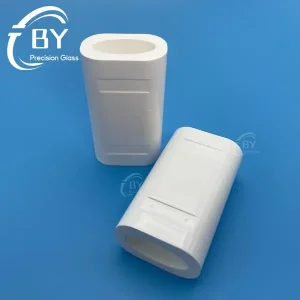
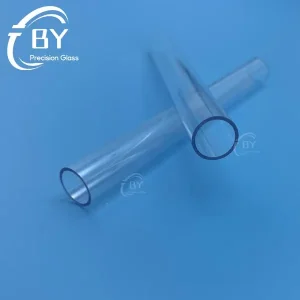
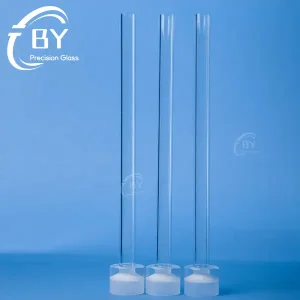
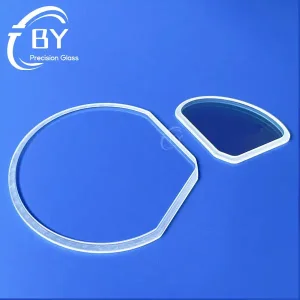
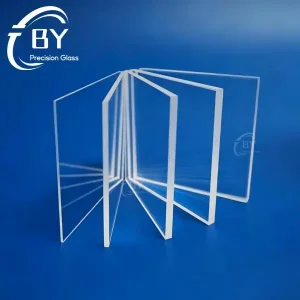
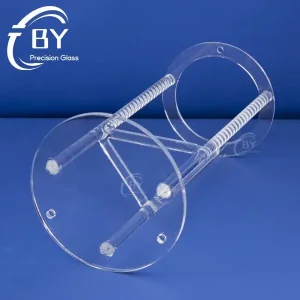
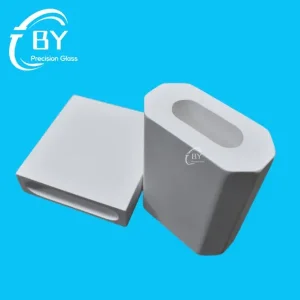
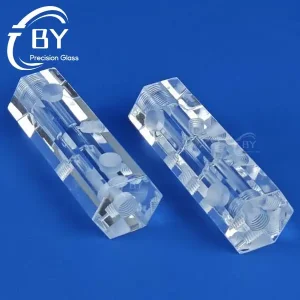
Specialized Quartz Tubes, Sapphire Windows & Laser Cavities
Explore custom precision components engineered to withstand high thermal loads, UV irradiation, and corrosive chemical environments.
Frequently Asked Questions on Laboratory Quartz Glassware Sourcing
Comprehensive technical answers to critical questions asked by procurement officers, laboratory managers, and optical engineers.
What is the fundamental difference between fused quartz and synthetic fused silica?
Which chemicals will etch or attack laboratory quartz glassware?
- Hydrofluoric Acid (HF): Dissolves SiO2 rapidly even at ambient room temperature, forming hexafluorosilicic acid.
- Hot Concentrated Phosphoric Acid (H3PO4): Shows notable dissolution rates above 150°C.
- Strong Basic Solutions: Concentrated alkaline solutions (such as boiling NaOH or KOH) react with silica over prolonged exposure above 100°C.
Can Tianjin BY Photonics fabricate quartz glassware directly from 3D CAD models?
How is devitrification prevented during long-term high-temperature laboratory use?
- Never touch quartz glassware directly with bare hands before heating; always wear lint-free gloves.
- Wipe surfaces thoroughly with reagent-grade ethanol or dilute nitric acid followed by deionized water before furnace loading.
- Ensure the furnace heating environment is free from alkali vapor emission.
What are your standard packaging protocols to prevent breakage during international ocean or air cargo?
What dimensional tolerances can BY Photonics maintain on custom quartz glassware?
Request an Engineering DFM Assessment & Wholesale Quotation
Send your drawings or technical requirements to our engineering team in Tianjin. Receive a detailed manufacturability review, material grade consultation, and direct factory quotation within 24 business hours.