
Precision Ceramic & Quartz Infrastructure (Part I)
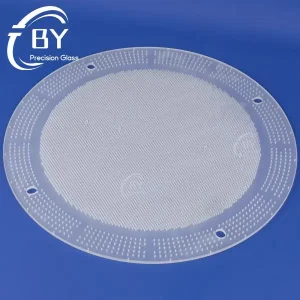
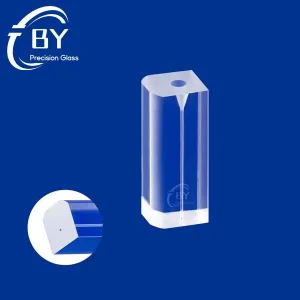
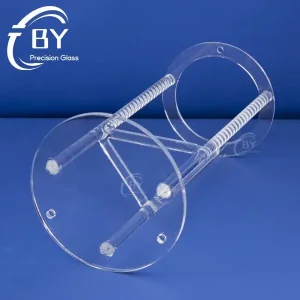
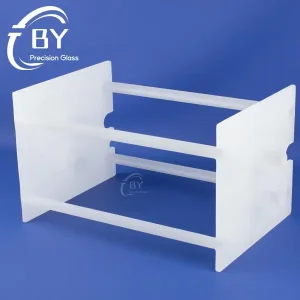
High-yield, dimensionally verified laser pump chambers, wafer carriers, cuvettes, and distribution plates engineered for high-flux photonic and semiconductor fabrication systems.
The Engineering Fundamentals of Laser Ceramic Reflectors
Why porous sintered 99.7% Al₂O₃ ceramic matrices have superseded metallic and polymer reflectors in high-energy solid-state laser (SSL) pumping cavities.
Unlike specular mirrors (such as gold- or silver-plated brass) that produce localized thermal focal hot-spots within Nd:YAG or Alexandrite rods, micro-porous ceramic reflectors deliver near-perfect Lambertian diffuse scattering. The internal microcrystalline boundaries randomize the angle of incidence, guaranteeing homogeneous gain media excitation and minimizing thermal lens aberration.
Industrial flashlamp-pumped systems cycle deionized (DI) cooling water under severe turbulent velocities and cavitation pressure. High-grade laser ceramic reflectors incorporate a proprietary borosilicate-silica eutectic glass glaze fired at >1200°C. This glassy coating hermetically seals the porous substrate, completely preventing coolant absorption, biological fouling, and solarization degradation.
Flashlamp pulse trigger voltages often exceed 20 to 30 kV. In gold-coated metal pump chambers, electrical arcing to the cavity wall poses an ongoing risk of catastrophic driver failure. Porous Al₂O₃ provides bulk dielectric strength (>15 kV/mm), serving as an innate electrical insulator that eliminates simmer failure and short-circuit hazards in aesthetic and military handpieces.
Comparative Analysis: Ceramic vs. Alternative Cavities
Quantified operational metrics for solid-state laser cavity designers evaluating diffuse alumina ceramic, gold-electroplated metal, and PTFE (Spectralon-grade) materials.
| Performance Parameter | High-Purity Laser Ceramic (Glazed) | Gold-Plated Metallic Cavity | PTFE / Sintered Polymer |
|---|---|---|---|
| Diffuse Reflectance (600–1000 nm) | 97.8% – 99.1% | 94.0% – 96.0% (Specular) | 98.5% – 99.3% |
| Thermal Shock Threshold | > 1200°C (Zero Flaking) | 350°C (Risk of Gold Delamination) | < 260°C (Thermal Creep Risk) |
| Coolant Chemical Stability | Immune to DI Water, Glycol, UV | Prone to Oxidation & Flaking | Porous to Hydrocarbons, Hard to Clean |
| Dielectric Strength (Arc Safety) | > 18 kV / mm | 0 kV / mm (Conductive / Arcing Risk) | > 20 kV / mm |
| Operational Lifespan (MTBF) | > 10,000 Pumping Hours | 2,000 – 4,000 Hours (Re-plating req.) | 3,000 – 5,000 Hours (Yellowing) |
| Mechanical Rigidity & Machining | Diamond Grinding / CNC to ±0.02 mm | CNC Machining to ±0.01 mm | Soft Polymer (Creeps Under Clamping) |
Localized Application Scenarios for Laser Ceramic Reflectors
From hospital dermatology clinics to high-power aerospace laser cladding cells, discover where ceramic cavities provide decisive optical, thermal, and mechanical advantages.
Dominating laser hair removal, tattoo removal, and vascular lesion therapies (Alexandrite 755 nm and Nd:YAG 1064 nm). In dual-rod or triple-bore configurations (such as Candela GentleLase/GentleMax replacements), the ceramic reflector ensures uniform pump energy across the rod cross-section, eliminating hot-spots that fracture expensive laser crystals and delivering smooth top-hat beam profiles on human tissue.
In solid-state laser cutting, spot welding, and aerospace additive repair, flashlamp-pumped and diode-pumped systems operate at extreme duty cycles. Ceramic reflectors resist continuous multi-kilowatt thermal back-reflections and corrosive fluid environments. Their high thermal conductivity quickly conducts heat away to external cooling circuits, ensuring stable beam quality without laser power drift.
Military-spec target designators, tactical rangefinders, and airborne LIDAR systems require components that survive severe G-forces, ballistic vibrations, and extreme thermal cycling (-40°C to +85°C). High-purity sintered ceramics maintain dimensional rigidity with zero mechanical deformation, and the unglazed or selectively glazed alumina will never peel or shed particles in sealed optical pods.
Ultrafast Ti:Sapphire amplifier stages, terawatt laser chains, and dye laser systems demand custom cavity geometries. Wholesale Chinese suppliers offer rapid CAD-to-part five-axis CNC green-machining, permitting exotic elliptical, parabolic, and multi-lamp cylindrical architectures tailored precisely to specialized research beam envelopes.
Urological lithotripsy (Ho:YAG at 2.1 μm) and dental ablation (Er:YAG at 2.94 μm) rely on intense xenon or krypton flashlamp pumping pulses. Ceramic reflectors feature low absorption across both the pumping spectrum and infrared scatter, preserving pump cavity energy efficiency and reducing cooling chiller capacity requirements in mobile surgical consoles.
Pulsed laser annealing (PLA) and wafer dicing tools use high-repetition-rate diode and flashlamp-pumped heads. Ceramic chambers offer zero-outgassing characteristics in cleanroom environments, preventing volatile organic chemical (VOC) contamination on sensitive projection optics, quartz gas distribution plates, and wafer surfaces.
Chinese Factory Supply Chain Resilience & Efficiency
How Chinese advanced ceramics clusters achieve superior cost efficiency, sub-micron precision, and rapid scalability for global photonics OEMs.
China commands an integrated supply chain for ultra-pure alumina precursors and rare-earth dopants. With direct access to calcined nano-powder synthesis, factories eliminate third-party markup and maintain tight control over grain-size distribution (< 1.5 μm) prior to isostatic pressing.
Dual-stage machining strategy: complex cooling channels, triple-bore alignments, and O-ring grooves are pre-machined in the green body state (chalk-like softness), sintered at 1700°C, and finished on multi-axis diamond grinding centers to achieve runout tolerances of ±0.015 mm.
While Western fabrication houses quote 12 to 18 weeks lead times for bespoke laser ceramics, Chinese facilities leverage modular tooling and in-house sintering kilns to deliver custom validated prototypes in 15 to 20 business days, drastically compressing the OEM product development lifecycle.
Every production lot undergoes rigorous inspection: coordinate measuring machines (CMM) for bore concentricity, spectrophotometric integrating spheres for diffuse reflectance confirmation, and dye-penetrant / helium leak testing to guarantee zero micro-crack defects.
Technology Roadmap: Next-Generation Laser Ceramics
Key developmental vectors shaping the future of diffuse photonics, thermal management, and monolithic cavity architectures.
Stereolithography of ceramic slurries is transforming pump chamber design. Conformal helical cooling jackets, previously impossible with conventional diamond core drilling, can now be integrated directly within the ceramic reflector body, reducing thermal gradients across high-power laser rods by up to 35%.
Modern flashlamps emit unwanted deep ultraviolet radiation (< 380 nm) that solarizes laser crystals and generates excessive waste heat. Next-gen reflectors utilize samarium- or cerium-doped internal glazes that absorb harmful UV while selectively reflecting the target pump wavelengths (700–900 nm), turning the reflector into an optical bandpass filter.
While pure alumina has a thermal conductivity of ~30 W/(m·K), ongoing research in aluminum nitride (AlN, ~170 W/(m·K)) composites aims to create ultra-high-conductivity diffuse reflectors capable of sustaining megawatt-class peak pump intensities without needing separate flow tubes.
Localized Support & Global Compliance Assurance
Navigating international trade standards, environmental directives, and Design-for-Manufacturability (DFM) requirements with total transparency.
All ceramic formulations and glaze constituents are 100% free of lead, cadmium, hexavalent chromium, and hazardous heavy metals. Material safety data sheets (MSDS) and full compliance dossiers accompany every wholesale shipment for frictionless entry into European, North American, and Asian-Pacific jurisdictions.
Our standard and custom commercial laser ceramic components are classified as dual-use commercial goods (EAR99 / non-ITAR), enabling streamlined global distribution, low-tariff classification, and direct courier air-freight with complete documentation.
Precision ceramics require specialized transit care. Components are packed in custom high-density anti-static closed-cell EPE foam compartments, hermetically vacuum-sealed inside desiccant-loaded moisture barriers, and crated in heavy-duty outer containers to guarantee zero transit damage.
Frequently Asked Technical Questions (FAQ)
Authoritative answers to critical engineering, manufacturing, and procurement inquiries regarding laser ceramic reflectors.
Precision Ceramic & Quartz Infrastructure (Part II)
Complete the optical train with Candela slider windows, doped quartz flow tubes, Borofloat wafers, and chemically inert sapphire observation plates.
Optimize Your Laser Cavity Efficiency Today
Upload your 2D engineering prints (DWG, DXF, PDF) or 3D CAD files (STEP, IGES) for a confidential, 24-hour Design-for-Manufacturability (DFM) assessment from our senior ceramic materials engineering desk.
Request Engineering Feasibility & Quote