
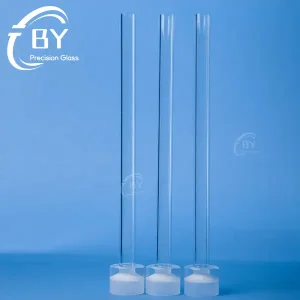
Precision Quartz & Optical Component Catalog (Featured Batch A)
Explore OEM/ODM calibrated quartz components machined with micro-subtractive laser grinding, sub-nanometer optical polishing, and molecular thermal diffusion.
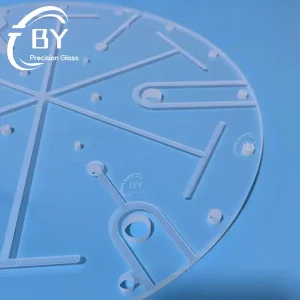
Custom Precision Quartz Glass Fabrication
View Specifications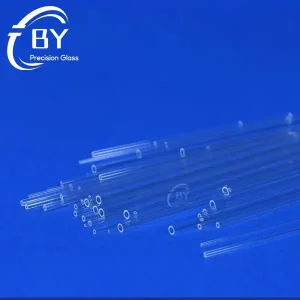
Fluorine-Doped Fused Silica Capillary Tube
View Specifications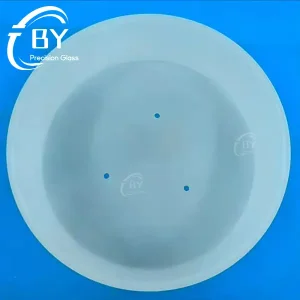
Custom Quartz Glass Components for Vacuum Coating
View Specifications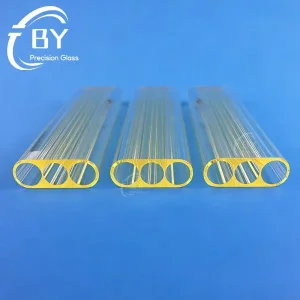
Laser Cavity Flow Tubes & Filters (Sm-Doped)
View Specifications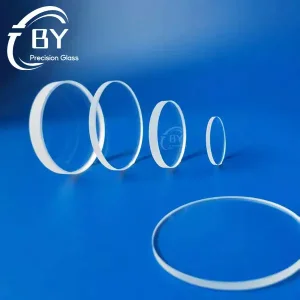
Quartz Windows for Lithography Equipment
View Specifications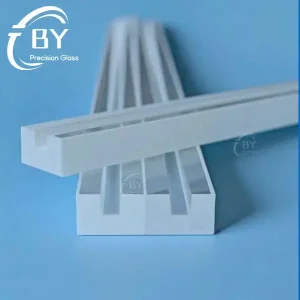
Square Groove Quartz Substrate for Fiber Couplers
View Specifications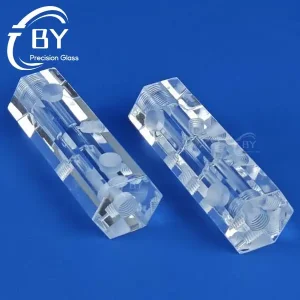
Fabrication of Precision Quartz Components
View SpecificationsGlobal Procurement Dynamics: High-Purity Quartz Cuvettes
Strategic supply chain analysis for analytical instrument OEMs, biopharmaceutical laboratories, and clinical diagnostics manufacturers seeking high-yield, chemically pure optical cells.
Spectroscopy System OEMs
Global UV-Vis and Fluorescence spectrophotometer manufacturers demand matched-cell pairs with certified optical path length tolerances down to ±0.005 mm to eliminate systematic calibration drift in analytical instruments.
- Matched optical transmission: ΔT < 0.3%
- Zero chemical leachables in deep-UV assay
- Customized exterior form factors for carousels
Biopharma & Life Sciences
High-throughput automated liquid handlers and HPLC-coupled flow detection arrays require ultra-micro flow cuvettes that offer laminar fluid transport without dead volume or baseline noise induced by bubble pinning.
- Internal flow volumes down to sub-microliter
- Resistance to harsh CIP (Clean-in-Place) solvents
- Certified bio-inert surface passivations
Industrial Petrochemical & QC
Continuous monitoring in harsh industrial synthesis processes demands high-temperature, pressure-resistant quartz absorption cells capable of continuous 900°C exposure without devitrification or seal failure.
- Direct molecular fusion bonding (no epoxies)
- Thermal expansion coefficient: 5.5×10⁻⁷ /°C
- High hydrostatic pressure cell ratings
Material Engineering: Synthetic Fused Silica vs. Natural Fused Quartz
Critical optical properties, synthetic OH- radical concentration, and raw material purity determine boundary transmission efficiency across 185 nm to 3,500 nm.
| Material Grade | Spectral Transmission | Hydroxyl [OH⁻] Content | Bubble / Inclusion Class | Core Application Domain |
|---|---|---|---|---|
| JGS1 (UV Synthetic Silica) | 185 nm – 2,500 nm Deep UV Optimized | < 5 ppm (Trace) | DIN ISO 10110 Class 0 | Deep-UV absorption cells, laser fluorometry, HPLC detection |
| JGS2 (Optical Grade Quartz) | 220 nm – 2,500 nm | < 30 ppm | DIN ISO 10110 Class 1 | Standard laboratory spectroscopy, general colorimetry |
| JGS3 (Infrared Fused Quartz) | 260 nm – 3,500 nm Zero Water-Band Peak | < 1 ppm (Dry Quartz) | DIN ISO 10110 Class 0/1 | FTIR cells, NIR transmission analysis, high-temperature thermal sight |
| ESL Synthetic Quartz | 160 nm – 2,200 nm Vacuum UV Ready | Controlled (~1000 ppm) | Fluorescence-Free Grade | Semiconductor excimer laser windows, vacuum UV spectroscopy |
Thermal Diffusion Bonding (Zero-Adhesive Sintering)
Traditional quartz cuvettes bonded with epoxy resins or optical cements inevitably fail when exposed to concentrated acids, bases, or organic solvents such as DMSO, acetone, and dichloromethane. Our factory deploys high-temperature diffusion bonding at 1,180°C in ISO-Class 5 environments. The interfaces achieve direct atomic fusion, transforming separate plates into a single monolith that eliminates glue contamination, fluorescent background noise, and thermal expansion shear.
Precision Metrology & Wavefront Verification
Every optical transmission face undergoes planetary chemical-mechanical polishing (CMP) to achieve surface roughness Ra < 0.5 nm and optical scratch-dig ratings conforming to MIL-PRF-13830B (20-10 Scratch-Dig). Transmitted wavefront distortion (TWD) is held within λ/4 to λ/10 @ 632.8 nm, completely preventing beam refraction divergence that compromises optical absorbance linearity at high dynamic ranges (OD 0 to 4.0).
Macro-Industry Landscape & Technology Roadmap
Meeting the challenges of miniaturization, extreme analytical environments, and automated continuous-flow processing.
1.2B+
Global Molecular Diagnostics Market Valuation Driven by Optical Precision
±0.003mm
Achievable Pathlength Precision on Micro-Subtractive CNC Milling
1180°C
Molecular Fusion Temperature Guaranteeing Total Solvent Immersion Stability
< 0.5nm
Surface Roughness Ra Attained via Double-Sided Pitch Polishing
Next-Gen Microfluidic Flow Cells (Lab-on-Chip)
As biomedical analysis transitions to microfluidic flow cytometry, single-cell genomics, and online bioprocess monitoring, standard static cuvettes are being replaced by ultra-thin fused silica microchannel flow cells. We integrate deep reactive-ion etching (DRIE) and ultrasonic micro-machining to create hermetically sealed quartz capillary junctions capable of processing nanoliter samples without sample cross-talk or cell shearing.
Inline Spectral Process Analytical Technology (PAT)
Continuous pharmaceutical manufacturing relies on online spectroscopy to ensure real-time API release. BY Photonics builds pressurized quartz sight cells designed with sapphire-reinforced faceplates, titanium flow housings, and calibrated pathlengths that withstand up to 15 MPa fluid pressure and rigorous steam-in-place (SIP) cycles without optical drift or physical seal fatigue.
Global Supply Reliability, Quality Assurance & Compliance
Transparent quality control architecture and export-grade logistics for enterprise supply chain security.
Full Regulatory Compliance
All quartz parts conform to RoHS 3 (EU 2015/863), REACH (EC 1907/2006), and TSCA frameworks. We supply batch-specific Certificate of Analysis (CoA), melt data sheets, and spectrographic purity scans verifying trace metal impurities below 1.0 ppm.
Custom Engineered Clean Packing
Optical cuvettes are cleaned via multi-stage ultrasonic degreasing in pure deionized water (18.2 MΩ·cm), vacuum-sealed in anti-static medical-grade blister packaging within an ISO Class 6 cleanroom, and cushioned in shock-absorbing air suspension cases.
Dedicated DFM Engineering Support
Our Tianjin technical center delivers comprehensive Design for Manufacturability (DFM) reviews within 24 hours. We evaluate tolerance stacks, recommend thermal expansion offsets, and optimize internal chamber chamfers to minimize machining costs and cycle times.
Precision Quartz & Optical Component Catalog (Featured Batch B)
Industrial laser optics, sapphire sight glasses, diffuse ceramic reflectors, and specialty optical flow tubes engineered for extreme operating environments.
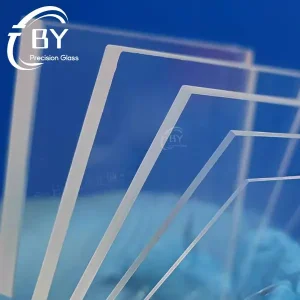
Borosilicate Windows & Plates for Viewports
View Specifications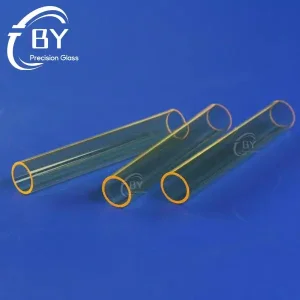
UV Block Yellow Quartz Tube for IPL Handles
View Specifications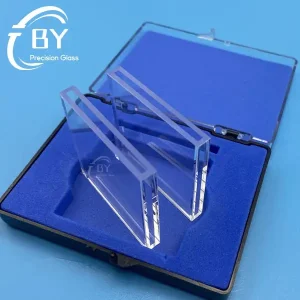
Custom Quartz Cuvette for Spectrophotometer
View Specifications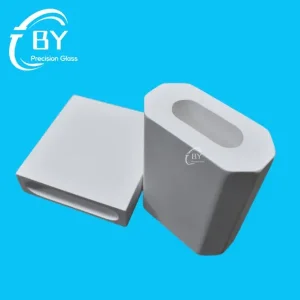
Spectralon-Grade PTFE Diffuse Reflectors
View Specifications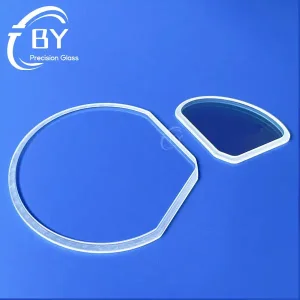
Sapphire Viewing Plates for Harsh Environments
View Specifications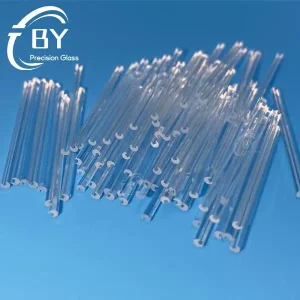
Quartz Substrate Groove for Optical Couplers
View Specifications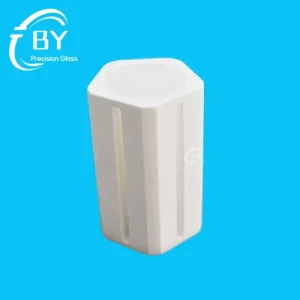
PTFE High-Reflectivity Diode Cavity Reflectors
View Specifications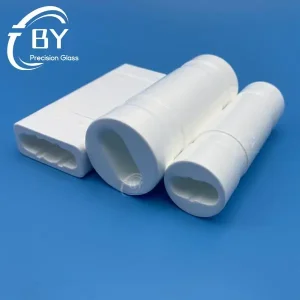
Ceramic Reflectors for Semiconductor Lasers
View SpecificationsFrequently Asked Technical & Sourcing Questions
Detailed operational answers addressing manufacturing tolerances, solvent compatibility, optical paths, and wholesale logistics.
What manufacturing method guarantees that quartz cuvettes will not leak when using aggressive organic solvents?
Cuvettes manufactured using adhesive bonding (glue or optical cement) deteriorate rapidly when exposed to organic solvents like acetone, toluene, chloroform, or DMSO. BY Photonics exclusively uses thermal diffusion fusion bonding. Optical quartz plates are brought into intimate contact in a cleanroom environment and subjected to controlled sintering temperatures approaching the glass transition point (approx. 1,180°C). This causes atomic migration across the boundaries, resulting in a single, monolithic silica body that is completely leakproof, vacuum-tight, and impervious to chemical attack.
What are the exact optical transmission differences between JGS1, JGS2, and JGS3 materials?
JGS1 is a high-purity synthetic fused silica created through silicon tetrachloride oxidation. It provides transmission from 185 nm to 2,500 nm, making it the essential standard for deep-UV spectroscopy and DNA/protein concentration measurements at 260/280 nm. JGS2 is optical grade quartz synthesized from natural crystal powder; it transmits between 220 nm and 2,500 nm, offering an economical choice for general visible-light absorption. JGS3 is produced using specialized gas electro-fusion yielding an exceptionally dry, low-OH quartz (hydroxyl < 1 ppm). It transmits from 260 nm up to 3,500 nm, completely eliminating the characteristic deep absorption water-band dip located around 2,730 nm.
What standard tolerances does BY Photonics maintain for high-precision OEM cuvettes?
For standard 10 mm path length spectrophotometer cuvettes, our manufacturing pathlength tolerance is held within ±0.01 mm, with custom options achieving ±0.005 mm on demand. Exterior dimension tolerances are held to ±0.1 mm to ensure smooth automated sample changer loading. Window surface flatness is held to λ/4 @ 632.8 nm, parallelism < 3 arcminutes, and surface quality meets 20-10 Scratch-Dig specifications per MIL-PRF-13830B.
Can you manufacture matched cuvette pairs with certified identical transmission curves?
Yes. We provide certified matched pairs and matched sets of four, six, or eight cells for dual-beam spectrophotometers and comparative assay validation. Matched sets are sorted from identical quartz ingot slices and batch polished simultaneously, guaranteeing that transmission deviation across the UV spectrum (specifically at 200 nm, 220 nm, and 240 nm) remains below ΔT < 0.3%. Each matched set comes labeled with serialized verification data.
What file formats and parameters are needed to request an engineering quotation for custom cuvettes?
We accept 3D CAD files in STEP, STP, or IGES formats, alongside 2D engineering drawings in PDF, DWG, or DXF. Please specify the required glass material grade (e.g., JGS1 vs. JGS3), critical optical path dimensions and tolerances, polished vs. frosted surfaces, operating temperature/pressure parameters, and estimated batch volumes. Our engineering desk returns complete DFM assessments within 24 business hours.
Connect with an Optical Manufacturing Engineer
Send your CAD models or detailed tolerance requirements. Receive process feasibility feedback, volume wholesale tier structures, and verified delivery schedules in 24 hours.
Submit Engineering Drawing