
Specialty Glass & Opticalware Portfolio
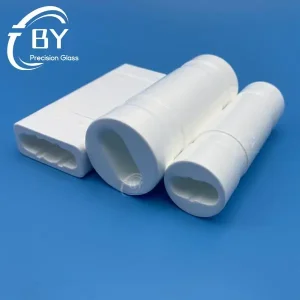
Engineered to exacting tolerances. Explore our high-purity glass, custom quartz carriers, doped filter tubing, and cavity reflectors engineered in tandem with our borosilicate micro-capillary product lines.
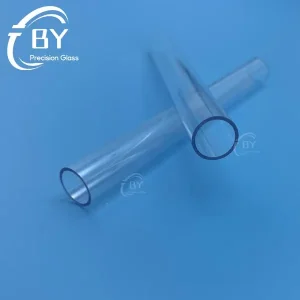
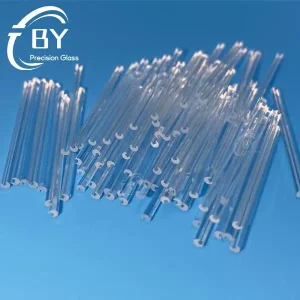

Precision Borosilicate Capillary Tubing & Rods: Structural Excellence
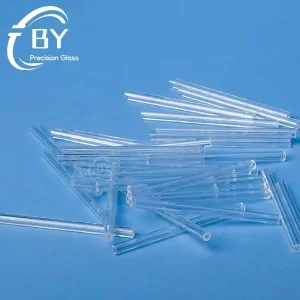
Borosilicate 3.3 glass remains the undisputed global benchmark for fluidic precision, extreme thermal-shock endurance, and chemical inertness. Unlike standard soda-lime or soft glasses, its low thermal expansion coefficient and high hydrolytic resistance safeguard analytical accuracy in modern micro-systems.
Dynamic Thermal & Mechanical Integrity
Engineered with high silica (~81%) and boron trioxide (~13%) contents, our borosilicate 3.3 composition (equivalent to Pyrex® and Duran® standards) offers superior resistance to devitrification and mechanical fatigue. In continuous laboratory processes up to 450°C and short excursions to 500°C, capillary walls maintain absolute geometric stability, preventing lumen deformation in hot gas micro-sampling.
Total Chemical Inertness & Purity
Achieving Class 1 for acid resistance (DIN 12116) and Class 2 for alkali resistance (DIN ISO 695), custom borosilicate tubes prevent ion-leaching when exposed to aggressive organic solvents, bio-fluids, or harsh acids. This makes our capillary tubing the premier substrate for micro-flow chromatography columns, microfluidic lab-on-a-chip connectors, and high-purity medical reagents.
Micro-Bore Concentricity Control
Utilizing continuous real-time dual-axis optical gauging on high-precision drawing towers, our inner-to-outer diameter concentricity is held within 3% variance. This eliminates laminar flow turbulence, minimizes hydrodynamic dead volume in analytical flow cells, and guarantees concentric alignment when assembling fiber optic glass ferrules and micro-connectors.
Macro-Industry Solutions & Procurement Demands
Global Original Equipment Manufacturers (OEMs) and contract research organizations require tier-1 glass processors who bridge the gap between raw cane redrawing and sub-micron cold CNC finishing. Here is how our specialized factory workflows solve critical engineering bottlenecks across four major technological domains.
Capillary Electrophoresis & Bio-Diagnostics
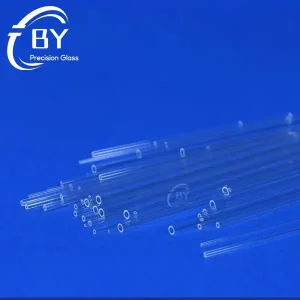
In genomic sequencing (Sanger / NGS) and micro-capillary electrophoresis (CE), ID uniformity defines separation voltage stability and band resolution. We supply micro-bore borosilicate capillary tubing with ultra-smooth inner walls (Ra < 0.02 µm) and multi-bore cross-sections (dual-bore, four-bore, rectangular channels) tailored to optical detection windows.
Optoelectronics & Fiber Splicing
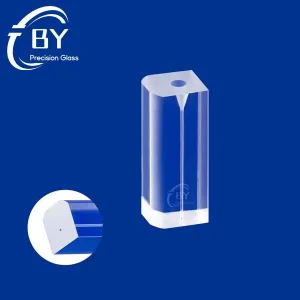
Borosilicate glass rods and capillaries serve as high-stability outer jackets and collimating lenses in fiber pigtailed devices, DWDM modules, and MEMS switches. Matching index properties and precisely machined chamfers (internal bevels up to 60°) facilitate non-destructive optical fiber insertion without surface micro-cleaving.
Analytical Instrumentation & GC/HPLC
Gas chromatography (GC) transfer lines, mass spectrometry sample probes, and high-pressure liquid chromatography flow cells require borosilicate capillaries capable of handling continuous cyclic pressure loads up to 150 bar. We implement defect-free fire-polishing to remove micro-notches, raising burst pressure thresholds by over 40%.
Thermal Sight Gauges & Level Indicators
For boiler water columns, chemical reactors, and industrial process pipelines, heavy-wall borosilicate capillary tubing and solid circular rods deliver visual process transparency while preventing caustic clouding. Our post-forming tempering delivers enhanced mechanical flexural strength exceeding 25 MPa.
| Physical / Chemical Property | Borosilicate 3.3 (Standard) | Synthetic Fused Silica (Comparison) | Industrial Advantage |
|---|---|---|---|
| Coefficient of Thermal Expansion (20–300°C) | 3.3 ± 0.1 × 10⁻⁶ K⁻¹ | 0.54 × 10⁻⁶ K⁻¹ | Optimal Match for Kovar & Metal Seals |
| Transformation Temperature (Tg) | 525 ± 10 °C | ~1,075 °C | Cost-effective redrawing & flame closing |
| Hydrolytic Class (ISO 719) | Class HGB 1 | Class HGB 1 | Zero alkali release in sensitive buffers |
| Refractive Index (nd @ 587.6 nm) | 1.473 | 1.458 | High visible transmittance (>91% 400-800nm) |
| Density (at 25°C) | 2.23 g/cm³ | 2.20 g/cm³ | Lightweight micro-component integration |
| Young’s Modulus (E) | 63 GPa | 72 GPa | High elastic resilience for thin-wall capillary tips |
State-of-the-Art Fabrication & Engineering Roadmap
BY Photonics combines hot precision thermal down-draw processes with advanced CNC sub-micron grinding under one roof. Our forward-looking production roadmap focuses on automated defect filtering, multi-lumen geometry development, and ultra-high chemical consistency for next-generation systems.
Vertical Oxyhydrogen Redrawing Towers
Our 12-meter high down-draw vertical towers operate in cleanroom conditions, equipped with electronic tension and feed rate synchronizers. Continuous optical laser scanners inspect OD and wall thickness at 2,000 measurements per second, feeding real-time micro-adjustments back to furnace thermal zones to maintain nominal outer diameters from 0.20 mm to 30.0 mm without ovality.
Precision Cold-End Tooling & Beveling
Precision dicing, diamond wheel scoring, laser cleavage, and acoustic cracking yield chip-free end faces. We offer custom mechanical finishes including mirror flat optical end-polishing (80/50 to 20/10 Scratch-Dig), inside/outside chamfers, conical tips for micro-injection needles, and precision fire-polished edges that eliminate sharp chipping during assembly.
2025–2030 Roadmap: Nanofluidics & AI Metrology
The microfluidics frontier requires sub-micron internal channels and hybrid glass-polymer hermetic bonds. Our roadmap integrates AI vision models for micro-defect classification (bubble inclusions < 0.05 mm), continuous expansion of non-circular cross-sections (D-shape, square, multi-bore), and low-energy electric melting furnaces to achieve carbon-neutral fabrication.
Worldwide Compliance & Localized OEM Support
Procuring custom glass components requires stringent raw material validation, environmental traceability, and secure export packing. Every batch from our Tianjin production center is shipped with full material certs and dimension reports.
Environmental & Medical Directives
All raw borosilicate materials comply with EU RoHS (Directive 2011/65/EU and amendments) and REACH (EC 1907/2006) regulations, containing zero hazardous substances or heavy metals (Pb, Cd, Hg, Cr(VI)). Furthermore, our glass matches USP Type I neutral borosilicate criteria, meeting international safety criteria for medical diagnostic probes.
Class 10,000 Packaging & Moisture Barricades
Micro-capillaries are susceptible to particulate accumulation and atmospheric moisture contamination during transoceanic transit. Our components undergo ultrasonic solvent cleaning, deionized water cascading rinses, nitrogen drying, and vacuum sealing inside anti-static dust-free blister packs within a certified ISO Class 7 cleanroom environment.
Rapid DFM Engineering & Global Logistics
Direct access to our senior glass engineers guarantees comprehensive Design-for-Manufacturability (DFM) reviews within 24 working hours. We support agile prototyping from 10 pieces to high-volume multi-million cane shipments, partnering with global courier networks (DHL, FedEx, UPS) and door-to-door DDP freight forwarders for rapid international fulfillment.
Frequently Asked Questions by Glass Engineers & Buyers
Get in-depth answers to common questions regarding dimensional tolerances, chemical performance, customization capabilities, and minimum order requirements.
Sapphire, Fused Silica & Advanced Ceramic Solutions
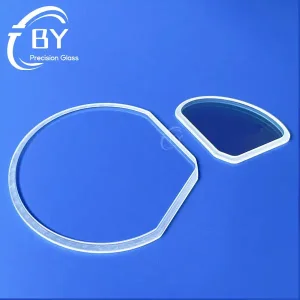
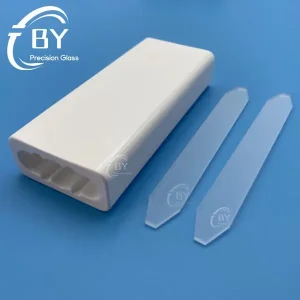
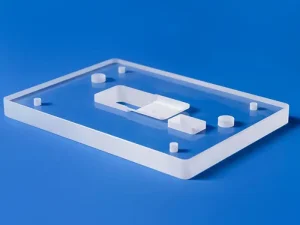
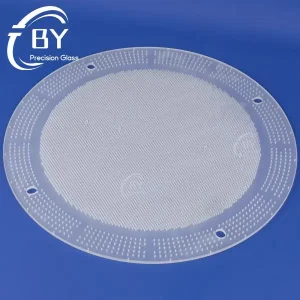
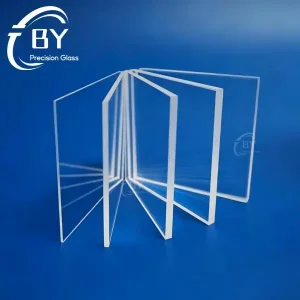
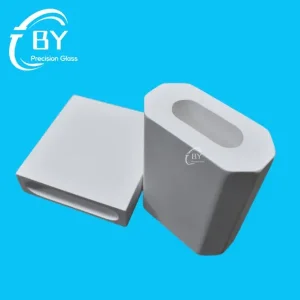
Expand your optical sub-assembly sourcing. As a consolidated manufacturer, BY Photonics produces precision sapphire windows, synthetic quartz plates, gas distribution manifolds, and laser pumping reflectors.
Accelerate Your Custom Glass Sub-Assembly
Submit your dimensional CAD drawings (.STEP, .DWG, .DXF, or PDF prints) to our Tianjin engineering team. We assess thermal feasibility, down-draw tolerances, and edge finish options within 24 working hours.