
Industrial Glass & Optical Assemblies Portfolio
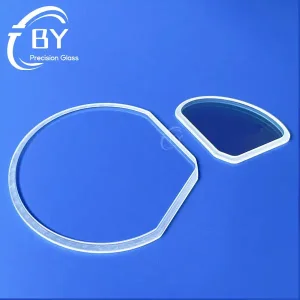
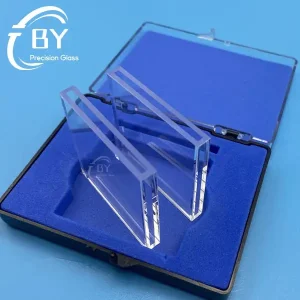
Explore precision-fabricated optical glass windows, specialized flow tubes, and custom quartz elements designed to custom drawings.
Engineering Precision Optical Windows: Material Purity & Subsurface Damage Dynamics
A technical treatise on synthetic vitreous silica, monocrystalline sapphire, and precision borosilicates in next-generation mission-critical assemblies.
Lattice Integrity & Bubble Classes
Optical window performance relies on the elimination of inclusions and microscopic striations. BY Photonics controls inclusion density strictly adhering to DIN ISO 10110 standards, guaranteeing zero scattering centers in high-energy laser paths and deep UV analytical chambers.
Laser-Induced Damage Threshold (LIDT)
For high-fluence pulsed lasers (1064nm, 532nm, 355nm), subsurface damage (SSD) during cold grinding remains the primary initiator of mechanical breakdown. Our proprietary magnetorheological finishing and chemo-mechanical polishing (CMP) mitigate crack propagation, maintaining certified high LIDT limits.
Thermal & Chemical Stabilization
High working temperatures up to 1100°C for fused quartz and 1800°C for c-plane sapphire allow seamless operation in hostile process chambers. Resistance to hydrofluoric acid gas etching, hot plasma, and rapid thermal cycling prevents surface devitrification and mechanical failure.
Global Industrial Status & Optical Supply Chain Realities
Understanding geopolitical material shortages, cleanroom capacity demands, and Tier-1 commercial delivery benchmarks.
Synthetic Preform Bottlenecks
Global demand driven by EUV lithography tooling, optical interconnects, and aerospace defense platforms has placed high constraints on raw synthetic soot deposition. Tianjin BY Photonics maintains integrated raw stock inventory, securing consistent production runs without supply disruption.
Semiconductor Equipment Precision
Advanced 3nm and 2nm node fabs demand optical windows, gas distribution plates, and wafer carriers capable of zero trace-metal contamination. Flame-worked quartzware and chemically polished fused silica prevent wafer defectivity caused by sodium or iron leeching.
Tier-1 Export Compliance
Navigating global compliance protocols necessitates verifiable end-to-end documentation. Components ship with raw ingot spectral verification, dual-axis interferometry reports, and packaging conforming strictly to cleanroom class 100/1000 protocol requirements.
Custom Optical Windows: Industry-Specific Solutions
Engineered substrate architectures calibrated to specific electromagnetic transmission profiles and aggressive thermal gradients.
Aerospace & Defense Vision Systems
For forward-looking infrared (FLIR), targeting pods, and high-altitude avionics, optical windows must withstand aero-thermal shock and abrasive particulate impacts. C-plane monocrystalline sapphire windows and JGS3 low-OH quartz offer wide transmittance (UV through mid-wave IR) combined with Mohs 9 hardness.
Semiconductor Metrology & Etch Chambers
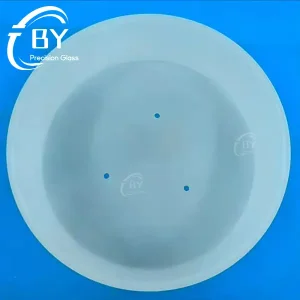
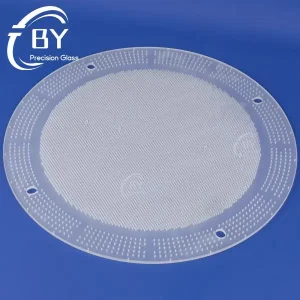
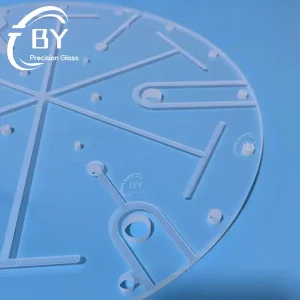
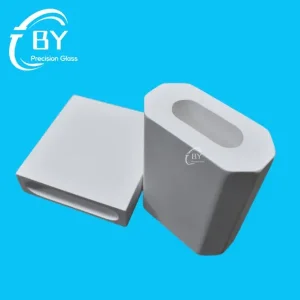
High-density plasma environments (CF4, Cl2) rapidly etch standard borosilicate and optical crowns. We engineer gas distribution plates, quartz diffusion boats, and plasma viewports using synthetic JGS1 fused silica, preserving chamber purity and optical transmission under continuous processing.
Medical Diagnostic Optics & Aesthetic Systems
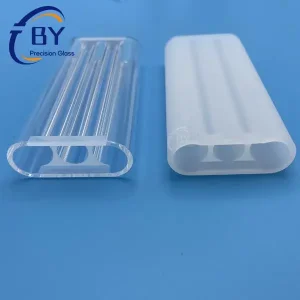
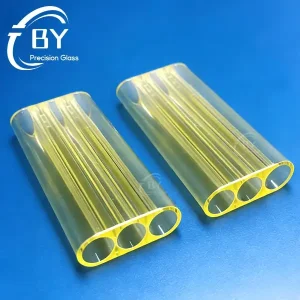
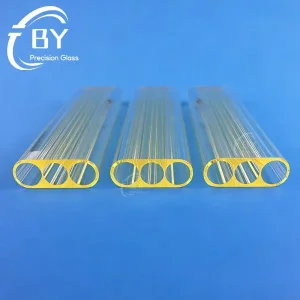
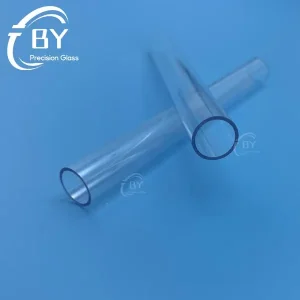
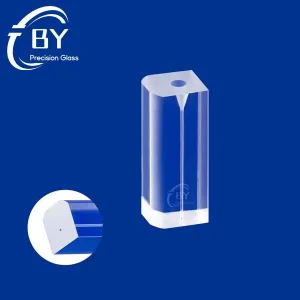
Laser dermatology and analytical spectrometry require precise beam conditioning. Our samarium-doped quartz flow tubes absorb parasitic 1064nm emissions while transmitting pump bands, while our sapphire IPL light guides ensure optimal epidermal contact cooling and UV containment.
Substrate Engineering Matrix: Optical, Mechanical & Thermal Properties
Direct comparison of optical substrate materials utilized in our precision window manufacturing lines.
| Material Class | Transmission Band | Max Service Temp | Thermal Expansion (α) | Refractive Index (nd) | Core Application Domain |
|---|---|---|---|---|---|
| JGS1 Synthetic Fused Silica | 185 nm – 2,500 nm | 1100 °C | 0.54 × 10⁻⁶ / °C | 1.458 | Excimer Lasers, DUV Optics |
| JGS2 Optical Fused Quartz | 220 nm – 2,500 nm | 1100 °C | 0.55 × 10⁻⁶ / °C | 1.458 | Laser Flow Tubes, Viewports |
| JGS3 Infrared Grade Quartz | 260 nm – 3,500 nm | 1100 °C | 0.55 × 10⁻⁶ / °C | 1.458 | IR Sensors, Heating Wells |
| Sapphire Single Crystal (Al₂O₃) | 170 nm – 5,500 nm | 1800 °C | 5.8 × 10⁻⁶ / °C | 1.768 | High-Pressure Viewports, IPL |
| Borofloat 33® Borosilicate | 350 nm – 2,500 nm | 450 °C | 3.25 × 10⁻⁶ / °C | 1.471 | MEMS Substrates, Sight Glass |
| Sm³⁺-Doped Laser Cavity Glass | Custom Pump Selective | 400 °C | 9.5 × 10⁻⁶ / °C | 1.520 | Solid-State Laser Cavities |
Localized Engineering Support & International Compliance Assurance
Bridging foundry production with Tier-1 mechanical integration, direct-to-drawing verification, and global logistics transparency.
Full Drawing Traceability
We accept native CAD datasets (.STEP, .IGES, .DWG, .DXF, and dimensioned PDF formats). Each production lot is assigned a traceable batch ledger linking raw material ingots to final laser interferometer inspection reports.
Rapid 24h DFM Reviews
Avoid costly dimensional tolerancing oversights. Our optical engineering team provides comprehensive Design for Manufacturability (DFM) feedback within 24 business hours, suggesting optimal corner relief, bevel angles, and coating feasibility.
Ultra-Clean Export Packaging
All finished optical glass windows undergo ultrasonic solvent degreasing and Class 100 HEPA wipe-down before vacuum-sealing in antistatic, lint-free pet carriers. Guaranteed zero particle deposition during cross-border transit.
Metrology Verification
Our quality assurance lab utilizes Zygo laser interferometers, spectrophotometers covering 190nm–3500nm, non-contact coordinate measuring machines (CMM), and optical profilometers verifying surface roughness below 0.5 nm Ra.
Technology Roadmap: The Next Decade in Advanced Optical Fabrication
Continuous investment in cutting-edge cold working, laser-assisted micro-machining, and hybrid bonding solutions.
Picosecond & Femtosecond Laser Processing
Advancing past traditional mechanical diamond grinding tools, our development lines utilize ultra-short pulsed lasers for micro-hole drilling, crack-free edge chamfering, and internal microfluidic channel fabrication inside pure silica.
Hydroxide-Catalysis & Optical Contact Bonding
Eliminating epoxy adhesives in high-energy laser assemblies: our cleanroom teams are scaling optical contact bonding and silicate bonding to join sapphire plates and fused quartz flow tubes with zero laser degradation and thermal mismatch.
Extreme Freeform & Conformal Geometries
Expanding from flat windows to conformal optical surfaces. Upgrades across 5-axis CNC ultrasonic grinding centers enable complex curved windows, hyper-hemispherical domes, and lightweighted aerospace window structures.
Frequently Asked Questions: Technical & Sourcing Inquiries
Essential guidance for procurement specialists, optical designers, and systems integration engineers.
What parameters determine whether I should specify JGS1, JGS2, or JGS3?
How does BY Photonics manage Subsurface Damage (SSD) during cold processing?
What surface quality and flatness tolerances are realistically achievable for OEM runs?
Can you machine integrated features like steps, counterbores, and micro-grooves into quartz and sapphire?
What Anti-Reflective (AR) coatings can be applied to custom optical glass windows?
Specialized Semiconductor, Laser & Fiber Components
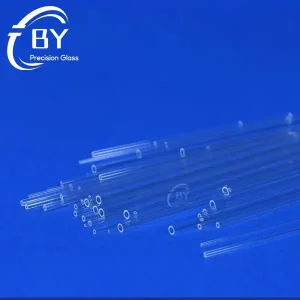
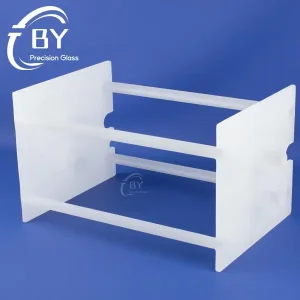
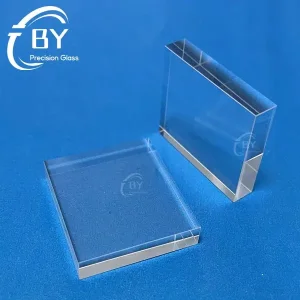
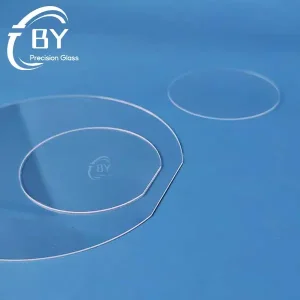
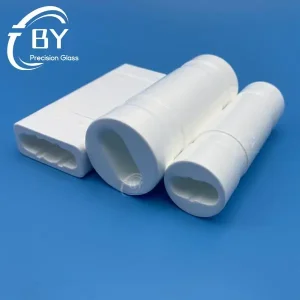
Explore high-temperature diffusion boats, light guide blocks, wafers, and precision capillary hardware.
Initiate Your Custom Optical Component Fabrication
Send your engineering drawings (.STEP, .DWG, .DXF, or PDF). Our team will provide a manufacturability assessment, raw substrate evaluation, and a verified fabrication quote within 24 hours.
Submit Drawing to Engineering Desk