
Engineered Quartzware, Viewing Optics & Laser Subassemblies
Explore our tight-tolerance optical windows, quartz cuvettes, ceramic cavities, and gas distribution plates manufactured to ISO 9001 and MIL-PRF-13830B standards.
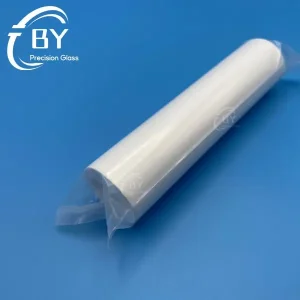
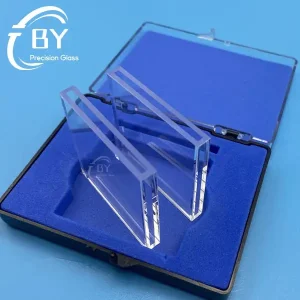
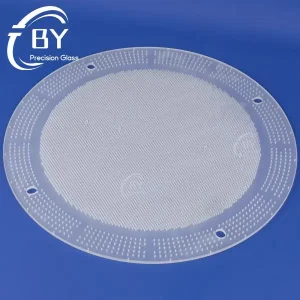
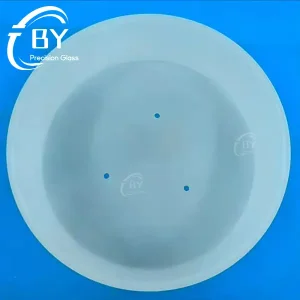
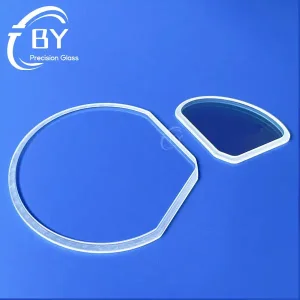
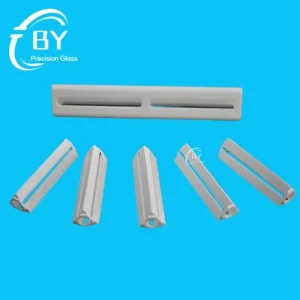
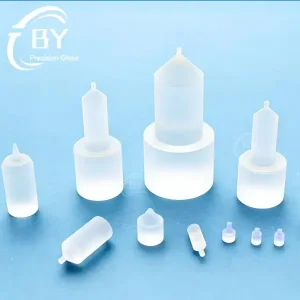
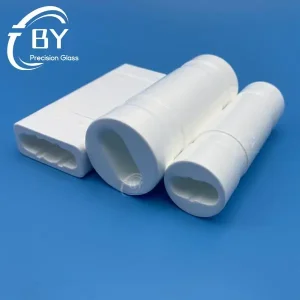
Evolutionary Trends in Custom Quartz Sight Glass Manufacturing
As process parameters in advanced semiconductor manufacturing, green hydrogen reactors, and aerospace testing push towards extreme thermodynamic thresholds, custom quartz sight glasses have evolved from simple passive viewing ports into safety-critical, spectrally optimized optical metrology assemblies.
High-Purity Fused Quartz vs. Standard Borosilicate Sight Glasses: The Engineering Paradigm
In high-pressure and high-temperature visual observation environments, standard borosilicate sight glasses (such as Borofloat® 33 or DIN 7080 standard glasses) face fundamental structural limitations when operations exceed 450°C or experience sudden thermal transients exceeding 150°C. Custom quartz sight glasses manufactured from JGS1, JGS2, and JGS3 raw synthetics exhibit a near-zero Coefficient of Thermal Expansion (CTE ~ 5.5 × 10⁻⁷ /°C). This ultra-low expansion profile prevents catastrophic thermal shock failure even when subjected to immediate water quenching from 1100°C.
Furthermore, contemporary analytical applications require direct in-situ spectral sensing through sight viewports. By Photonics addresses this requirement through precision double-sided optical polishing (flatness up to λ/10, scratch-dig 20-10), enabling seamless laser spectroscopy, ultraviolet flame sensing down to 185 nm, and infrared pyrometry up to 3500 nm without optical path distortion.
Thermal Resilience >1100°C
Unlike soda-lime or borosilicate glasses which soften around 500°C, fused silica sight glasses maintain rigid dimensional integrity and mechanical strength up to a continuous service temperature of 1100°C and short-term peak tolerance of 1300°C.
Broadband Spectral Transparency
From deep UV lithography and excimer tracking (185 nm) through the visible spectrum and into Mid-IR pyrometric wavelengths (3.5 µm), our JGS1, JGS2, and JGS3 grades deliver an internal transmission efficiency exceeding 92% across critical process bands.
Severe Chemical & Acid Inertness
Except for hydrofluoric acid and concentrated hot phosphoric acid, high-purity quartz sight glasses remain impervious to nearly all corrosive acids, solvents, and aggressive halogens encountered in chlorine etching and pharmaceutical synthesis.
Procurement Specifications: ASME-BPE, DIN 7080 & Custom Geometry Standards
International EPC contractors and instrument manufacturers require comprehensive material verification and strict dimensional compliance. Below is our engineering baseline comparison for sight glass selection.
| Physical / Optical Parameter | JGS1 Synthetic Fused Silica | JGS2 Fused Quartz | JGS3 Low-OH Fused Quartz | Borofloat® 33 (Reference) |
|---|---|---|---|---|
| Transmission Range (T > 80%) | 185 nm – 2,500 nm (Deep UV) | 220 nm – 2,500 nm (Standard Optical) | 260 nm – 3,500 nm (Infrared Grade) | 350 nm – 2,000 nm |
| Max Continuous Temperature | 1,150 °C | 1,100 °C | 1,100 °C | 450 °C |
| Coefficient of Thermal Expansion (CTE) | 5.5 × 10⁻⁷ / °C (20–300°C) | 5.5 × 10⁻⁷ / °C (20–300°C) | 5.5 × 10⁻⁷ / °C (20–300°C) | 32.5 × 10⁻⁷ / °C |
| Refractive Index (nd @ 589.3 nm) | 1.4585 | 1.4585 | 1.4585 | 1.4714 |
| Hydroxyl Ion (OH⁻) Content | < 1,200 ppm (UV active) | < 150 – 200 ppm | < 5 ppm (Zero 2.73 µm absorption) | N/A (Multi-component) |
| Typical Sight Glass Configuration | Excimer laser ports, UV reactor discs | Process observation, sanitary viewports | IR furnace ports, thermal viewports | Standard low-temp fluid pipes |
China Factory 4.0: Supply Chain Resilience, Cold Working & Annealing Control
Operating from our modern 3,000+ m² facility in Tianjin, BY Photonics integrates raw quartz ingot cutting, 5-axis ultrasonic CNC milling, double-sided planetary lapping, and stress-relieving thermal annealing into an unbroken, certified manufacturing loop.
5-Axis Ultrasonic CNC Machining
Hard and brittle materials such as fused quartz and sapphire are susceptible to sub-surface micro-cracking when sheared conventionally. Our ultrasonic-assisted CNC machining minimizes cutting force by up to 40%, generating complex step-profiles, bolt-hole circles, and O-ring grooves without chipping or subsurface micro-fissures.
Stress-Free Controlled Annealing
Following heavy diamond sawing or high-temperature oxyhydrogen flame welding, residual internal stress can drastically compromise pressure retention. Every custom quartz sight glass undergoes a computer-controlled thermal annealing cycle at 1150°C to ensure zero localized birefringence under polariscope testing.
Integrated Supply Chain Traceability
From raw ingot sourcing to final vacuum-sealed cleanroom packaging, every production batch is linked to chemical purity spectrographic analysis, flatness interferometry certificates (Zygo metrology), and pressure burst simulation logs, offering global procurement teams 100% auditable quality records.
Global Commercial Landscapes & Critical Operating Scenarios
Where standard industrial glass fails under extreme mechanical pressure or hostile chemistries, custom engineered quartz sight glasses provide dependable, crystal-clear operational visualization.
Semiconductor CVD & Plasma Etch Viewports
Within sub-10nm chip manufacturing equipment, viewports are subjected to fluorine-based etch gases (NF₃, CF₄) and intense RF plasma. Custom fused quartz sight discs provide an ultra-clean barrier preventing silicon substrate contamination while facilitating accurate endpoint pyrometry and optical emission spectroscopy (OES).
Petrochemical & Supercritical Fluid Reactors
Modern hydrogenation units and supercritical CO₂ extraction chambers operate at pressures up to 350 bar (5,000+ PSI). By Photonics manufactures thick circular and rectangular quartz sight glasses with specialized diamond-ground bevels and custom elastomeric/metallic seals compliant with ASME Section VIII Division 1 guidelines.
Sanitary Biopharmaceutical Synthesis
Fermentation vessels and WFI (Water For Injection) storage facilities demand sight glasses complying with ASME-BPE cleanability criteria. Our quartz sight windows feature Ra < 0.2 µm mirror-polished contact surfaces to prevent bacterial adhesion and withstand CIP/SIP (Clean-In-Place / Steam-In-Place) thermal sterilization cycles.
Nuclear Reactor & Pyrometallurgical Inspection
In high radiation and molten metal refining environments, standard glasses discolour (solarization effect). Synthetic low-defect fused silica windows offer exceptional resistance to gamma-ray radiation darkening and molten slag spatter, keeping molten furnace lines continuously observable.
Frequently Asked Questions: Custom Quartz Sight Glass Engineering
Clear, technically rigorous answers to common questions posed by mechanical design engineers, procurement specialists, and plant safety inspectors.
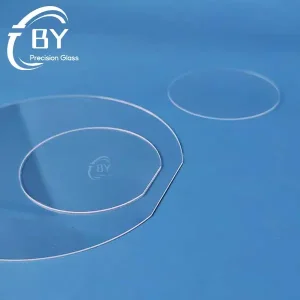
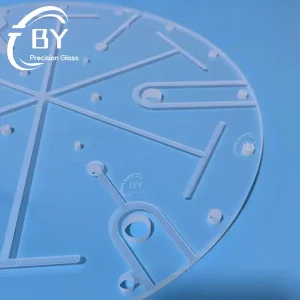
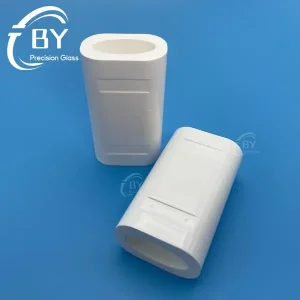
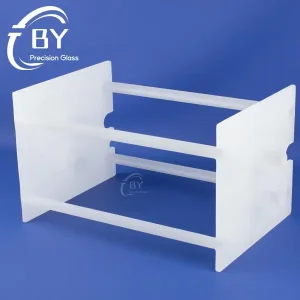
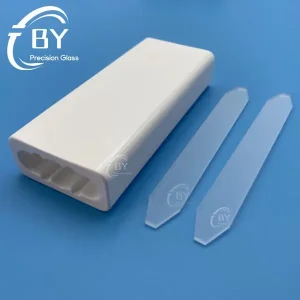
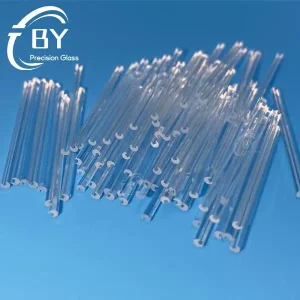
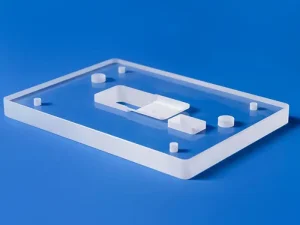
Specialty Glass Wafers, Diffusion Ware & Machined Optics
Explore our Borofloat 33® glass wafers, high-temperature diffusion boats, laser cavity tubes, and precision machined quartz plates fabricated for next-generation industrial tooling.

Direct OEM Engineering Consultation & Drawing Review
Whether designing a custom circular viewport for high-pressure autoclaves, an oblong liquid level gauge glass for chemical distillation, or an AR-coated fused silica window for semiconductor metrology, our senior optical process engineers review CAD drawings (STEP, IGES, DXF, PDF) and deliver Design-For-Manufacturability (DFM) feedback and finite element stress verification within 24 working hours.