Precision Optical & Quartz Fabrication Solutions
Explore our premium grade micro-machined fused silica, cavity reflectors, and optical components engineered for high-reliability industrial assemblies.
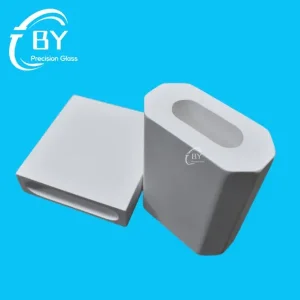

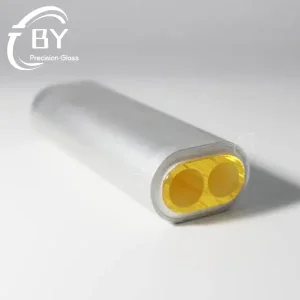
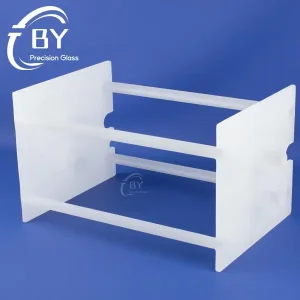

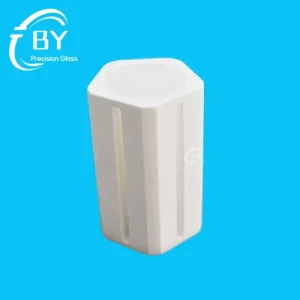
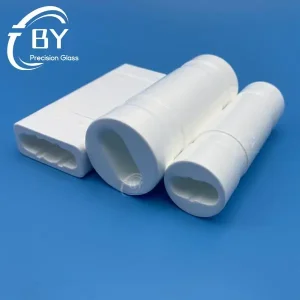
Borosilicate Glass Ferrule Material Architecture & Precision Redrawing
A rigorous metallurgical and mechanical overview of low-expansion borosilicate ferrules across optical alignment, high-frequency optoelectronics, and microfluidic channels.
Thermal Stability & CTE Compatibility
Borosilicate glass ferrules feature an exceptionally low coefficient of thermal expansion (CTE 3.25 × 10⁻⁶/K). In high-density dense wavelength division multiplexing (DWDM) and high-speed transceivers, this thermal resilience eliminates channel drift and maintains insertion loss below 0.1 dB under extreme temperature fluctuations (-40°C to +85°C).
Sub-Micron Dimensional Precision
Utilizing high-precision multi-stage down-drawing towers and diamond micro-lapping machinery, inner bores are controlled to 125µm, 126µm, or customized dual-bore geometry with inner bore circularity error within ≤0.5µm and concentricity error <1.0µm, ensuring repeatable, flawless single-mode and polarization-maintaining fiber terminations.
UV Transparency & Rapid Curing
Unlike opaque zirconia or alumina ferrules, borosilicate glass provides exceptional optical transmission in the near-ultraviolet band (>90% at 365 nm). This empowers optical sub-assembly engineers to perform 360-degree rapid UV adhesive curing, increasing production throughput by over 400% during transceiver and pigtail packaging.
Technical Comparison: Borosilicate Glass vs. Zirconia (ZrO₂) vs. Quartz Ferrules
| Physical & Optical Parameters | Borosilicate Glass Ferrule | Ceramic Zirconia Ferrule | Synthetic Fused Quartz Ferrule |
|---|---|---|---|
| Thermal Expansion (CTE) | 3.25 × 10⁻⁶ / K (Low, Stable) | 9.60 × 10⁻⁶ / K (High) | 0.55 × 10⁻⁶ / K (Ultra-Low) |
| UV Transmittance (365 nm) | > 90% (Instant 360° UV Curing) | 0% (Opaque, Thermal Bake Only) | > 92% (Instant UV Curing) |
| Inner Bore Tolerance | ±0.5 μm (Precision Redrawn) | ±0.7 μm (Extrusion / Molded) | ±0.3 μm (High Precision) |
| Chemical Inertness & Acid Wash | Excellent (Class 1 Hydrolytic) | Moderate / High | Outstanding (Hydrofluoric Sensitive) |
| Batch Cost-Efficiency | High Optimization (Cost-Effective) | Medium | Premium / High Cost |
Enterprise Procurement Demands & Industry Ecosystems
Strategic analysis of systemic supply-chain integration across hyperscale data centers, medical instrumentation, microfluidics, and aerospace sensing nodes.
AI Data Centers & CPO Optics
With co-packaged optics (CPO) driving transceivers to 800G and 1.6T, borosilicate glass ferrules provide multi-channel fiber arrays and collimator mounts with zero electrical conductivity and ultra-stable beam pitch integrity under thermal load.
Biomedical & Endoscopic Probes
Medical OEM manufacturers utilize biocompatible borosilicate ferrules inside miniature laser delivery catheters, optical coherence tomography (OCT) imaging tips, and laser surgery instruments that demand strict non-toxic biocompatibility and autoclave resistance.
Lab-on-a-Chip & Fluidics
Microfluidic designers integrate precision bore glass ferrules as capillary fluid connectors and high-purity fluid interfaces in capillary electrophoresis, flow cytometry, and mass spectrometry, avoiding ion leaching and sample contamination.
Aerospace Fiber Gyroscopes
In Fiber Optic Gyroscopes (FOG) and avionics flight controls, borosilicate capillary sleeves guarantee stable fiber polarization alignment, eliminating signal degradation caused by mechanical stress and high altitude temperature shifts.
Technological Roadmap & Next-Generation Engineering Horizons
Anticipating future photonics requirements: from nanoscale multi-core interconnects to automated laser polishing and high-throughput optical packaging.
Phase 1: Multi-Core & Multi-Bore Precision Redrawing
Developing 4-core, 8-core, and customized spatial arrangement capillaries with pitch accuracy within ±0.25 μm to support Space-Division Multiplexing (SDM) in next-generation terabit communications.
Phase 2: Femtosecond Laser Micromachining & Angled End-Faces
Integrating 5-axis femtosecond cold laser etching to manufacture pre-angled (8° APC), chamfered, and slotted glass ferrules without sub-surface micro-cracking, maximizing return loss (>65 dB).
Phase 3: AI-Driven In-Line Interferometric Metrology
Full-scale deployment of 100% digital automated optical inspection (AOI) with sub-pixel laser confocal scanning, offering real-time dimensional verification and automated material certification data packs.
Enterprise Reliability, Global Compliance & Localized Engineering Support
BY Photonics ensures full regulatory compliance, strict material chain of custody, and responsive engineering interaction worldwide.
RoHS, REACH & Conflict-Free
All borosilicate glass formulas and auxiliary polishing media comply fully with EU RoHS 3 (Directive 2015/863) and REACH SVHC mandates. We provide certified laboratory test records confirming zero heavy metal or hazardous chemical content.
Dedicated Engineering Desk
Our Tianjin technical facility operates a 24-hour drawing review window. Procurement and R&D teams receive direct DFM (Design for Manufacturability) analysis, tolerance optimization reports, and prototyping support within one business day.
Cleanroom Packing & Global Logistics
Finished ferrules and micro-capillaries are ultrasonically cleaned and packaged in Class 10,000 cleanrooms using anti-static, shock-absorbing vacuum-sealed trays, ensuring intact delivery to Europe, North America, Japan, and Southeast Asia.
Frequently Asked Questions on Borosilicate Glass Ferrules
Direct technical answers addressing the critical parameters, fabrication methods, and integration practices prioritized by optics buyers.
Borosilicate glass ferrules provide high optical transparency at 365 nm UV wavelengths, allowing 360-degree rapid UV curable adhesive bonding in seconds without high-temperature baking. Furthermore, borosilicate has a lower CTE that matches optical silica fiber closely, avoiding thermal stress delamination in demanding environments.
Standard inner bore sizes include 125.0µm, 126.0µm, and custom bores up to several millimeters. Standard bore tolerance is held to ±0.5µm with concentricity ≤1.0µm. For high-precision single-mode or polarization-maintaining (PM) requirements, bore tolerance can be refined to ±0.3µm upon engineering review.
Yes. We perform precision CNC end-face grinding, dual-sided optical polishing, and precise angle cuts (such as 8° APC, flat 0°, or customized angles). Surface quality can be specified to 20-10 scratch-dig with end-face perpendicularity <0.5°.
For custom redrawn borosilicate ferrule prototypes matching your CAD drawings, typical lead time is 2 to 3 weeks. We maintain flexible small-batch support for scientific R&D with pilot orders from 50–100 pieces, ramping smoothly to multi-million-piece batch supply for OEM contracts.
Specialty Optics, Sapphire Viewports & Spectrophotometer Components
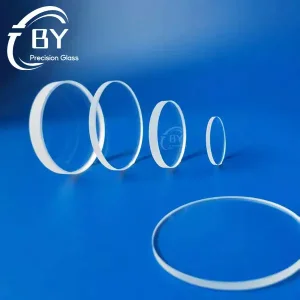
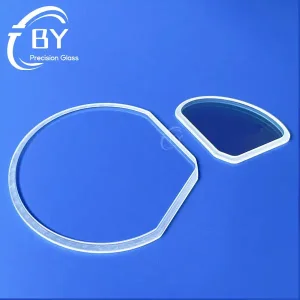
Engineered optics for laser chambers, lithography tools, harsh chemical sight glasses, and advanced spectroscopic instruments.