
Featured Precision Fused Silica & Optical Glass Components
Explore our core substrate solutions engineered to support dual porous cavity architectures, high-energy laser excitation flow channels, and semiconductor-grade synthetic quartz assemblies.
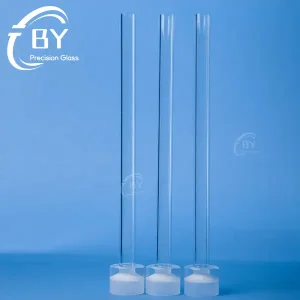
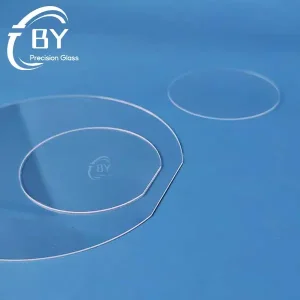


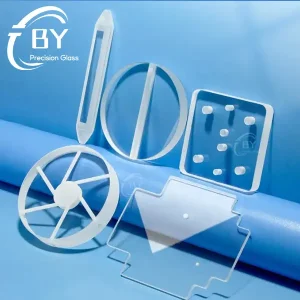
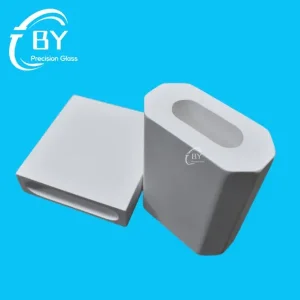
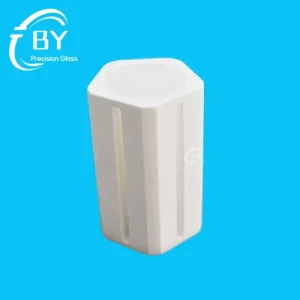

Morphology, Sol-Gel Synthesis & Dual Porous Silica Physics
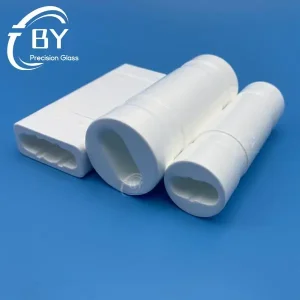
A dual porous silica cavity represents a quantum leap beyond standard monolithic quartzware and random sintered frits. By tailoring hierarchical bimodal pore systems, optical and fluidic engineers achieve zero dead-volume permeability combined with extraordinary localized surface interaction.
The matrix integrates continuous macropores (typically 1.5 to 5.0 µm) for unrestricted convective hydraulic mass transport alongside an intra-skeleton network of ordered mesopores (ranging from 5 to 30 nm). This guarantees negligible hydrodynamic backpressure while maintaining a surface area exceeding 350 m²/g.
Synthesized through controlled spinodal decomposition using tetraethoxysilane (TEOS) or tetramethoxysilane (TMOS) in the presence of water-soluble polymers (e.g., PEO). BY Photonics tightens phase separation kinetics to ensure isotropic pore distribution across broad monolithic dimensions.
By relying on synthetic JGS1 grade fused silica molecular networks, our dual porous silica cavities withstand thermal shock deltas up to ΔT=1000°C without micro-cleavage. In laser cavity applications, this suppresses thermal lensing and preserves structural integrity under extreme flux.
| Performance Metric / Property | Standard Sintered Silica Frit | Monolithic Synthetic Fused Silica | BY Photonics Dual Porous Silica Cavity |
|---|---|---|---|
| Pore Architecture | Random polydisperse interstitial voids (0.5–20 µm) | Dense non-porous (<0.1 nm molecular interstitial) | Co-continuous Macroporous (2–5 µm) + Mesoporous (10–25 nm) |
| Specific Surface Area (BET) | 0.5 – 3.2 m²/g | < 0.1 m²/g (Geometric only) | 320 – 480 m²/g (Tunable via post-synthesis) |
| Hydraulic Permeability (Darcy k) | Erratic backpressure, prone to particle clogging | Impermeable (Hermetic bulk barrier) | Stable convective flow, Darcy coeff. 10⁻¹² to 10⁻¹³ m² |
| Laser Damage Threshold (LDT @ 1064nm, 10ns) | Poor (< 3 J/cm², interface scatter burn) | > 20 J/cm² (Optical polish baseline) | > 12.5 J/cm² (Fused matrix boundary, low scatter) |
| Thermal Expansion Coeff. (α 20–300°C) | ~0.55 × 10⁻⁶ / K (Micro-cracking under stress) | 0.54 × 10⁻⁶ / K | 0.52 × 10⁻⁶ / K (Ultra-low residual strain) |
| Chemical Stability & Leachability | Binder contamination risks, alkali leaching | Inert to aggressive acids (except HF/hot KOH) | High purity (>99.998% SiO₂), undetectable leaching |
Localized Application Scenarios & Subsystem Integration
From cleanroom microfabrication in advanced foundries to ultra-stable pump cavity chambers for medical and military laser oscillators, dual porous silica structures overcome conventional boundary-layer transport bottlenecks.
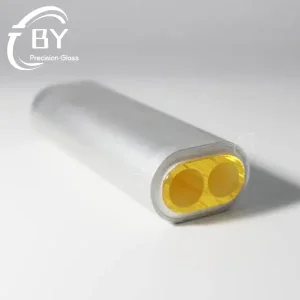
Integrated within solid-state (DPSS) and flashlamp-pumped laser heads, dual porous silica flow tubes and cavity liners facilitate turbulent liquid coolant convective heat transfer without bubble cavitation. When co-doped with samarium, they simultaneously eliminate parasitic 1064 nm amplified spontaneous emission (ASE).
In lab-on-a-chip diagnostics and continuous chemical flow reactors, our dual porous silica monoliths act as catalytic enzyme scaffolds. Macropores permit uninterrupted fluid conveyance at linear velocities up to 10 mm/s, while mesopores immobilize proteins, oligonucleotides, and precious metallic nanoparticles.
Deep-ultraviolet (DUV 193nm / EUV 13.5nm) lithography equipment demands radical hydrocarbon outgassing suppression. Sintered dual porous silica inserts act as active getter chambers, stripping sub-ppm organic contaminants from ultra-high purity nitrogen and argon gas purge lines without introducing quartz dust.
Overcoming packed-bed limits, our dual porous silica rods are directly fused into capillary tubing or Borofloat housings. By eradicating interstitial void variance, chromatographic columns demonstrate reduced van Deemter peak broadening, elevating separation efficiency above 120,000 theoretical plates/meter.
China Factory Supply Chain Resilience & Technology Roadmap
Operating from our 3,000+ m² precision glass manufacturing hub in Tianjin, China, BY Photonics maintains 100% domestic vertical integration: from synthetic alkoxide chemical precursors to 5-axis CNC diamond grinding and oxyhydrogen fire-polishing.
Unlike Western providers vulnerable to trans-oceanic quartz ingot disruptions, BY Photonics sources ultra-pure silicon precursors directly within northern China's industrial chemical corridor. We manage sol-gel condensation, hydrothermal pore swelling, supercritical drying, and vacuum high-temperature sintering entirely on-site.
Global competitors often quote 8 to 16 weeks for custom dual porous cavity tooling. Leveraging our fleet of 120+ processing machines, our Tianjin facility cuts rapid engineering validation cycles down to 7–10 business days for bespoke customer prints, supported by English-speaking optical fabrication engineers.
Our 2026–2030 development horizon concentrates on sub-nanometer mesopore tuning (±0.3 nm accuracy) via atomic layer deposition (ALD) of metal oxides (TiO₂, Al₂O₃, ZrO₂) inside silica cavities, unlocking refractive index grading and advanced bio-plasmonic signal enhancement.
International Industrial Dynamics, Localization & Quality Compliance
In high-tech optics and life sciences, reliability means rigorous documentation, full traceability from raw sand to finished export cartons, and absolute compliance with international trade frameworks.
Every cavity lot undergoes dimensional validation via Mitutoyo non-contact CNC vision systems, surface roughness interferometry (Ra < 0.5 nm on polished sealing faces), and micromeritics ASAP BET gas adsorption analysis for exact pore volume and surface area verification.
Our raw synthetic silica (JGS1), optical glass stock, and rare-earth dopants undergo regular independent ICP-OES tests. Fully compliant with EU RoHS Directives (2011/65/EU) and REACH (EC 1907/2006) regulations, eliminating concerns over restricted substances or halogens.
Components are ultrasonically decontaminated, dried in a nitrogen atmosphere, and vacuum-sealed inside Class 100/1000 cleanrooms using anti-static, non-shedding medical pouches. With FedEx, DHL, and air freight consolidation, consignments arrive in Europe and North America within 3–5 working days.
Frequently Asked Questions on Dual Porous Silica Cavities
In-depth answers addressing structural durability, fabrication limitations, surface chemistry modifications, and ordering protocols for research institutes and industrial OEMs.
How does a dual porous silica cavity differ from standard porous borosilicate frits?
What are the maximum temperature thresholds and thermal shock limits?
Can the mesopores and macropores be custom-tailored to specific flow rates and molecular cutoffs?
What surface modification and functionalization options are available?
Which CAD file formats should I supply, and what dimensional tolerances do you hold?
How do you prevent contamination and particulate shedding during shipping?
Complementary Laser, Semiconductor & Optical Glassware
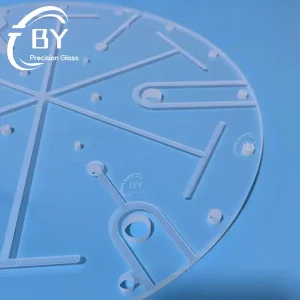
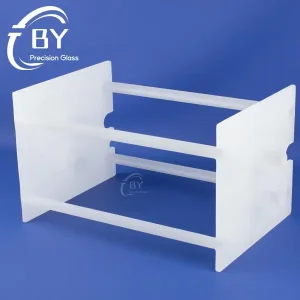
Integrate our dual porous silica cavities with matched laser flow tubes, lithography grade quartz optical flats, and Samarium-doped glass cavity filters for comprehensive OEM optical assemblies.
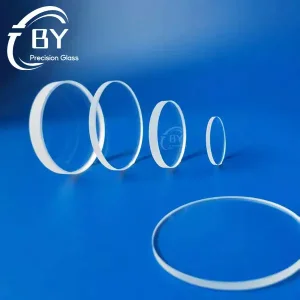
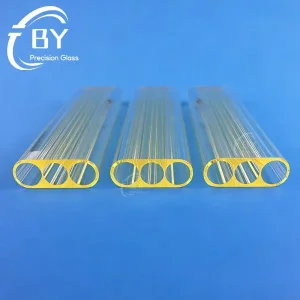
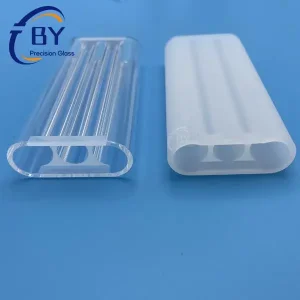

Initiate Your Dual Porous Silica Cavity Specification
Direct drawing assessment from our senior optical processing engineers in Tianjin. Receive full design-for-manufacturability (DFM) feedback and transparent batch pricing in under 24 hours.