
Featured Spectroscopy & Precision Optical Components
Explore our verified optical cuvette series, flow-through channels, and precision laser glassware engineered directly at our advanced fabrication facility.
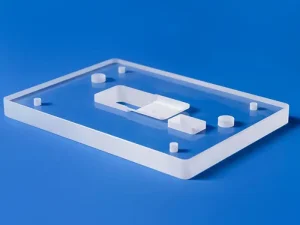
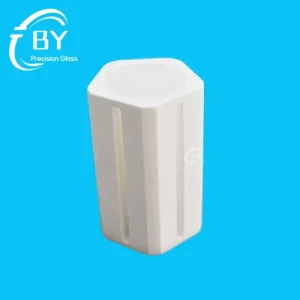
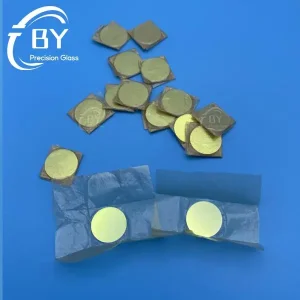
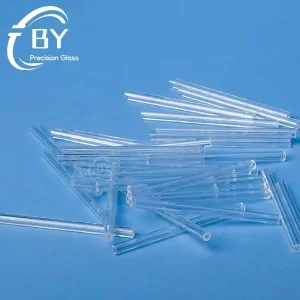
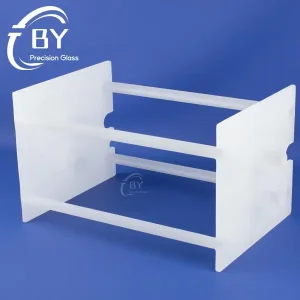
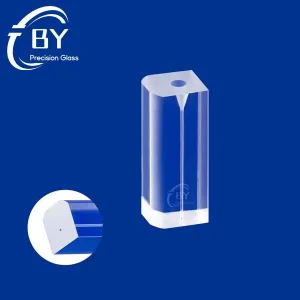
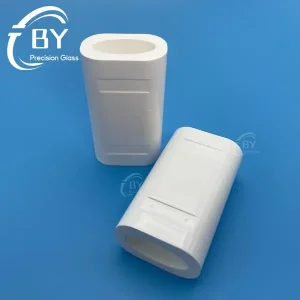
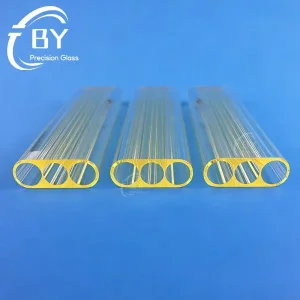
Metrological Precision & Optical Path Engineering
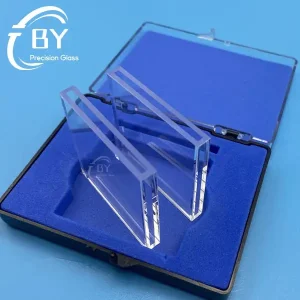
Spectrophotometer cuvettes are the fundamental sample-light interface in UV-Vis, NIR, and fluorescence spectroscopy. Sub-micron dimensional accuracy dictates Beer-Lambert photometric certainty.
Pathlength Accuracy & Beer-Lambert Law
The core validity of spectrophotometric quantitative analysis relies strictly on optical pathlength (b) consistency. In standard 10 mm pathlength absorption cuvettes, our CNC double-sided lapping maintains an absolute dimensional tolerance of ±0.005 mm. This eliminates pathlength variance errors, preventing baseline drift during high-sensitivity pharmaceutical trace assay validations.
Thermal Fusion vs. Adhesive Bonding
Traditional lower-tier cuvettes utilize epoxy or solvent adhesives that degrade, leach, and fluoresce under harsh organic solvents (chloroform, acetone, DMSO) or extreme acid washes. BY Photonics manufactures cuvettes via proprietary High-Temperature Oxyhydrogen Direct Flame Molecular Fusion. The joints form a seamless, monolithic glass bond with zero adhesives, surviving from -40°C to 1100°C.
Parallelism & Wavefront Transmission
Optical window surfaces are ground and polished to a transmitted wavefront error of < λ/4 @ 632.8 nm with parallelism held within < 3 arc minutes. Scratch-dig surface quality achieves MIL-PRF-13830B 20-10 or 40-20, guaranteeing minimal beam distortion, zero stray parasitic reflections, and pristine internal transmission curves above 82% from 200 nm to 2500 nm.
Optical Glass vs. Synthetic Quartz Cuvette Grades
Selecting the appropriate substrate determines spectral cutoff, optical clarity, chemical stability, and thermal resilience. We provide an exact engineering grade matrix for procurement engineers.
| Substrate Grade | Material Class | Effective Spectral Range | Transmission @ Peak | Typical Instrument Application |
|---|---|---|---|---|
| JGS1 Synthetic Silica | UV Synthetic Quartz | 190 nm – 2500 nm | ≥ 83% @ 200 nm; ≥ 91% @ 250 nm | Far-UV DNA/Protein quantification, photolithography metrology, Cary 5000 / Lambda 1050 spectrophotometers |
| JGS2 Fused Quartz | Standard UV Quartz | 220 nm – 2500 nm | ≥ 80% @ 220 nm; ≥ 90% @ 260 nm | Routine biochemical assays, environmental pollutant screening, industrial analytical chromatography |
| JGS3 Low-OH Silica | Infrared Grade Quartz | 260 nm – 3500 nm | ≥ 90% across NIR spectrum (<5 ppm OH) | Near-infrared (NIR) moisture testing, petrochemical hydrocarbon verification, vibrational spectroscopy |
| Optical Glass (K9 / BK7) | Crown Optical Glass | 320 nm – 2500 nm | ≥ 89% in Vis spectrum (400–700 nm) | Colorimetric assays, clinical visible spectrophotometers, university physics/chemistry teaching labs |
| Borosilicate 3.3 | Low-Expansion Borosilicate | 340 nm – 2500 nm | ≥ 88% across visible band | High thermal shock environments, industrial process flow sensors, non-critical educational absorption |
Why Global Buyers Source Cuvettes from BY Photonics
Headquartered in Tianjin, China, BY Photonics operates a modern optical facility blending traditional high-precision flame working with 5-axis CNC ultrasonic cold processing.
Complete Vertical Integration
From raw ingot slicing, JGS1 fused silica block annealing, 5-axis ultrasonic CNC core drilling to four-wall oxyhydrogen fire-fusion and multi-station chemical-mechanical planarization (CMP)—all steps are executed under one unified quality management protocol.
Optical Pair-Matching Capability
For dual-beam spectrophotometers, baseline drift must remain under 0.001 Abs. We offer certified matched cuvette pairs and sets where transmittance variation is strictly controlled within ΔT < 0.5% at identical test wavelengths (220 nm and 546 nm).
Class 10,000 Cleanroom Packaging
Optical surfaces are vulnerable to airborne particulate contamination, organic oil residue, and electrostatic dust attraction. All spectrophotometer cuvettes undergo 7-stage ultrasonic deionized water cleaning, hot clean-air drying, and hermetic dust-free casing in a Class 10,000 cleanroom.
Agile OEM/ODM Customization
Whether you need sub-micro volume flow cells (50 µl), micro-cuvettes with black quartz self-masking walls, screw-cap anaerobic cells with PTFE/silicone septa, or jacketed thermostatic temperature-controlled cuvettes, our engineering desk delivers DFM drawings within 24 hours.
Spectroscopy Market Evolution & Macro-Industry Solutions
As life science diagnostics, semiconductor cleanroom chemical monitoring, and real-time process spectrometry advance, the demands placed on spectrophotometer optical cells have expanded exponentially.
Micro-Volume & Sub-Micro Sample Analysis
With precious nucleic acid (DNA/RNA) and synthetic peptide formulations, sample conservation is critical. Modern bioprocessing relies on ultra-micro cuvettes (sample apertures of 1–2 mm, working volumes down to 10–50 µL). BY Photonics utilizes monolithic laser-sintered black quartz mask technology to eliminate stray ambient light while sustaining 10 mm and 1 mm optical paths without internal reflections.
Continuous Online In-Line Process Flow Cells
Industrial biopharma and chemical recycling require real-time PAT (Process Analytical Technology). We manufacture customized quartz flow-through cells featuring PEEK and 316L stainless steel manifold connectors, designed to endure line pressures up to 10 bar while providing continuous UV-Vis spectrophotometric quantification of column chromatography eluents.
Fluorescence & Dual-Direction Spectroscopy
Unlike standard absorption cuvettes with two clear windows and two frosted walls, 4-window polished quartz cells are essential for photoluminescence, Raman, and fluorescence spectrometry. Precision flat polishing ensures that 90° excitation and emission light routes exhibit minimal background Rayleigh and Raman scatter from the quartz substrate itself.
Localized Application Scenarios & Compliance Validation
Across global regulatory domains, spectrophotometer cuvettes must pass stringent optical verification to satisfy international analytical compendia.
Pharmaceutical QA/QC (USP <857> & EP 2.2.25)
Compliant with United States Pharmacopeia (USP) chapter <857> and European Pharmacopoeia (EP 2.2.25) specifications for photometric accuracy and stray light testing. Our cuvettes undergo baseline matching and holmium oxide / potassium dichromate testing compatibility verification.
Environmental Water Testing (EPA Standards)
Employed in long-pathlength absorption (20 mm, 50 mm, and 100 mm cuvettes) for ultra-low trace detection of heavy metals, nitrates, total phosphorus, and COD in municipal drinking water and wastewater discharge, where high optical transmission is paramount.
Genomics, Proteomics & Life Sciences
Synthetic JGS1 quartz provides exceptional transmission at 260 nm (nucleic acids) and 280 nm (proteins). Monolithic thermal fusion eliminates chemical leaching risks from biological surfactants (Triton X-100, Tween-20) and high-concentration salt buffers.
Petrochemical & Industrial Nanotechnology
Utilized for near-infrared (NIR) identification of fuel hydrocarbon polymers and colloidal particle size characterization via dynamic light scattering (DLS). Withstands aromatic organic solvents, toluene, heptane, and concentrated hydrochloric acid.
Global B2B Procurement Criteria & Factory Audit Checklist
When global laboratory instrument manufacturers and distribution conglomerates evaluate cuvette supply contracts, key technical and supply chain risk variables must be rigorously scored.
1. Material Traceability & Spectrophotometer Validation
Every production batch of raw fused silica or optical glass is cataloged by raw ingot batch code. Every shipment can be bundled with an optical transmission certificate showing a calibrated Cary 5000 UV-Vis scan curve proving baseline compliance from 190 nm to 2500 nm.
2. High-Yield Dimensional Consistency
Standard footprint dimensions (outside dimensions: 12.5 mm × 12.5 mm × 45 mm) must integrate flawlessly with instrument standard sample holders (Agilent, Shimadzu, Thermo Fisher, PerkinElmer). Outer dimension tolerance is strictly controlled within ±0.1 mm to prevent optical cell jamming or tilt misalignment.
3. Export Drop-Proof Drop-Test Packaging
To eliminate international maritime or airfreight courier damage, cuvettes are individually nested inside precision shock-absorbing polymer cases, sealed in anti-static moisture barrier bags, and boxed inside reinforced corrugated multi-tier export cartons with custom high-density EPE foam cushions.
Customized Optical & Semiconductor Quartz Solutions
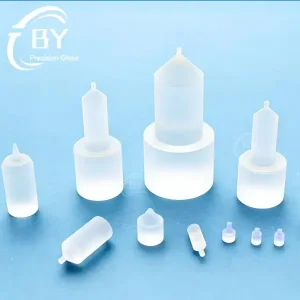
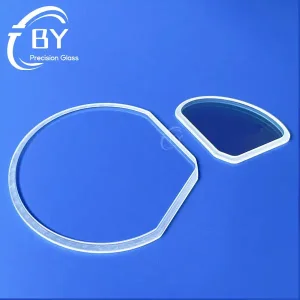
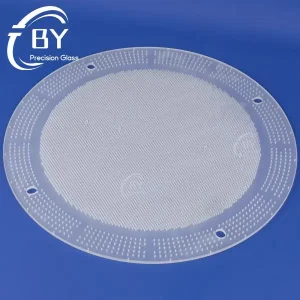
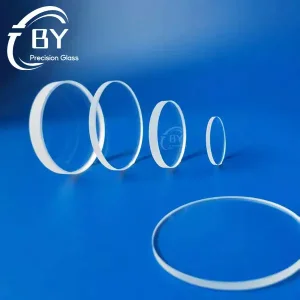
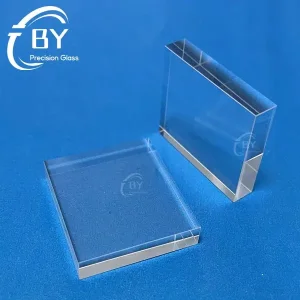
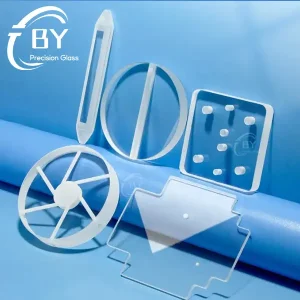
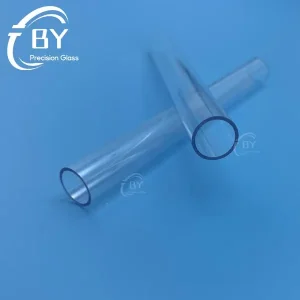
In addition to precision spectrophotometer cuvettes, BY Photonics delivers engineered quartzware, sapphire optics, and laser components to research institutes and factories globally.
Frequently Asked Technical & Sourcing Questions
Key metallurgical, chemical, and metrological considerations addressed by our Senior Optics Processing Engineers.