Precision Optical Substrates & Laser Cavity Components
Explore our foundational range of optical components, specialized laser flow tubes, and quartzware for demanding laser and semiconductor architectures.

High-Power Fiber End Caps: Physics, Power Density & Collimation
Mitigating optical catastrophic damage (COD) and thermal lensing in multikilowatt continuous-wave (CW) and pulsed collimator assemblies.
Beam Expansion Physics
By fusion-splicing an ultra-pure synthetic fused silica end cap to the fiber delivery facet, light expands naturally via numerical aperture divergence inside a bulk index-matched glass body.
- Lowers power density before beam exits to air
- Eliminates catastrophic facet burning at >10 kW
- Protects sensitive fiber core dopants from hydration
Thermal Lensing Suppression
Low OH-content (JGS1 synthetic grade) material guarantees bulk absorption coefficients below 3 ppm/cm at 1064 nm, preserving high beam parameter product (BPP) stability.
- Minimizes focal drift during deep penetration welds
- Mitigates wave-front distortion (WFE < λ/10)
- Enhances thermal dissipation when encased in copper mounts
Interfacial Fusion Purity
Using CO₂ laser splicing or precise oxyhydrogen micro-flame methods, the end cap achieves an atomically continuous splice interface free of interstitial sub-micron voids.
- Splice loss < 0.05 dB across signal channels
- Back-reflection attenuation > 50 dB (with 8° angled cleave)
- Mechanical pull strength > 15 N at splice joint
Engineering Specifications: Fiber End Caps for Collimation
Comprehensive standard tolerances and customizable parameters for QBH, QD, and customized high-power fiber collimators.
| Parameter | Standard Specification | High-Precision Grade | Test & Metrology Validation |
|---|---|---|---|
| Base Material | Synthetic Fused Silica (JGS1) | Corning 7980 / Suprasil 3001 Low-OH | Spectrophotometer Transmission Profile |
| Diameter (OD) Range | 1.0 mm to 15.0 mm (±0.05 mm) | Custom contours (±0.005 mm) | Laser Micrometer non-contact gauge |
| Length Range | 2.0 mm to 50.0 mm (±0.1 mm) | Calculated Rayleigh length (±0.02 mm) | High-accuracy optical comparators |
| Facet Surface Quality | 20-10 Scratch-Dig | 10-5 Scratch-Dig (Laser Grade) | Microscopic darkfield visual inspection |
| Surface Flatness | λ/4 @ 632.8 nm | Up to λ/10 @ 632.8 nm | Zygo Verifire Interferometer |
| Facet Geometry | 0° Flat perpendicular | 8° / custom angle polished facet | Dual-axis goniometric alignment |
| Anti-Reflective Coating | Single band: R < 0.2% @ 1064 nm | Dual-band: 1064 nm + 635 nm pilot | Cavity ring-down spectrophotometry |
| Fiber Compatibility | 100/120 µm, 200/220 µm step index | Large-Mode-Area (LMA) & Triple-clad | Fusion test under real load conditions |
Localized Applications & Heavy Industrial Environments
From automotive EV battery manufacturing hubs to remote shipyard metal fabrication, where reliable collimator end caps safeguard multi-million-dollar lines.
EV Battery Hairpin Welding
Automated gantry welding cells in industrial manufacturing require continuous 4 kW to 8 kW beam delivery without beam center drift. Fiber end caps within collimators ensure zero thermal expansion-induced focus shift across 24/7 battery pack welding shifts.
Ultra-Thick Sheet Laser Cutting
Equipped on 20 kW to 60 kW metal cutting collimation heads. High-durability AR-coated end caps tolerate intense back-reflections during copper and aluminum piercing cycles without facet carbonization or interface decoupling.
Defense & Directed Energy Systems
Coherent beam combination (CBC) and spectral beam combination (SBC) arrays require absolute phase stability. BY Photonics end caps achieve wavefront anomalies below λ/10, maintaining single-mode beam propagation in harsh mobile environments.
Supply Chain Resilience: The Chinese Production Ecosystem
Combining vertically integrated raw synthetic ingot processing, rapid prototyping, and scalable CNC optical polishing.
Vertical Raw Material Sourcing
By partnering directly with domestic ultra-high purity silicon tetrachloride (SiCl₄) synthesis plants, our facility secures uninterrupted supplies of low-hydroxyl, bubble-free synthetic fused silica, mitigating global raw ingot bottlenecks.
In-House Cold & Hot Processing
From high-speed cylindrical grinding and CNC step-contouring to ultrasonic chemical cleaning and cleanroom IAD ion-assisted e-beam coating, our end-to-end line under one roof eliminates transit-induced micro-scratches.
Rapid Delivery & Batch Scalability
Standard diameter blanks (OD 1.0mm, 2.0mm, 3.0mm, 5.0mm) ship within 48 hours for prototyping. Scalable multi-spindle polishing lines handle volume orders of 50,000+ pieces/month with unified process control.
Technology Roadmap: Next-Gen Collimator Optics (2026–2030)
How fiber end cap architectures are evolving to meet 100+ kW CW single-aperture demands, mid-IR wavelengths, and ultrafast femtosecond ablation.
Monolithic Lens-Integrated End Caps
Eliminating downstream collimation lenses entirely. Future end caps feature micro-machined and laser-polished aspheric convex facets directly on the distal end, converting divergent fiber output into a collimated beam in a single fused glass body.
Fluorine-Doped Cladding Jackets
To eliminate cladding modes and stray light heating, advanced capillary jackets with index-matching fluorine dopants strip out cladding radiation before the beam reaches the end cap facet, preventing housing burnouts.
Mid-IR & Thulium Compatibility
With 2 µm thulium fiber lasers rising in plastic welding and medical surgery, modified infrared-grade fused quartz (JGS3 / Suprasil 300) substrates with hydroxyl content < 0.5 ppm are deployed to eliminate OH absorption peaks at 2200 nm.
Localized Engineering Support & International Compliance
Ensuring cross-border OEM integration with comprehensive quality verification, metrology reports, and trade compliance.
Full Lot Traceability
Every delivery batch includes raw material optical spectrometry charts, Zygo surface profile scans, and scratch-dig inspection certificates conforming to ISO 10110 and MIL-PRF-13830B criteria.
Global Engineering Consultations
Our Tianjin technical center collaborates directly with laser R&D groups across North America, Europe, and Asia-Pacific. We provide DFM (Design for Manufacturability) guidance on beam divergence match and fusion splice recipes.
RoHS & REACH Compliance
All quartz and fused silica end caps are chemically inert, mercury-free, and fully certified under European Union RoHS and REACH directives, packed in Class 100 cleanroom environments ready for vacuum assembly.
Frequently Asked Questions
Answers to common questions regarding splicing compatibility, coating parameters, and wholesale ordering.
Why is synthetic fused silica (JGS1) mandatory for high-power fiber end caps?
What is the recommended end cap diameter-to-length ratio for fiber collimators?
Can you provide custom angled facets (e.g., 8° cleave/polish)?
How do you clean and package fiber end caps for overseas export?
Featured Optical Components & Industrial Quartz Solutions
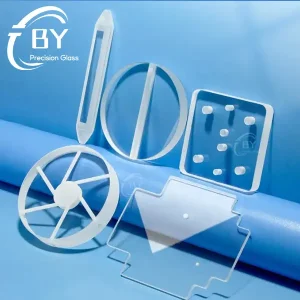
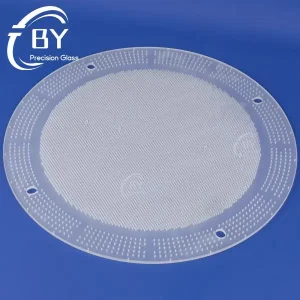
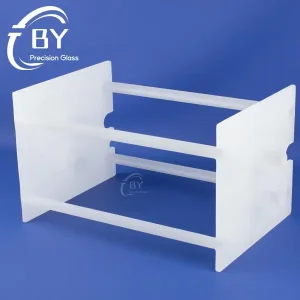
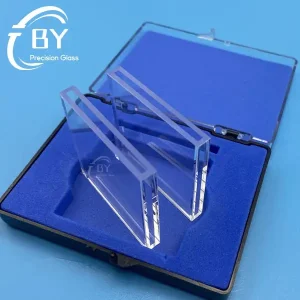
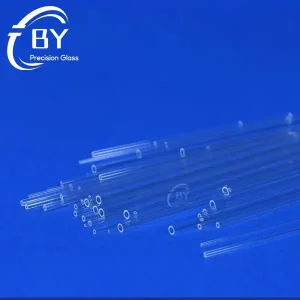
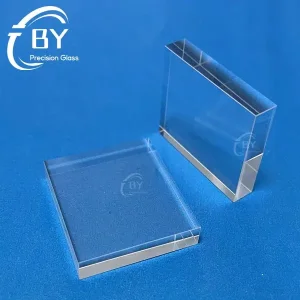
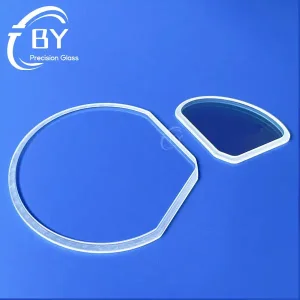
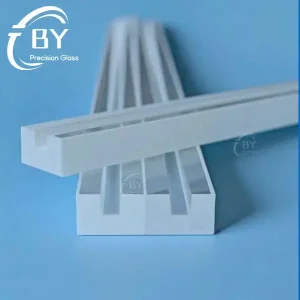
Explore our complete manufacturing series, covering vacuum plates, capillary tubing, aesthetic light guides, and precision quartz tooling.