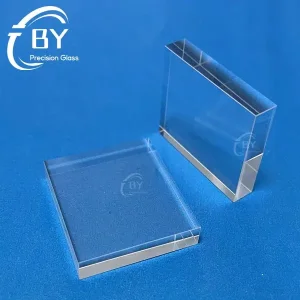
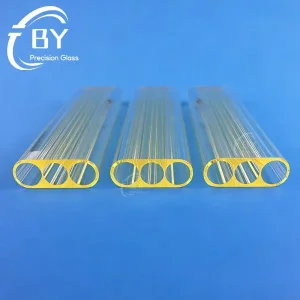
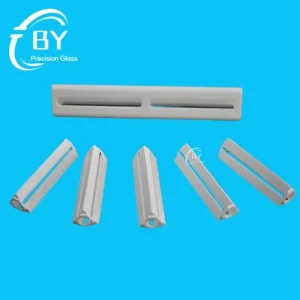
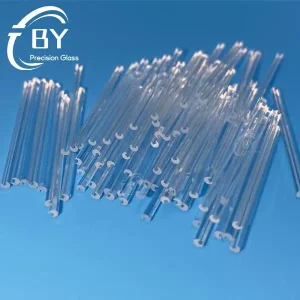
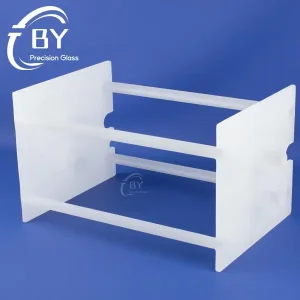
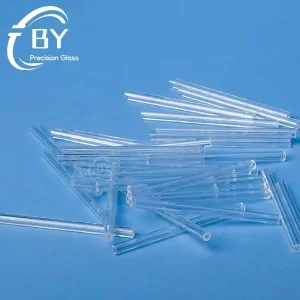
Featured Microscopic Quartz Components & Assemblies
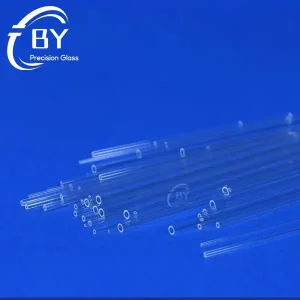
Explore our core batch-manufactured fused quartz capillaries, flow channels, and UV-absorbing optical elements engineered for nanoscale fluidics and laser cavity systems.

Microscopic Quartz Capillaries: Emerging Frontiers & Industry Trends
From single-cell genomic sequencing to deep-ultraviolet lithography fluid metering, quartz capillaries have transitioned from passive fluid conduits into high-precision micro-photonic and electrokinetic core components.
Next-Gen Microfluidics & Lab-on-a-Chip
Modern microfluidic platforms demand sub-micron inner diameter (ID) repeatability. High-purity synthetic fused silica (JGS1) provides ultra-low background autofluorescence and an pristine surface finish, preventing biomolecular non-specific absorption during capillary electrophoresis (CE) and digital PCR droplet production.
Optofluidic & Waveguide Integration
By engineering fluorine-doped quartz cladding or customized multi-bore capillary cross-sections, researchers integrate liquid waveguides directly with microscopic sensing. Light and analyte travel concurrently through the micro-channel, amplifying Raman and absorbance signals by orders of magnitude.
Extreme Environment Sensor Sleeves
With resistance exceeding 1,100 °C and an exceptionally low thermal expansion coefficient (5.5 × 10⁻⁷ /°C), synthetic quartz capillaries serve as ultra-resilient protective sleeves for Fiber Bragg Grating (FBG) temperature and pressure transducers deployed in aerospace engines and deep geothermal wells.
Global Enterprise Procurement Demands & Industrial Realities
Optical instrument OEMs, life-science diagnostic conglomerates, and semiconductor toolbuilders face stringent technical bottlenecks when procuring quartz capillaries at scale.
Zero-Blemish Bore Concentricity
In high-throughput flow cytometry and automated capillary electrophoresis arrays, any eccentricity across internal diameters causes flow turbulence and misaligned optical focus. OEMs now demand strict concentricity within ±1.5 µm across meter-length draws.
Chemical Purity & Bio-Inertness
Trace alkali metals (Fe, Al, Ti, Na) catalyze background luminescence and distort mass spectrometer baseline readouts. High-volume buyers require traceable raw material certification guaranteeing elemental contamination levels below single-digit parts per billion (ppb).
Integrated Downstream Machining
Procuring raw capillary tubing is no longer sufficient. Enterprise procurement managers increasingly seek single-source suppliers capable of secondary operations: clean precision laser cleaving, optical end-face polishing, flame sealing, and metallized exterior coatings.
| Material Classification | Transmission Bandwidth | Hydroxyl (OH⁻) Content | Microscopic Working Attributes | Strategic Industrial Use-Cases |
|---|---|---|---|---|
| JGS1 Synthetic Fused Silica | 185 nm – 2,500 nm | < 5 ppm to 1200 ppm (Grade dep.) | Nil autofluorescence, exceptional DUV transmission | Micro-spectroscopy, DNA sequencing, capillary electrophoresis |
| JGS2 Fused Quartz | 220 nm – 2,500 nm | ~30 – 150 ppm | High mechanical strength, thermal shock resilience | Laser flow cooling jackets, industrial sensor sleeves |
| JGS3 Fused Silica (Low OH) | 260 nm – 3,500 nm | < 5 ppm | Suppressed absorption bands at 1.38 µm, 2.2 µm, 2.7 µm | Mid-IR fiber optics, micro-gas sensing capillaries |
| Fluorine-Doped Silica | 200 nm – 2,100 nm | Controlled dopant profile | Lower refractive index than pure quartz core | Liquid core optical waveguides, optofluidic total internal reflection |
| Cerium / Samarium Doped | Selective cut-off filtering | Custom alloy mix | Selective absorption of 1064nm parasitic oscillation / 400nm UV | Laser cavity protection, solid-state pump chamber cooling |
China Factory 4.0: Supply Chain Resilience & Micro-Machining Precision
Combining raw ingot syntheses, high-tower micro-drawing furnaces, and precision five-axis CNC machining under one roof in Tianjin, China to deliver unmatched manufacturing scalability and cost efficiency.
Vertical Cost Control
By bypassing multiple subcontractor tiers and conducting raw material pulling, flame welding, and sub-micron lapping within an integrated facility, production overhead drops by 25-40% compared to Western counterparts.
In-Line Laser Interferometry
Our redrawing lines operate continuous real-time multi-axis laser micrometer gauge heads. Geometric variances trigger automatic micro-feed stepper motors to guarantee ±0.002 mm wall consistency on high-volume runs.
Rigid Cleanroom QA
Capillary processing, ultrasonic acid wash, deionized solvent rinsing, and vacuum packaging occur in Class 1,000 / ISO 6 cleanrooms to eliminate organic contaminants, particulates, and micro-crystallization nuclei.
Rapid DFM & Customization
Equipped with specialized diamond grinding equipment and oxyhydrogen lathe stations, we turn around custom pre-series prototypes in 7–10 business days, expediting client NPI (New Product Introduction) cycles.
Localized Industrial & Laboratory Application Scenarios
Specific field implementations of micro-capillaries across demanding industrial, scientific, and clinical ecosystems worldwide.
Gas Chromatography & Mass Spectrometry (GC-MS)
Micro-bore quartz capillaries serve as transfer lines and retention-gap tubes. Their structural stability up to 450 °C under polyimide coatings and chemical non-reactivity ensure ghost-peak-free baseline profiles for volatile environmental sample analysis.
Semiconductor Photolithography Cooling
In high-power excimer DUV lithography scanners (operating at 193 nm ArF and 248 nm KrF), custom thin-walled multi-lumen quartz capillary conduits circulate hyper-pure coolant directly adjacent to optical components without photochemical degradation.
Single-Cell Microinjection & Patch Clamp
Capillary blanks drawn down to sub-micron tips under micropipette pullers enable electrophysiological cell membrane measurements and intracellular gene payload injection with minimal cellular structural trauma.
Frequently Asked Questions (FAQ) for Engineering & Sourcing
Authoritative technical answers to common engineering questions encountered during micro-quartz capillary procurement, fabrication, and system integration.
Comprehensive Quartz, Sapphire & Laser Cavity Components
Complementary precision products engineered to OEM specifications, including diffuse reflectors, sapphire light guides, laser flow tubes, and semiconductor diffusion tooling.