
High-Performance Optical, Laser & Flowtube Assemblies
Custom-machined borosilicate, fused quartz, and technical ceramics fabricated to drawing specifications. Explore our prime catalog units manufactured under strict cleanroom conditions.
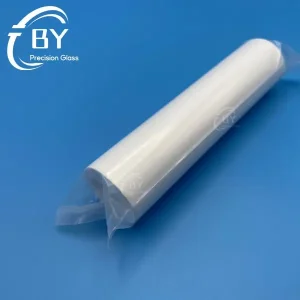
Candela VBeam Laser 6" White Cavity Ceramic Reflector (2 Pk)
Configure Component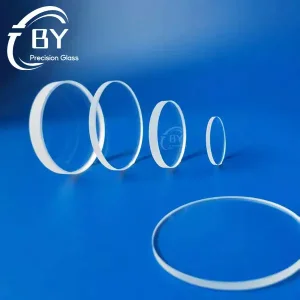
Quartz Optical Windows for Semiconductor Lithography Equipment
Configure Component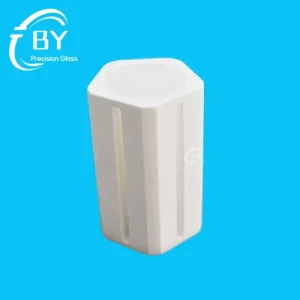
Diffuse High-Reflectivity PTFE Reflectors for Diode-Pumping
Configure Component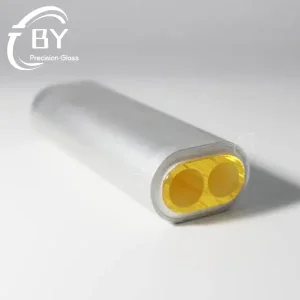
Custom Packed Laser Cavity Flowtubes for Laser Head Systems
Configure Component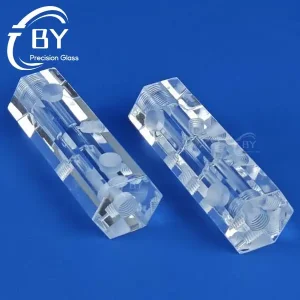
High-Quality Custom Fabrication of Quartz Precision Components
Configure Component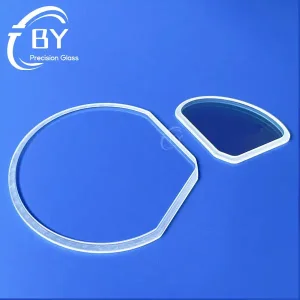
Sapphire Viewing Plates for Severe Harsh Chemical Media
Configure Component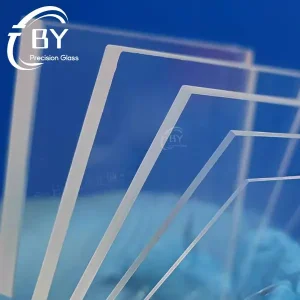
Borosilicate Windows and Ground Plates for Industrial Viewports
Configure Component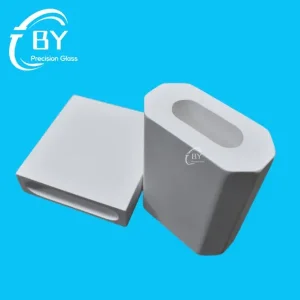
Diffuse Reflectors Made of Spectralon-Grade PTFE for Cavities
Configure ComponentMacro Commercial Dynamics & Global Supply Chain Evolution
A technical assessment of modern borosilicate 3.3 glass tube production, supply security, regulatory requirements, and international trade benchmarks.
Global Market Valuation & Drivers
The global precision borosilicate glass tube market is witnessing a steady CAGR of 6.8% through 2032. Growth is fueled by increasing biopharmaceutical drug formulation, expansion in solar thermal collectors, analytical instrument miniaturization, and micro-capillary flow cell adoption across genomics and point-of-care diagnostics.
Material Supply & Raw Mineral Economics
Borosilicate 3.3 contains approximately 81% SiO₂, 13% B₂O₃, and 4% Na₂O/K₂O. Escalating purity constraints require refining feedstocks to parts-per-billion transition metal thresholds (Fe < 10 ppm) to safeguard ultra-violet to near-infrared transmittance curves and suppress solarization under intense optical irradiation.
Stringent Compliance & Pharmacopeia
Tier-1 OEMs demand strict adherence to DIN ISO 3585 (3.3 expansion borosilicate glass) alongside Type I Class A hydrolytic resistance according to ISO 719 / ISO 720. In microfluidics and laser cooling assemblies, our manufacturing processes guarantee zero chemical leaching, minimal surface alkalinity, and certified traceability.
High-Precision Redrawing, Calibration & Thermal Stress Relief
Combining primary melting furnace control with secondary down-draw capillary redrawing and CNC cold-working in Tianjin, China since 2010.
Vello & Danner Tubing Draw
Initial mother tubing is drawn using precision Vello down-draw or Danner rotary mandrel technology. Continuous non-contact optical laser micrometers monitor outside diameter and wall thickness at high scanning frequencies (500 Hz), mitigating dimensional drift across long pull batches.
Vertical Capillary Redrawing
For custom micro-bore tubing, optical flow cells, and precision ferrules, larger parent tubes are vertically redrawn through induction-heated micro-zones. This yields internal diameters (ID) down to 5 microns while holding wall concentricity within <1.5% total runout.
Fire-Polishing & CNC Grinding
Tube ends undergo diamond abrasive wheel saw cutting, chamfering, and controlled oxy-hydrogen flame-polishing. Micro-cracks are sealed without warping the internal diameter, ensuring high burst pressure and smooth laminar flow for fluidic systems.
Annealing & Stress Birefringence
All finished borosilicate tubes pass through computer-regulated continuous lehr ovens, dwelling at 560°C before a slow cooling descent. Residual optical birefringence is evaluated with circular polariscopes to maintain stress below 3.0 nm/mm, avoiding spontaneous mechanical failure.
Technical Benchmark: Borosilicate 3.3 vs Alternative Glass Classes
Comprehensive data sheet comparing thermodynamic, optical, and mechanical attributes across high-performance substrate families processed at Tianjin BY Photonics.
| Property Parameter | Borosilicate 3.3 (Standard) | JGS1 UV Synthetic Silica | JGS2 / JGS3 Fused Quartz | Sapphire (Single Crystal Al₂O₃) |
|---|---|---|---|---|
| Coefficient of Expansion (CTE) | 3.3 × 10⁻⁶ / K | 0.54 × 10⁻⁶ / K | 0.55 × 10⁻⁶ / K | 5.8 × 10⁻⁶ / K (Parallel) |
| Optical Spectral Range | 310 nm – 2,500 nm | 185 nm – 2,500 nm | 220 nm – 3,500 nm | 170 nm – 5,500 nm |
| Softening Point (10⁷.⁶ dPa·s) | 825 °C | 1,730 °C | 1,680 °C | 2,050 °C (Melting) |
| Annealing Point | 560 °C | 1,180 °C | 1,120 °C | N/A (Crystalline) |
| Refractive Index ($n_d$, 587.6 nm) | 1.473 | 1.458 | 1.458 | 1.768 |
| Density (g/cm³) | 2.23 | 2.20 | 2.20 | 3.98 |
| Hydrolytic Resistance (ISO 719) | Class HGB 1 | Class HGB 1 | Class HGB 1 | Chemically Inert |
| Dielectric Constant ($\epsilon$, 1 MHz) | 4.6 | 3.75 | 3.75 | 9.3 – 11.5 |
| Relative Cost Index | Economic / High Batch | High / Laser Grade | Medium-High | Very High / Premium |
Turnkey Solutions Engineered for High-Stress Environments
From aerospace telemetry and flashlamp cooling to microfluidic genomics, our precision borosilicate glass tubes eliminate process variance.
Diagnostics & Bio-Fluidics
Integrated as capillary tubes in Sanger sequencing, capillary electrophoresis (CE), HPLC detection cells, and automated blood analyzers. Hydrolytic Class 1 resistance eliminates leaching, preserving enzyme assay integrity and ensuring pristine laminar sample flow.
Laser Flow Tubes & Jackets
Employed as deionized water cooling sleeves for Nd:YAG, pulsed dye, and Alexandrite laser resonators. Available with Samarium-doped glass (Sm³⁺) or cerium-doping to absorb parasitic 1064 nm amplified spontaneous emission (ASE) and block solarizing ultraviolet lines.
Semiconductor & Vacuum Viewports
Serving as gas transport tubes, pyrometer viewports, and ozone-generation envelopes in PECVD and ALD tooling. Zero gas outgassing under high vacuum and dimensional stability up to 500°C safeguard process chamber purity.
Chemical & Petrochemical Sight Glass
Engineered for high-pressure boiler level gauges, corrosive acid sight flow indicators, and distillation columns. Highly resistant to water, neutral salts, and concentrated acids (save hydrofluoric and hot phosphoric acid).
Technology Roadmap: The Next Era of Precision Tubing (2025–2032)
BY Photonics continuously innovates its glassworking infrastructure. Here is how we are addressing the next generation of extreme-precision engineering requirements.
Sub-Micron Laser Redrawing
Deployment of real-time dual-axis interferometric feedback systems on redrawing lines, narrowing standard capillary inner-diameter dimensional variance from ±0.01 mm to an unprecedented ±0.002 mm across production batches.
Oxy-Hydrogen Hybrid Melting
Complete transformation of our Tianjin annealing and hot-forming operations to clean oxy-hydrogen torches, eliminating carbon micro-particulates and improving bubble/inclusion ratings according to ISO 10110-3.
Thin-Film Internal Coatings
Developing internal-bore Atomic Layer Deposition (ALD) for borosilicate tubing, enabling oleophobic, anti-reflective, and chemically passivated inner linings without restricting small capillary flow diameters.
Machine-Vision Defect Screening
Integration of AI-driven deep learning inspection stations capable of 360-degree axial scanning for seeds, cords, stones, and micro-stress cracks down to 10-micron defect detection thresholds.
Engineering Questions & Procurement Insights (FAQ)
Authoritative answers addressing chemical composition, pressure ratings, cutting tolerances, and custom prototype turnaround times.
What is the maximum thermal shock resistance of Borosilicate 3.3 tubes?
Precision borosilicate 3.3 exhibits a thermal shock resistance ($\Delta T$) ranging between 100 K and 150 K depending on wall thickness. Because of its extremely low coefficient of thermal expansion (3.3 × 10⁻⁶/K), it withstands rapid water quenching from 150°C without crack propagation, unlike soda-lime glass which typically fails at $\Delta T > 50$ K.
Can you manufacture non-circular or multi-lumen borosilicate capillary tubes?
Yes. BY Photonics specializes in redrawing square, rectangular, D-shape, hexagonal, and multi-bore (2 to 7 lumens) capillary tubing. By precision-machining the parent preform on 5-axis CNC equipment prior to hot drawing, the cross-sectional geometry is geometrically replicated down to micron-scale channels.
How do you calculate bursting pressure ratings for borosilicate glass tubes?
Bursting pressure ($P$) is governed by Barlow’s formula: $P = (2 \cdot K \cdot S) / (OD)$, where $K$ is the design tensile stress (typically 7 MPa for annealed borosilicate with safety factors), $S$ is wall thickness, and $OD$ is outer diameter. For critical high-pressure viewports, we perform 100% hydrostatic proof testing up to 1.5× rated operating pressure.
What end-finishing options are available for wholesale tubing orders?
We supply tube ends as saw-cut (with or without edge bevel), precision flat-ground and diamond lapped ($Ra < 0.4\ \mu\text{m}$), fire-polished for round, chip-free rims, or flange-formed and threaded for direct assembly into DIN/ISO vacuum couplings and Swagelok fluid fittings.
Semiconductor Quartzware, Optics & Micro-Capillaries
Explore our companion product categories fabricated in parallel at our Tianjin glassmaking plant to support end-to-end electro-optic systems.
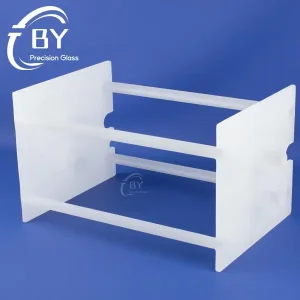
Quartz Diffusion Boat for High-Purity Semiconductor Furnaces
Configure Component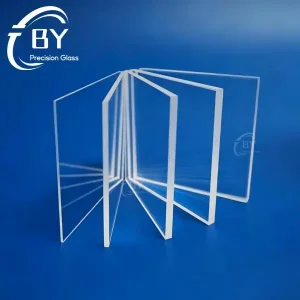
JGS1 Ultraviolet (UV) Grade Synthetic Fused Silica Plates
Configure Component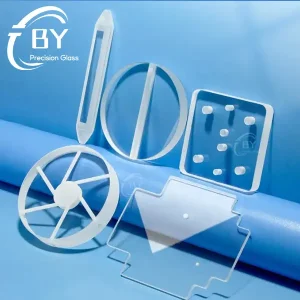
High Temperature Custom Quartz Glass Furnace Fabrication
Configure Component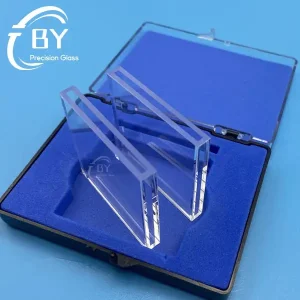
Custom Precision Quartz Cuvette for Spectrophotometer Cells
Configure Component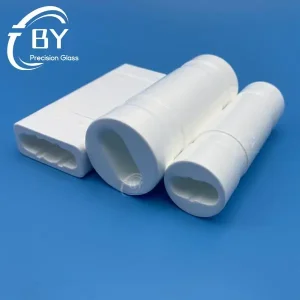
Diffuse Ceramics Reflectors for Semiconductor Solid Lasers
Configure Component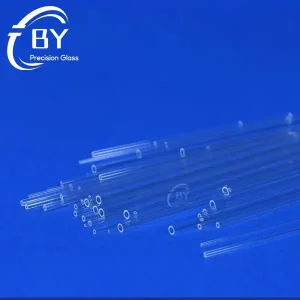
Fluorine-Doped Low-Refractive Fused Silica Capillary Tube
Configure Component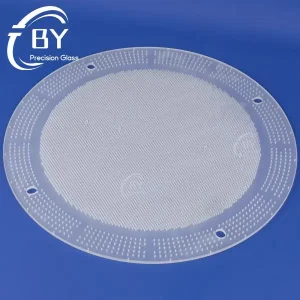
Custom High-Purity Optical Quartz Gas Distribution Plates
Configure Component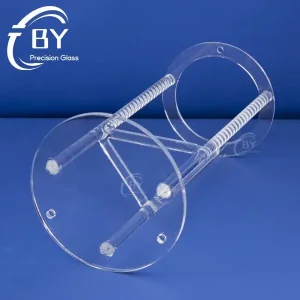
Quartz Wafer Carriers & Cassettes for Semiconductor Wet Clean
Configure ComponentRequest Custom Engineering DFM & Wholesale Quotations
Submit your CAD, STEP, DXF, or dimensioned PDF drawings. Our engineering desk in Tianjin returns a comprehensive Design-for-Manufacturability (DFM) assessment, material test certificates, and batch volume pricing within 24 working hours.