High-Precision Optical & Glass Components
Engineered cold/hot worked quartz, synthetic fused silica, and borosilicate components machined to tight drawing tolerances.


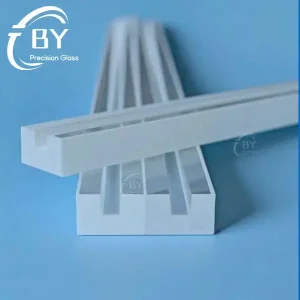
Precision Geometric Physics of Rectangle Glass Capillary Tubing
Overcoming optical aberration, fluid hydrodynamic boundary layers, and thermal expansion mismatch in high-aspect-ratio capillary conduits.
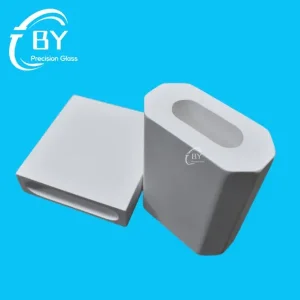
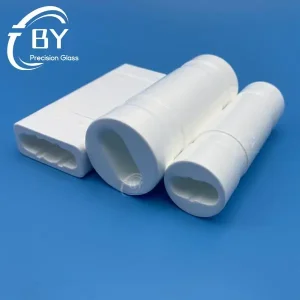
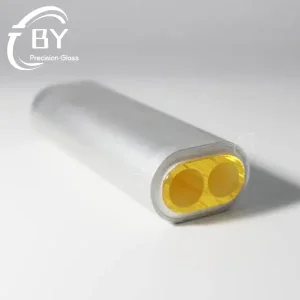
In modern analytical diagnostics, optofluidics, and high-frequency telecommunications, cylindrical micro-tubing often encounters severe operational ceilings. The natural curved boundary of a standard circular glass capillary functions as a cylindrical lens, inducing cylindrical wavefront deformation, uncontrolled light refractions, and optical astigmatism. This curvature fundamentally restricts signal resolution in spectrophotometric detection, flow cytometry fluorescence interrogation, and high-resolution microscopy imaging. Precision rectangle glass capillary tubes eliminate radial lens aberrations by presenting parallel planar interfaces perpendicular to optical inspection axes.
Beyond optical advantages, rectangle and square cross-section capillary architectures provide planar fluid dynamic profiles. Unlike circular cross-sections where parabolic shear strain varies evenly along the radius, a rectangular bore provides a broad, planar laminar flow channel with consistent path-length geometry. This predictable depth-to-width ratio is vital for single-cell sorting, real-time electrophoresis analysis, high-throughput capillary isoelectric focusing, and on-chip DNA sequencing platforms.
Producing precise rectangular micro-bores requires exact heat management during thermal redrawing. Any localized temperature gradient in the oxyhydrogen furnace leads to corner deformation or wall sagging. BY Photonics maintains aspect ratio dimensional stability through closed-loop laser gauge monitoring across orthogonal axes, holding outer and inner bore tolerances down to ±0.003 mm.
Planar Optical Coupling
Flat external and internal walls allow direct, perpendicular laser excitation and signal capture without the spherical aberrations caused by circular tubes.
High Thermal Shock Threshold
Fabricated using high-purity synthetic silica (JGS1) and clear fused quartz (JGS2), retaining geometric integrity up to 1,100 °C under rapid thermal cycling.
Sub-Micron Channel Accuracy
Multi-step down-drawing processes controlled by multi-axis real-time laser diffraction benches eliminate inner bore micro-tapering and axial wall variation.
Why Tier-1 Global OEMs Source Custom Capillaries From Tianjin BY Photonics
Combining primary synthetic raw material refinement, automated down-draw towers, and precision cold finishing within one certified facility.
Direct Feedstock Control
Direct supply lines for synthetic silicon tetrachloride precursors (JGS1) and refined natural crystal quartz eliminate intermediate markups, securing batch-to-batch stability and stable pricing.
In-House Tooling & Drawing Towers
Proprietary vertical drawing towers with servo-regulated feed mechanisms allow agile changeovers between rectangular, square, multi-bore, and customized cross-sectional forms.
Integrated Annealing Cycles
Thermal stress relief protocols eliminate birefringence patterns and residual hoop tension, guaranteeing clean cleaving and crack-free dice cutting during high-speed downstream assembly.
Export-Grade Cleanroom Packing
Ultrasonic cleaning in Class 10,000 cleanrooms, vacuum de-ionized packaging, and custom-molded anti-vibration cassettes prevent shipping micro-fractures during worldwide transport.
Substrate Properties: Synthetic Silica, Fused Quartz & Borosilicate
Compare spectral transmission, thermal limits, and mechanical durability to select the right material for your application.
| Material Designation | Spectral Window | Thermal Expansion (CTE) | Softening Point | Chemical Resistance | Primary Industrial Use |
|---|---|---|---|---|---|
| JGS1 UV Synthetic Fused Silica | 185 nm – 2,500 nm | 5.5 × 10⁻⁷ / °C | 1,683 °C | Hydrofluoric acid excepted; extreme acid/alkali tolerance | Deep-UV capillary electrophoresis, high-power laser fluidics |
| JGS2 Optical Fused Quartz | 220 nm – 2,500 nm | 5.4 × 10⁻⁷ / °C | 1,665 °C | High resistance to neutral and acidic environments | Industrial flow cells, thermal sensor sheaths, sight glasses |
| JGS3 Low-OH Infrared Quartz | 260 nm – 3,500 nm | 5.5 × 10⁻⁷ / °C | 1,670 °C | Zero water absorption; resistant to corrosive dry gas | Infrared absorption spectroscopy, gas analysis chambers |
| Borosilicate 3.3 Glass | 350 nm – 2,500 nm | 3.3 × 10⁻⁶ / °C | 820 °C | Class 1 hydrolytic and acid resistance (ISO 719/720) | General clinical fluidics, chromatography, disposable OEM cells |
| Optical Sapphire (Al₂O₃) | 170 nm – 5,500 nm | 5.8 × 10⁻⁶ / °C | 2,040 °C | Completely inert to virtually all acids, alkalis, and solvents | Ultra-high-pressure HPLC, abrasive slurries, plasma viewports |
Addressing Critical Technical Roadblocks Across Global Industries
How customized rectangular glass capillary configurations drive modern instrumentation and medical innovations.
Next-Gen Genomics & Cytometry
By shifting from circular flow capillaries to custom rectangular capillary channels, automated flow cytometers avoid lens-induced signal spread. Flat internal channels align cells uniformly along the optical path, improving single-cell fluorescence detection sensitivity.
Micro-Optic Fiber Couplers & Waveguides
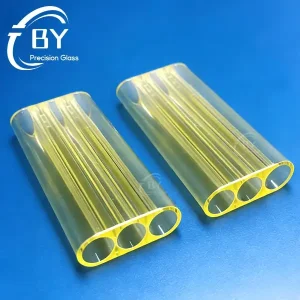
Multi-bore and high-aspect rectangular capillaries function as precision alignment sleeves for ribbon fibers, micro-prism assemblies, and planar lightwave circuits (PLC). Tight corner radii prevent adhesive pooling and protect fiber cladding integrity.
High-Pressure Semiconductor Chromatography
Modern micro-bore HPLC equipment demands tubes capable of withstanding operating pressures above 15,000 psi without structural micro-fissuring. BY Photonics provides precision fire-polished borosilicate and fused quartz channels that maintain laminar fluid profiles under high shear loads.
Engineering & Wholesale Procurement Inquiries
Key information regarding tolerances, material testing certificates, packaging standards, and custom manufacturing runs.
What dimensional tolerances can you hold on custom rectangular bores?
Can you manufacture rectangular tubes with optical polished outer faces?
How do you clean and package capillary tubes for international transit?
What is the typical Minimum Order Quantity (MOQ) and sample lead time?
Do you supply full material traceability and inspection reports?
Can rectangular capillary tubes be diced or cleaved to short lengths?
High-Performance Quartz, Optical & Ceramic Solutions
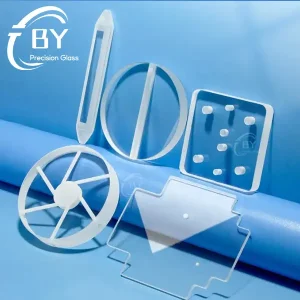
Explore our specialized range of laser reflectors, gas distribution plates, IPL components, and doped laser glass parts.