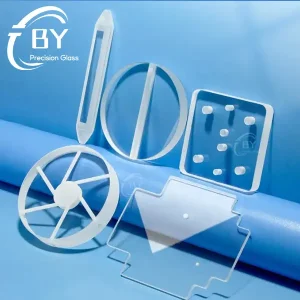
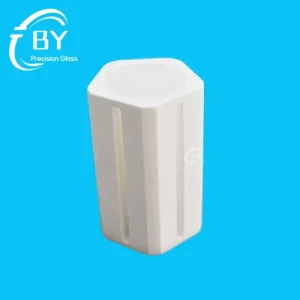
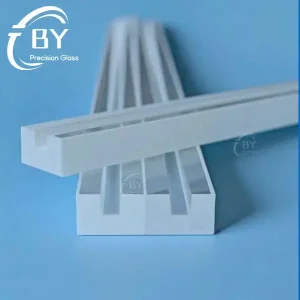
Precision Laser Cavity Components & Engineering Glassware
Explore our manufactured optical sub-assemblies, engineered for long optical lifespans, zero thermal degradation, and seamless OEM retrofit integration.
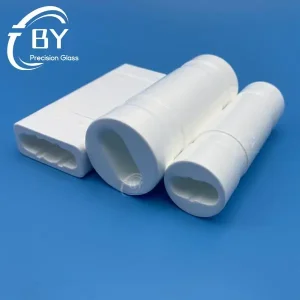
Engineering Physics: Yellow Glazed Ceramic Laser Reflectors
A comprehensive technical analysis of diffuse ceramic cavities, selective yellow glaze filtering, and thermal boundary mitigation in high-fluence flashlamp-pumped systems.
In lamp-pumped solid-state laser (LPSSL) physics, pump energy conversion efficiency and thermal management within the optical resonant cavity dictate system performance, pulse stability, and the operational lifespan of the laser gain medium. Traditional laser pump cavities relied extensively on specular polished metallic reflectors, notably gold-plated brass or aluminum chambers. However, metallic specular reflectors suffer from inherent physical vulnerabilities: catastrophic delamination of electroplated coatings under continuous turbulent coolant flow, localized thermal focal hot spots on laser rods, electrochemical galvanic oxidation, and total reflectance degradation across shorter optical bands.
The introduction of porous alumina (Al2O3) diffuse ceramic reflectors revolutionized solid-state cavity engineering. By utilizing high-purity (≥99.7%) synthetic alumina sintered under tightly controlled sub-micron atmospheres, diffuse ceramic cavities produce Lambertian scattering. Light bouncing within the chamber undergoes thousands of random microscopic internal reflections before hitting the laser rod, establishing an exceptionally homogeneous spatial photon distribution across the cross-section of the gain crystal.
The Crucial Role of the Doped Yellow Ceramic Glaze
While white diffuse ceramics exhibit diffuse reflectance exceeding 98% across the broad 500 nm to 2000 nm spectrum, raw unglazed or pure white ceramics exhibit severe operational limitations in high-power flashlamp-pumped systems (such as xenon or krypton arc discharge lamps):
- Uncontrolled UV Radiation & Solarization: Xenon flashlamps emit intensely in the harmful deep ultraviolet (<380 nm) and blue spectral bands. When high-energy UV photons strike solid-state laser crystals such as Nd:YAG, Cr:Tm:Ho:YAG, or Alexandrite (BeAl2O4:Cr3+), they induce color centers ("solarization"), creating irreversible crystal darkening, increased passive absorption, and thermal lensing that permanently degrades laser beam quality.
- Suppression of Parasitic Thermal Lens Effect: Laser rods have specific absorption pump bands (e.g., Nd:YAG primarily absorbs near 580 nm, 730-760 nm, and 800-820 nm). Pumping the rod with shorter wavelength radiation generates extreme heat deposition without producing laser inversion, exacerbating thermal lensing and birefringence.
- Porous Coolant Erosion & Contamination: Porous structural ceramics directly exposed to deionized (DI) cooling water trap micro-bubbles, mineral ions, and organic residues inside their pores, creating optical attenuation and bacterial bio-fouling.
To resolve these interrelated optical and fluid-dynamic bottlenecks, precision manufacturers engineer a proprietary Yellow Glazed Ceramic Cavity Reflector. By fusing a rare-earth/transition-metal doped ceramic glaze over the optical active zone at temperatures between 1,200°C and 1,350°C, a glassified, pore-free, hydraulically sealed barrier is established. This yellow glaze functions as a precise high-attenuation edge filter: it completely absorbs wavelengths below ~450 nm while maintaining supreme diffuse reflectance (>97%) throughout the critical pump bands (550 nm – 1,100 nm).
Engineering Comparative Evaluation Matrix
Quantitative performance comparison between yellow glazed ceramics and alternative solid-state laser pump cavity configurations.
| Evaluation Parameter | Yellow Glazed Alumina Ceramic | Standard White Ceramic (Unglazed) | Gold-Plated Metal Cavity | PTFE (Spectralon-grade) Diffuse |
|---|---|---|---|---|
| Reflectance @ 600–1000nm | 97.5% – 98.5% (Diffuse) | 98.5% – 99.2% (Diffuse) | 94.0% – 96.5% (Specular) | 99.0% – 99.5% (Diffuse) |
| UV Filtering Functionality | Selective Absorption (<450nm) | None (Passes or scatters UV) | None (High UV absorption / degrades) | None (No spectral selectivity) |
| Solarization Prevention | Integrated (No flow filter needed) | Requires doped glass sleeve | Requires auxiliary optical filter | Requires auxiliary optical filter |
| Cooling Liquid Resistance | Immune to erosion & chemical scaling | Porous; absorbs ions and bio-sludge | Plating flakes under micro-cavitation | Deforms under pressure; micro-void leaks |
| Operating Temperature Limit | >1,100 °C (Ultra-high stability) | >1,200 °C (Brittle, unsealed) | ~350 °C (Gold layer peel risk) | ~260 °C (Melting / creep threshold) |
| Mechanical Tolerances | Sub-micron diamond grinding | Post-sinter diamond grinding | High precision CNC milling | Subject to thermal creep/relaxation |
| Service Maintenance Cycle | Longest (Zero coating peel) | Medium (Requires chemical cleaning) | Short (Frequent recoating required) | Medium (Susceptible to surface scorch) |
Controlled Spectral Attenuation
The specialized yellow glaze formulas incorporate precisely calculated oxides that create a sharp optical cutoff edge at ~450 nm, neutralizing high-energy UV radiation while preserving 98% efficiency across Nd:YAG absorption valleys.
- Eliminates need for costly samarium glass sleeves
- Suppresses core laser crystal solarization
- Mitigates thermal stress gradients in the laser rod
Hydraulic Sealing & Chemical Inertness
By vitrifying the inner cavity wall into an impermeable glass layer, cooling water cannot penetrate the porous alumina bulk, preventing corrosion, coolant turbidity, and bio-growth across high-pulse duty cycles.
- Tested against deionized water erosion up to 50 psi
- Impervious to thermal shock cycling (20°C to 120°C)
- Zero leaching of heavy metal contaminants
Dimensional Stability Under High Fluence
Unlike metallic housings that suffer from thermal expansion mismatch, structural alumina exhibits a thermal expansion coefficient matching optical quartz flow tubes, maintaining optical alignment under multi-kilowatt pumping.
- Coefficient of thermal expansion: 7.2–8.4 × 10⁻⁶/K
- Compressive strength exceeding 2,000 MPa
- Maintains bore alignment within ±0.015 mm
China Factory 4.0: Supply Chain Resilience & Precision Engineering
Inside Tianjin BY Photonics: Combining vertical material processing, robotic glaze application, and computerized optical verification under one roof.
Global laser OEMs, clinical device manufacturers, and optoelectronic integrators face volatile procurement cycles, unpredictable lead times, and extreme quality variations from decentralized subcontracting networks. BY Photonics addresses these supply chain friction points by integrating every phase of laser ceramic reflector fabrication inside a single ISO 9001:2015-certified smart manufacturing complex in Tianjin, China.
Isostatic Cold Pressing & High-Temp Sintering
Our raw synthetic alumina powder (≥99.7% Al2O3) undergoes wet isostatic pressing at >250 MPa, eliminating micro-void density gradients. Multi-zone electric kilns bake raw blanks at 1,700°C with automated atmosphere regulation, achieving optimal bulk density (3.1–3.3 g/cm³) and microscopic pore uniformity for Lambertian scattering.
5-Axis CNC Ultrasonic Diamond Machining
Structural laser ceramics possess extreme hardness (Mohs 9). BY Photonics deploys rigid 5-axis CNC ultrasonic-assisted milling and diamond jig grinding. We maintain bore-to-bore parallelism within 0.02 mm and outer reference tolerances within ±0.015 mm, ensuring direct drop-in alignment with OEM flashlamp holders and crystal mountings.
Robotic Glazing & Spectrophotometric Metrology
Automated robotic fluid dipping guarantees uniform yellow glaze film thickness (40–60 µm) across irregular multi-bore geometries, preventing optical pooling or raw edges. Every production lot undergoes diffuse reflectance spectrophotometry, CMM dimensional verification, and thermal shock integrity tests before shipment.
Global Commercial & Localized Application Scenarios
From high-volume aesthetic dermatology platforms to defense laser rangefinders and micro-machining workstations.
Medical Aesthetic Laser Systems
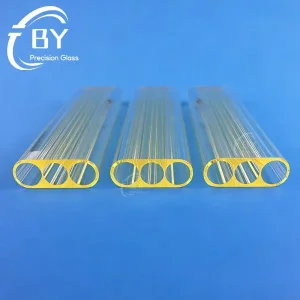
In dermatology platforms (e.g., Candela GentleLase, GentleMax Pro, Cynosure, Lutronic), yellow glazed ceramic cavities (such as Triple Bore configurations) house dual flashlamps and an Alexandrite (755 nm) or Nd:YAG (1064 nm) crystal rod. The yellow glaze prevents lamp UV emission from solarizing expensive Alexandrite rods, maintaining energy output across millions of pulses.
Industrial Laser Welding & Additive Manufacturing
Pulsed solid-state laser welders and cladding engines rely on high-energy flashlamps running at continuous duty cycles. Yellow glazed ceramic pump chambers withstand thermal shocks, turbulent cooling water, and mechanical vibration, delivering uniform beam quality for seam welding in battery and automotive manufacturing.
Defense, Avionics & LIDAR Rangefinding
Aerospace and military target designators operate across extreme temperature gradients (-40°C to +85°C). Monolithic yellow glazed ceramics exhibit negligible thermal expansion, zero risk of metallic plating flake-off, and absolute resistance to high shock loads, guaranteeing mission-critical optical integrity.
Semiconductor Wafer Processing & Inspection
Deep-UV and harmonic solid-state lasers utilized in lithography metrology and wafer dicing demand ultra-clean resonant heads. Yellow glazed ceramic chambers produce zero particle shedding or ionic discharge into cooling fluids, safeguarding cleanroom fluid loops and sub-nanometer sensors.
Diamond Cutting & Gemstone Precision Shaping
Q-switched Nd:YAG laser systems deployed in diamond sawing and sapphire slicing require tight TEM00 spatial beam profiles. The uniform Lambertian diffuse reflection provided by our yellow glazed cavities suppresses optical hot spots, preventing catastrophic thermal fractures in expensive gem workpieces.
Custom OEM Retrofits & Rapid Refurbishment
BY Photonics maintains direct production lines for high-demand replacement cavities, including old and new versions of Candela triple-bore laser heads. Clinic technicians and service providers source directly from our factory to eliminate distributor markups and achieve identical pulse energy parameters.
Frequently Asked Questions: Yellow Glazed Ceramic Reflectors
In-depth engineering answers covering operational longevity, optical tolerances, cooling fluid compatibility, and OEM custom design protocols.
What is the fundamental optical advantage of a yellow glaze compared to an unglazed white ceramic reflector?
How does the thermal expansion and shock resistance of alumina ceramics compare to gold-plated metal cavities?
Can BY Photonics manufacture custom bore configurations from our 2D/3D CAD drawings?
What coolant parameters should be maintained to guarantee optimal ceramic cavity longevity?
What dimensional tolerances and surface quality can be achieved on the inner bore surfaces?
How do you handle prototype batches versus wholesale production orders?
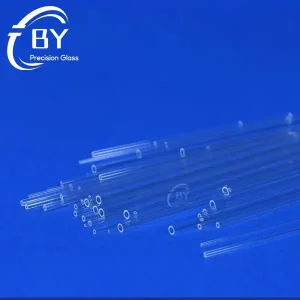
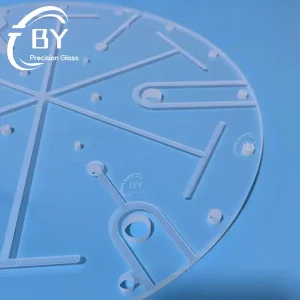
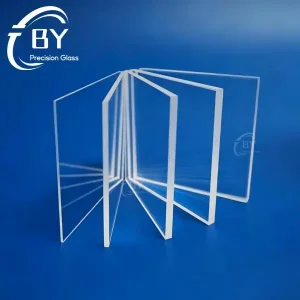
High-Purity Quartz, Capillary & Cavity Assemblies
Complementary optical glass products manufactured to tight tolerances for laser resonators, semiconductor tools, and analytical instruments.