High-Precision Optical Glass & UV Quartz Components
Engineered for high-throughput instrumentation, ultra-low stray light, and chemically aggressive analytical environments.
Next-Generation UV Spectroscopy: The Critical Role of Custom Cuvette Engineering
Why molecular absorption metrology demands higher optical homogeneity, thermal stress relief, and zero-adhesive sintering in modern biopharma and chemical physics.
Spectroscopic quantitative analysis based on the Beer-Lambert Law (A = ε × c × l) fundamentally assumes that the optical pathlength (l) remains mathematically constant and unaffected by mechanical deformation, solvent corrosion, or optical aberration. However, modern ultra-fast UV spectrophotometry, circular dichroism (CD), and fluorescence spectrometry operate with micro-liter sample volumes and deep ultraviolet wavelengths (190–260 nm), where slight standard deviations in cuvette glass density or window parallelism lead to massive absorbance error.
Traditional spectroscopy cells relied on epoxy bonding or intermediate glass frits. Under aggressive solvents such as dimethyl sulfoxide (DMSO), acetonitrile, strong acids, or prolonged ultrasonic decontamination, these adhesive layers leach organic contaminants, generate spurious peaks in the deep UV window, and eventually crack due to mismatched thermal expansion coefficients. High-precision manufacturing has therefore shifted toward direct molecular thermal fusion (sintering without glue) at elevated annealing temperatures exceeding 1,150°C, guaranteeing absolute molecular continuity of synthetic fused silica.
- Zero Fluorescence Background: Elimination of adhesive auto-fluorescence essential for single-molecule detection and protein folding diagnostics.
- Thermal-Shock Immunity: Linear expansion coefficients as low as 5.5 × 10⁻⁷/°C for temperature-programmed kinetics (Peltier thermal ramping).
- Precision Pathlength Integrity: Internal tolerances held to within ±0.005 mm across pathlengths ranging from 0.1 mm to 100 mm.
| Substrate Grade | Spectral Range | OH Content | Core Analytical Application |
|---|---|---|---|
| JGS1 Synthetic Fused Silica | 185 – 2,500 nm | < 5 ppm | Deep UV, DNA/RNA purity (A260/A280), CD spectropolarimetry |
| JGS2 Optical Fused Quartz | 220 – 2,500 nm | ~30 ppm | Routine UV-Vis absorption, pharmaceutical QA/QC kinetics |
| JGS3 Infrared Silica (Water-Free) | 260 – 3,500 nm | < 1 ppm | Vis-NIR, vibrational overtones, petroleum hydrocarbon monitoring |
| Optical Borosilicate (B270/N-BK7) | 340 – 2,500 nm | N/A | Visible spectrum colorimetry, student laboratories, enzymatic assays |
Emerging Procurement Requirements Across Worldwide Enterprises
Analyzing procurement specifications from Fortune 500 pharmaceutical manufacturers, in-vitro diagnostic (IVD) OEMs, and global scientific research consortia.
Sub-Micro & Nano-Liter Volume Flow Cells
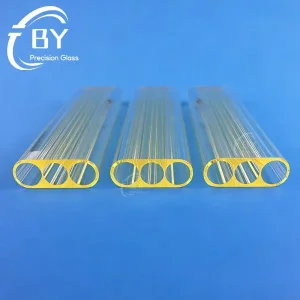
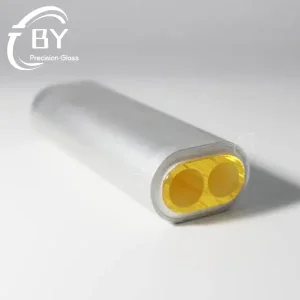
Modern genomics, HPLC, and capillary electrophoresis demand fluidic cuvette chambers with dead volumes below 10 μL. Global instrumentation buyers require micro-machined fused silica channels with optical aperture maskings (black quartz walls) that eliminate diffuse scattering, maximize signal-to-noise ratio, and prevent dynamic carryover between samples.
Stringent Regulatory & Batch Traceability
Biomedical and GLP/GMP laboratories operate under rigorous FDA 21 CFR Part 11 and ISO 17025 validation protocols. Procurement teams are discarding unbranded commodity cuvettes in favor of suppliers providing batch-specific certified baseline transmission traces, surface flatness verification (optical interferometry reports), and scratch-dig inspection certificates.
High-Duty-Cycle PAT Process Flow Units
Process Analytical Technology (PAT) in continuous biomanufacturing involves cuvettes integrated directly into pilot-scale bioreactor loops. Sourcing directors demand custom optical cells capable of withstanding steam-in-place (SIP), clean-in-place (CIP) with 1M sodium hydroxide, and prolonged hydrostatic pressures up to 15 bar without window delamination.
Supply Chain Resilience, Automation & Engineering Agility
Combining complete vertical integration—from raw silicon tetrachloride vapor synthesis to 5-axis CNC machining—under one certified roof in Tianjin.
Single-Roof Vertical Integration
Eliminating multi-tier subcontracting. Raw material synthesis, cold surface grinding, oxyhydrogen high-temperature fire polishing, CNC ultrasonic micro-milling, and cleanroom vacuum packaging are controlled under a unified quality assurance management regime.
Rapid Prototype to Mass Scaling
Agile production lines switch seamlessly from single-piece customized R&D prototypes to 50,000-unit monthly OEM runs. Our automated double-sided optical lapping centers hold thickness variation below ±0.002 mm across multi-thousand unit batches.
Advanced Metrology Equipment
Equipped with Zygo Verifire laser interferometers, PerkinElmer Lambda UV-Vis-NIR spectrophotometers, and coordinate measuring machines (CMM) ensuring 100% verified window flatness (λ/4 to λ/10) and surface quality down to 20-10 Scratch-Dig.
Robust Global Logistics Redundancy
Direct partnerships with global freight couriers, temperature-isolated, shock-proof custom vacuum packaging, and dedicated export customs documentation to ensure intact arrival in North America, Europe, East Asia, and Australasia.
Where Our Custom UV Cuvettes & Precision Quartz Operate
Engineered for mission-critical optical clarity in high-stakes commercial, clinical, and environmental analytical workflows.
Biopharma & Nucleic Acid Quantification
Micro-volume synthetic quartz cells for A260/A280 DNA/RNA analysis and A280 protein concentration profiling without background spectral absorption.
Environmental Water & Pollutant Monitoring
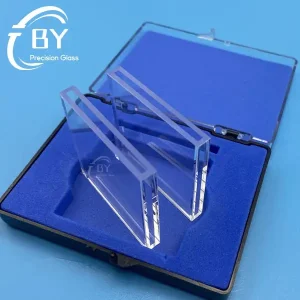
Long-pathlength rectangular cuvettes (50 mm–100 mm) optimized for trace chemical oxygen demand (COD), nitrate, and heavy metal detection down to parts-per-billion (ppb).
Semiconductor Wet Chemistry Control
Extreme acid/solvent-resistant continuous flow-through quartz cells monitoring etching bathes (HF, piranha, SPM) for dynamic chemical concentration.
Fluorescence & Phosphorescence Spectrometry
All-four-windows-polished cuvettes manufactured from ultra-pure JGS1 quartz, minimizing light leakage and secondary scattering for fluorophores and quantum dots.
Petrochemical & Synfuel Chromatography
High-pressure, temperature-jacketed flow quartz blocks serving as optical detection interfaces for supercritical fluid chromatography and NIR octane grading.
Frequently Asked Questions: Custom UV Cuvettes
Expert engineering insights regarding material selection, manufacturing tolerances, and cleaning protocols.
Why is fused silica (JGS1) mandatory for UV spectroscopy below 220 nm?
What is the difference between glued cuvettes and heat-fused (sintered) cuvettes?
What manufacturing tolerances can BY Photonics achieve for custom pathlengths?
Can you manufacture custom flow-through cuvettes with microfluidic connectors?
What is the recommended cleaning protocol for high-precision quartz cuvettes?
Custom Precision Glass & Specialized Quartzware
Explore additional manufactured components designed for laser systems, high-temperature furnaces, and analytical optoelectronics.