
Integrated Laser & Precision Quartz Hardware Series
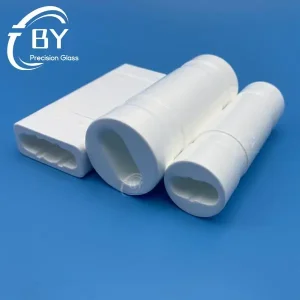
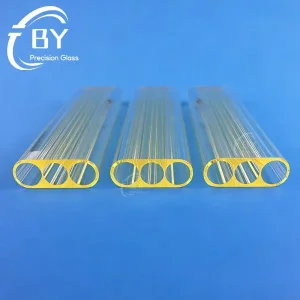
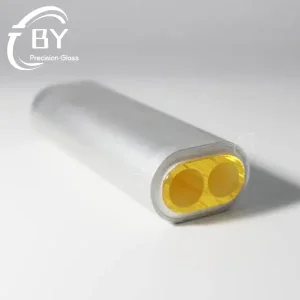
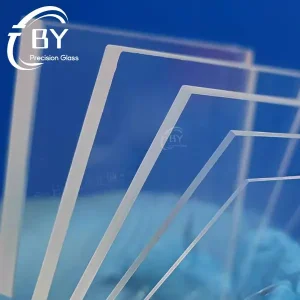
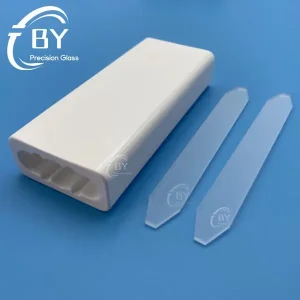
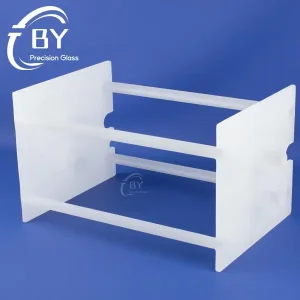
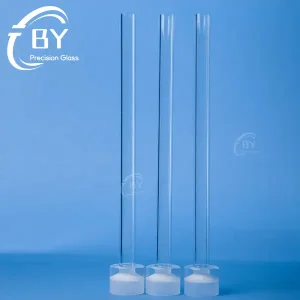
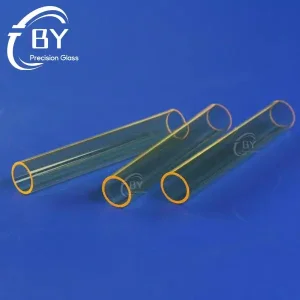
Featured optical glass, laser cavity flow tubes, and semiconductor-grade quartz assemblies machined in-house under micron-level tolerance regimes to support custom fiber coupling pipelines.

Engineering Custom Optical Fiber Couplers: Physics, Packaging & Modal Coupling
A rigorous examination of custom directional couplers, wavelength division multiplexers (WDMs), polarization-maintaining (PM) splitters, and high-power pump combiners manufactured from high-purity glass platforms.
1. The Paradigm Shift in High-Power & Polarized Optical Coupling
In modern photonic system design, the optical fiber coupler serves as the foundational pass-through and power distribution nexus across complex coherent networks. Whether configured as a 1×2 symmetrical Y-splitter, a 2×2 balanced 3dB tap coupler, or an N×1 high-brightness pump combiner for multi-kilowatt fiber lasers, coupler performance directly determines optical signal-to-noise ratio (OSNR), total inserted attenuation, and thermal tolerance. Tianjin BY Photonics approaches fiber coupler design through the prism of material science: an optical coupler is not merely twisted glass, but an integrated micro-optical system governed by evanescent wave transfer equations and packaged inside thermally matched synthetic fused silica capillaries.
As transmission data rates push beyond 800Gbps/1.6Tbps in artificial intelligence datacenters and coherent LiDAR architectures demand polarization extinction ratios (PER) exceeding 26 dB under mechanical vibration, standard off-the-shelf components fail. Custom engineering is required to precisely balance evanescent field penetration depth, taper angle profiles, adiabatic waist uniformity, and packaging expansion differentials. By utilizing proprietary JGS1/JGS2 synthetic fused silica sleeves, quartz end caps for high-power beam expansion, and precision redrawn capillaries, our assemblies eliminate thermal hot spots and mitigate optical catastrophic damage thresholds (CDT) under high CW irradiance.
Evanescent Field Control
Micro-controlled flame drawing and oxyhydrogen heating achieve sub-micron taper waist accuracy, providing custom coupling ratios from 99:1 tap monitors to precisely matched 50:50 quadrature splitters across wide operational bands.
- Coupling ratios configured from 0.1% to 50%
- Broadband WDL down to < 0.15 dB
- Direct evanescent wave overlap regulation
Polarization-Maintaining (PM)
Fabricated using stress-applying Panda or Bow-Tie fibers, custom PM couplers preserve single-polarization states with high PER, crucial for interferometers, fiber optic gyroscopes (FOGs), and coherent optical transceivers.
- PER held > 23 dB to 28 dB at target λ
- Precise slow/fast axis optical alignment
- Extremely low cross-coupling generation
High-Power Cladding Combiners
Combining multi-emitter laser diode arrays into active double-clad fibers requires adiabatic geometric tapering with minimal brightness degradation, integrated with quartz flow channels for thermal heat management.
- Power handling from 100W up to 12kW CW
- Transfer efficiency > 97%
- Damage-resistant fused silica end-capping
Macro-Level Industrial Solutions & Commercial Landscape
Strategic deployment of customized fused and micro-optic couplers across global hyperscale infrastructure, aerospace navigation, and industrial fiber laser fabrication.
Hyperscale AI Telemetry & CPO
With artificial intelligence clusters accelerating demand for 1.6T Co-Packaged Optics (CPO) and dense wavelength division multiplexing (DWDM), custom fiber splitters with flat spectral response across C+L bands minimize optical link budgets while maintaining strict channel isolation.
Aerospace, Gyroscopes & Defense
Fiber Optic Gyroscopes (FOGs) used in orbital avionics and naval inertial reference units depend entirely on non-reciprocal phase preservation in 2×2 PM fused couplers, operating without micro-cracking across -55°C to +125°C vibration regimes.
Biomedical OCT & Surgical Lasers
Optical Coherence Tomography (OCT) diagnostics operate at 840nm, 1060nm, and 1310nm. Custom wideband fiber couplers split reference and sample arms with sub-0.05dB insertion variance, enabling micron-level retinal and cardiovascular cross-sectional imaging.
Distributed Fiber Sensing (DAS/DTS)
Subsea oil reservoirs, border security perimeters, and smart civil pipelines rely on distributed acoustic and temperature sensing. Custom tap couplers channel Rayleigh backscatter signals through ultra-low-noise fused interfaces resistant to hydrogen darkening.
Engineering Selection Matrix: FBT vs. PLC vs. Micro-Optic Couplers
A comprehensive physical and optical evaluation matrix to guide optical hardware procurement teams, R&D principal investigators, and optoelectronic packaging engineers.
| Coupler Technology | Coupling Mechanism | Wavelength Range | Typical Excess Loss | Polarization Purity (PER) | Maximum Power Handling | Substrate Material |
|---|---|---|---|---|---|---|
| Fused Biconical Taper (FBT) | Adiabatic Core Evanescent Field Tapering | 405 nm – 2000 nm (Custom targeted) | < 0.07 dB | Standard: < 0.1 dB PDL; PM: > 25 dB | Up to 10W (Standard) / 500W+ (Fused Quartz) | JGS1 Synthetic Quartz Capillary |
| Planar Lightwave Circuit (PLC) | Photolithographic Silica Waveguide Network | 1260 nm – 1650 nm (O to U-band) | < 0.4 dB (1×4) to < 1.5 dB (1×64) | Moderate (Low PDL < 0.2 dB) | < 500 mW (Typical telecom) | Doped Silica on Silicon Substrate |
| Micro-Optic Filter Coupler | Free-Space Interference / Dichroic Filter Coating | UV to Far Infrared (200 nm – 3500 nm) | < 0.25 dB per channel | High (> 28 dB with PM Pigtails) | Up to 50W CW (Thermally heat-sinked) | Borosilicate / Sapphire Cell Tube |
| High-Power Cladding Combiner | Multimode Tapered Fiber Bundle (TFB) Fusion | 793 nm, 808 nm, 915 nm, 976 nm (Pump) | < 0.15 dB (Efficiency > 97%) | Unpolarized (Non-PM) / PM Cladding option | 1 kW – 12 kW CW | High-purity Quartz Flow Tube Jacket |
Material Science: The Foundation of Coupler Reliability
Coupler degradation occurs primarily at the glass-packaging boundary. BY Photonics leverages 15+ years of optical glass mastery to build packages that eliminate micro-bending stress and environmental drift.
Fused Silica Capillaries
Our in-house redrawn quartz capillaries match the thermal expansion coefficient (CTE ~5.5×10⁻⁷/K) of fused silica optical fibers perfectly. This eliminates thermal cycle hysteresis between -40°C and +125°C, ensuring stability.
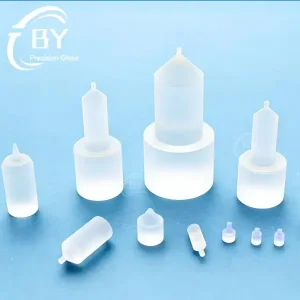
QBH Quartz End-Caps
For high-power fiber outputs and combiners, fiber core damage from back-reflections is prevented by fusion-splicing high-purity cylindrical quartz end caps that allow beam expansion before traversing air interfaces.
Flame-Sealed Isolation
Oxyhydrogen precision micro-torches achieve clean, bubble-free fusion boundaries. Eliminating adhesive glues within the optical path shields couplers against solarization, photothermal combustion, and degassing under high vacuum.
Telcordia Qualification, Quality Assurance & Regional Engineering Support
Guaranteed operational lifespan through strict adherence to international optical engineering benchmarks, comprehensive material batch certificates, and dedicated DFM engineering assistance.
Telcordia GR-1209 & GR-1221
Every custom coupler design family undergoes rigorous mechanical shock, thermal cycling (-40°C to +85°C), high-temperature storage (85°C at 85% RH for 2,000 hours), and water immersion testing to confirm telecommunications-grade survivability.
RoHS, REACH & ISO 9001:2015
Certified lead-free, non-toxic manufacturing protocols with total material traceability from raw synthetic silica boules to the finished packaged device. Full metallurgical and optical transmittance inspection sheets are provided with every batch.
Direct Engineering Channel
Our Tianjin headquarters works in tandem with logistics hubs across North America, Europe, and Asia-Pacific. Speak directly with process engineers who evaluate your CAD drawings, optical pinouts, and housing form factors in under 24 hours.
Technology Roadmap: Custom Coupler Innovations (2025–2032)
How next-generation optical networks, multicore fibers, and space-division multiplexing are transforming fiber coupler geometry and micro-machined glass housings.
Multicore Fiber (MCF) Fan-In / Fan-Out
Transitioning from single-core networks to 4-core, 7-core, and 19-core spatial multiplexing requires precision micro-optic capillary bundles. BY Photonics manufactures etched capillary arrays with pitch tolerance within ±0.5 μm.
Quantum Entanglement Couplers
Quantum key distribution (QKD) and photonic quantum computers require balanced 50:50 directional couplers with near-zero photon loss and matched phase delays. Fused silica packaging prevents phase distortion under cryogenic conditions.
Extreme Temperature Metal-Coated Pigtails
For deep-well nuclear and geothermal installations exceeding 350°C, polymer jackets burn away. We integrate gold/copper alloy coated fiber leads with laser-welded quartz housings, ensuring uninterrupted telemetry without gas leaks.
Frequently Asked Questions on Custom Fiber Couplers
Clear, definitive technical guidance directly from our manufacturing and optical engineering department.
What distinguishes custom fused fiber couplers from standard mass-market PLC splitters?
How does BY Photonics manage Polarization Extinction Ratio (PER) in PM fiber couplers?
What is the typical lead time for custom prototype fiber coupler development?
Can you manufacture fiber combiners and couplers suitable for multi-kilowatt laser systems?
What drawing and specification formats should clients provide for quotation?
Specialized Glass, Ceramic & Optical Substrates
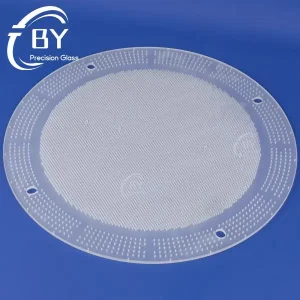
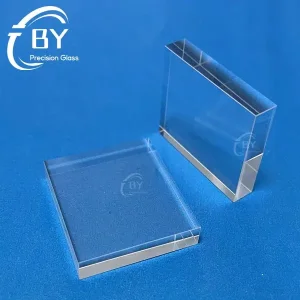
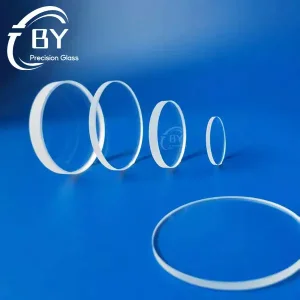
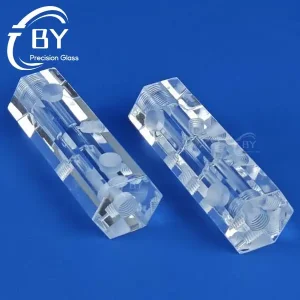
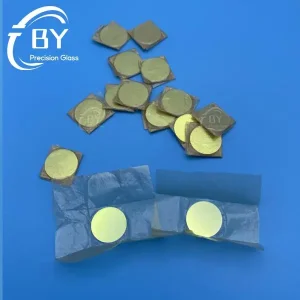
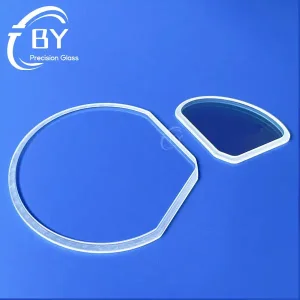
Explore additional optical elements manufactured alongside our fiber coupler lines, including IPL light guides, lithography quartz windows, and chemical-resistant viewports.
Initiate Your Custom Fiber Coupler Project
Upload your CAD optical layout or design specification directly to our manufacturing engineering desk. Get an actionable Design For Manufacturability (DFM) review and preliminary tooling analysis returned in under 24 business hours.