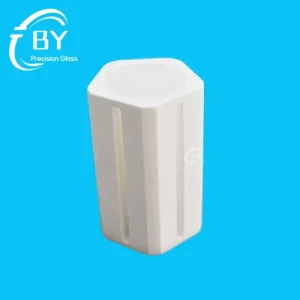
Precision Substrates & Machined Quartz Solutions
Explore standard and bespoke high-temperature fused quartz parts engineered for high-vacuum, laser flow, and lithography applications.
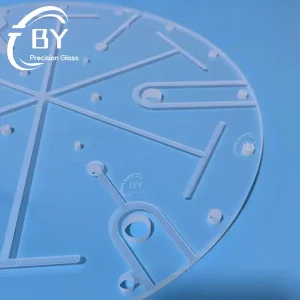
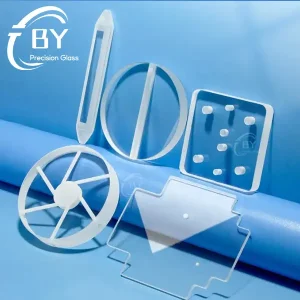
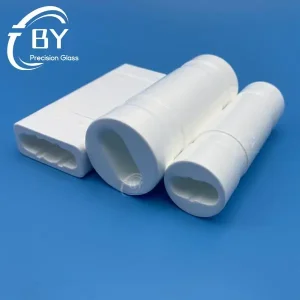

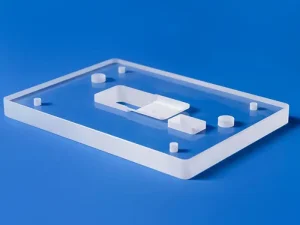
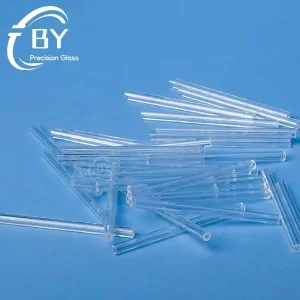
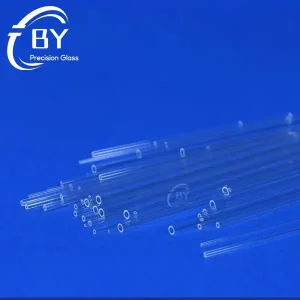
Global Landscape of High-Purity Quartz Discharge Chambers
Strategic overview of raw material purification, dielectric performance requirements, and micro-contamination prevention in high-density plasma operations.
Engineered Quartz Grades for Plasma Containment
A comprehensive comparison of fused silica and quartz variations used in industrial discharge chamber architecture.
| Quartz Grade / Spec | Transmission Bandwidth | Hydroxyl [OH⁻] Content | Dielectric Loss Tangent (tan δ) | Primary Industrial Use Case |
|---|---|---|---|---|
| JGS1 (Synthetic Fused Silica) | 185 nm – 2,500 nm (Deep UV) | < 50 ppm to 1,200 ppm (Controlled) | < 1.0 × 10⁻⁴ (at 1 MHz) | UV/EUV optical discharge, ICP etching sources, low-loss microwave plasma tubes |
| JGS2 (Fused Natural Quartz) | 220 nm – 2,500 nm (Standard Optical) | < 30 ppm | < 3.0 × 10⁻⁴ (at 1 MHz) | Semiconductor diffusion chambers, PECVD reaction vessels, general ion sources |
| JGS3 (Infrared Fused Quartz) | 260 nm – 3,500 nm (Low OH) | < 5 ppm (Water-free) | < 0.8 × 10⁻⁴ (at 10 GHz) | High-power microwave heating cavities, infrared pyrometry viewports, RF windows |
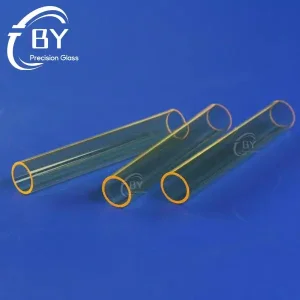
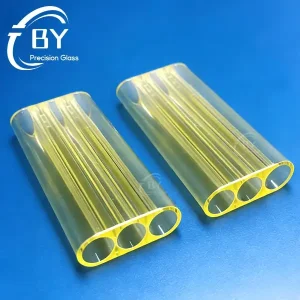
| Doped / Opaque Quartz | Broadband Absorption / Diffusion | Variable (< 20 ppm) | < 5.0 × 10⁻⁴ (at 1 MHz) | Thermal insulation baffles, radiation shielding collars, laser cavity flow tubes |
High-Stakes Industrial & Mission-Critical Implementations
Examine how bespoke quartz discharge vessels empower breakthrough performance in specialized engineering fields.
Semiconductor Etch & ALD
Chambers optimized for ICP, RIE, and Atomic Layer Deposition systems. Engineered to handle aggressive halogens (NF₃, CF₄, Cl₂) with exceptionally low particle spallation, maintaining atomic-level purity across thousands of operational wafer cycles.
Spacecraft Electric Propulsion
Radio-frequency ion thrusters (RIT) and helicon plasma thrusters rely on cylindrical and hemispherical quartz discharge chambers to ionize xenon or krypton propellants under intense vibrations, radiation, and zero-gravity thermal extremes.
Analytical ICP-OES & MS Torches
Spectroscopic systems require high concentricity injector tubes, demountable outer discharge vessels, and cooling gas jackets fabricated with sub-tenth millimeter concentricity to ensure steady laminar flow and reproducible signal calibration.
Engineering Horizons: 2026 to 2032 Evolution
Anticipating future industry transitions toward larger diameters, synthetic hybridization, and plasma erosion coatings.
Phase I: Extreme Geometry Scaling
Fabrication of seamless, large-diameter single-piece discharge liners (up to Ø600 mm) utilizing horizontal glassblowing lathes and precision CNC continuous 5-axis ultrasonic diamond grinding to meet 450mm wafer trial platforms.
Phase II: Nano-Engineered Coatings
Application of conformally applied ALD Yttria (Y₂O₃) and Alumina (Al₂O₃) passivation barriers directly inside custom quartz discharge vessels, reducing halogen-plasma erosion rates by up to 70% and virtually eliminating micro-flaking.
Phase III: Integrated Sensor Envelopes
Embedding high-precision sapphire optical emission monitoring (OEM) viewports and internal fiber-optic Bragg gratings (FBG) into the discharge walls for real-time cavity temperature mapping and instantaneous plasma sheath diagnostic tracking.
Enterprise Solutions for Global Quartz Sourcing
A rigorous quality assurance protocol that mitigates risk across international supply chain nodes.
Full Traceability
Every batch originates with comprehensive ingot chemical purity certificates (ICP-MS reports), documenting trace elements down to parts-per-billion levels.
Cleanroom Annealing
Post-welding thermal soaking inside computer-controlled electric kilns followed by Class 100 cleanroom chemical de-smudging and high-purity DI water ultrasonic flushing.
CMM Metrology
Contact and multi-sensor non-contact coordinate measuring machines confirm critical sealing ring planarity, chamber wall concentricity, and flange bolt patterns to within ±0.005 mm.
Secure Clean Packaging
Multi-layer anti-static vacuum containment, nitrogen purging, and shock-absorbent suspension cases engineered to survive long-distance trans-oceanic freight.
Frequently Asked Questions on Custom Quartz Discharge Chambers
In-depth engineering answers addressing thermal, dielectric, and structural design concerns.
Q: Why is fused quartz preferred over alumina ceramics in RF discharge chambers?
Fused quartz offers an exceptionally low dielectric loss tangent (tan δ < 0.0001 at 1 MHz) and low relative permittivity (εr ≈ 3.78), minimizing electromagnetic power dissipation and capacitive heating within chamber walls. Furthermore, its amorphous molecular network eliminates grain-boundary grooving and particle flaking characteristic of polycrystalline ceramics.
Q: How do you prevent devitrification (crystallization) in quartz chambers operated above 1,000°C?
Devitrification into cristobalite is primarily catalyzed by surface alkaline contaminants (Na, K, Li). Our facility implements ultra-pure acid leaching (HF/HNO₃ balance) post-fabrication and operates Class 1,000 thermal furnaces. When operating in customer setups, keeping clean vacuum conditions and preventing direct finger contact prevents devitrification up to 1,150°C continuous service.
Q: What is the typical lead time for custom engineered prototypes from customer CAD?
Standard design-for-manufacturability (DFM) reviews are returned within 24 working hours. Prototype tooling and delivery of precision CNC ground and flame-assembled custom quartz discharge vessels typically require 2 to 3 weeks, accompanied by full optical inspection, CMM dimensional readouts, and raw material purity verification.
Q: How do you achieve hermetic vacuum seals between quartz discharge chambers and metal flanges?
Depending on application operating temperatures, hermeticity is accomplished through calibrated Viton/Kalrez FFKM elastomeric O-rings with ground quartz surface finishes (Ra < 0.2 µm), precision tapered ground-joints, or via direct graded-glass-to-metal (Kovar/Invar) seals designed to absorb differential coefficient of thermal expansion (CTE) mismatches.
Specialized Flow Tubes, Cavities & Semiconductor Quartzware
Advanced optical cavities, doped filtering tubes, and lithography windows tailored for demanding industrial OEM integration.