
High-Precision Optical & Quartz Components
Engineered to drawing with complete material traceability, internal fire-polishing, and sub-nanometer surface roughness for mission-critical scientific and industrial instrumentation.
Global Commercial Status of Precision Quartz Glass Capillaries
A comprehensive analysis of market forces, supply chain shifts, and escalating micron-level performance demands in next-generation high-tech manufacturing.
In high-precision photonics, semiconductor fabrication, and molecular diagnostics, custom quartz glass capillaries serve as the critical fluidic and optical conduits that bridge macro-system architectures with micro-scale phenomena. Unlike standard borosilicate or soda-lime glass tubing, vitreous silica (quartz glass) exhibits an amorphous structure formed exclusively of silicon-oxygen tetrahedra ($SiO_2$). This lattice delivers extraordinary optical transmission from the vacuum ultraviolet (VUV 185 nm) through the near-infrared (NIR 3,500 nm), exceptional thermal shock endurance ($\Delta T > 1,000^\circ\text{C}$), near-zero coefficient of thermal expansion ($\alpha = 5.5 \times 10^{-7}/\text{K}$), and supreme chemical inertness against virtually all aggressive solvents except hydrofluoric and hot concentrated phosphoric acids.
The global precision quartz capillary market has entered a transformative expansion phase, projected to surpass USD 1.85 billion by 2031, expanding at a compound annual growth rate (CAGR) of 8.4%. This surge is propelled by three converging technological imperatives:
Next-Gen Genomics & CE
High-throughput Sanger sequencing, fragment analysis, and capillary electrophoresis (CE) mandate multi-channel capillary arrays with zero autofluorescence and sub-micron internal diameter uniformity to ensure picogram-level resolution.
- Capillary Zone Electrophoresis (CZE)
- Single-cell DNA/RNA profiling
- Inner bore tolerances < ±0.5 µm
EUV/DUV Semiconductor
Advanced sub-3nm nodes require custom quartz capillaries and gas distribution tubes within vacuum chambers for corrosive precursor dosing, gas purging, and lithographic sensor optical isolation.
- Atomic Layer Deposition (ALD) feed
- Extreme UV beam diagnostic windows
- Trace heavy metal content < 0.1 ppm
Fiber Optics & Laser Doping
From telecommunication fiber ferrule packaging to medical Nd:YAG laser cooling, Samarium-doped and fluorine-doped quartz capillaries eliminate parasitic ASE and optimize waveguiding coupling.
- Low-loss fiber collimator sleeve blanks
- Parasitic 1064nm fluorescence damping
- Concentricity error < 0.5%
Tianjin BY Photonics Co., Ltd., founded in 2010, occupies a unique position in this supply matrix. While standard manufacturers specialize strictly in hot drawing or cold mechanical machining, BY Photonics integrates raw chemical vapor deposition (CVD) synthetic ingot selection, vertical laser-controlled redrawing towers, ultrasonic 5-axis CNC machining, and oxyhydrogen micro-flame fusion welding under a single quality management system. This unified manufacturing architecture eliminates tolerance stack-up and surface defect transitions between fragmented subcontractors.
Synthetic Fused Silica vs. Natural Quartz Capillaries
Understanding hydroxyl ($OH^-$) radical concentration, bubble classes, and drawing rheology is vital for selecting the optimal capillary substrate.
Specifying a custom capillary requires strict alignment between the operating optical wavelength, chemical medium, and mechanical stress profile. At BY Photonics, we engineer capillaries utilizing three distinct optical quartz classifications in accordance with Chinese National Standards (GB) and international equivalents (Heraeus Suprasil / Infrasil, Corning HPFS):
| Grade / Material | Synthesis Process | Spectral Transmission | Hydroxyl ($OH^-$) Content | Typical Capillary Application |
|---|---|---|---|---|
| JGS1 (Synthetic Fused Silica) | $SiCl_4$ Gas Phase Chemical Flame Hydrolysis | 185 nm – 2,500 nm (Deep UV) | > 800 – 1,200 ppm (High OH) | UV Capillary Electrophoresis, HPLC Flow Cells, Excimer laser guides |
| JGS2 (Fused Quartz) | Oxyhydrogen Flame Fusion of Natural Crystal | 220 nm – 2,500 nm (Vis-UV) | 150 – 200 ppm | General chromatography, medical laser cooling tubes, viewports |
| JGS3 (Infrared Fused Quartz) | Electric Vacuum Melting of Natural Quartz | 260 nm – 3,500 nm (Near to Mid IR) | < 5 ppm (Water-free) | FTIR spectroscopy cells, NIR pyrometry probes, telecom couplers |
| Fluorine-Doped Silica | Plasma Deposition / Doped Soot Preform | Depressed refractive index cladding | Controlled < 20 ppm | Hollow-core waveguides, liquid-core optical fibers, UV light guides |
| Samarium-Doped Glass | Rare-earth molten silicate synthesis | Absorbs 1064nm, transmits 400-900nm | Engineered Dopant % | Flashlamp filter jackets, aesthetic laser triple-bore flow chambers |
Critical Engineering Principle: For applications operating at $254\text{ nm}$ or $214\text{ nm}$ (such as protein detection in micro-HPLC and CE), standard natural quartz exhibits catastrophic solarization (E-center defect generation) and intrinsic luminescence. JGS1 synthetic silica must be utilized to maintain optical baseline stability over thousands of continuous operational hours.
The Capillary Redrawing Mechanics: Precision Thermal Down-Drawing
Drawing high-purity quartz down to microscopic dimensions without collapsing the internal bore or introducing elliptical asymmetry requires mastery over the glass viscosity curve. Quartz glass has no distinct melting point; its softening point occurs at approximately $1,730^\circ\text{C}$, with working temperatures ranging between $1,900^\circ\text{C}$ and $2,150^\circ\text{C}$ where dynamic viscosity ($\eta$) drops to $10^4$ to $10^5\text{ dPa}\cdot\text{s}$.
Our Tianjin redrawing facility employs multi-story vertical draw towers equipped with inert-gas purged, cleanroom-enclosed resistance and induction furnace zones. Key proprietary controls include:
- Internal Bore Pressurization: Ultra-stable mass flow controllers maintain micro-positive pressure ($\pm 0.1\text{ mbar}$) inside the preform bore, balancing surface tension forces that naturally seek to close micro-lumens during furnace transit.
- Dual-Axis Laser Metrology: Non-contact high-speed laser micrometers scan Outer Diameter (OD) and Wall Thickness at 2,000 Hz, feeding direct closed-loop PID adjustments to the servo tractor drawing speed.
- Concentricity and Wall Uniformity: Drawing from precision-honed and fire-polished mother tubes yields total internal runout (TIR) and concentricity errors below 1.0% across kilometer-length canes.
Versatile Geometrical Architectures & Custom Profiles
Engineered structural varieties tailored to micro-hydrodynamics, optical coupling, and extreme pressure endurance.
Single-Bore Round Tubes
Classic microfluidic geometry featuring ultra-smooth internal fire-polished surfaces ($R_a < 0.5\text{ nm}$) without micro-fissures.
- ID range: $2\,\mu\text{m}$ to $3,000\,\mu\text{m}$
- OD range: $80\,\mu\text{m}$ to $10,000\,\mu\text{m}$
- Pressure rating up to 1,200 bar
Square & Rectangular Bores
Eliminates optical cylindrical lensing effects, providing planar optical windows for real-time laser excitation and confocal imaging.
- Zero wavefront distortion
- Ideal for flow cytometry flow cells
- Aspect ratios customized up to 1:10
Multi-Lumen & Triple-Bore
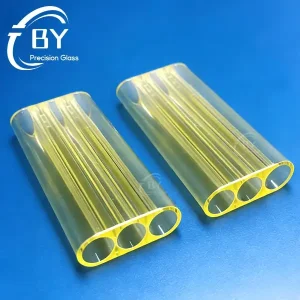
Integrated dual, triple, or hexagonal multi-channel configurations drawn with unified cross-sectional pitch accuracy.
- Separate fluidic & optical channels
- Laser pump head cooling flow tubes
- Samarium or cerium selective doping
Coated & Windowed Tubing
Outer protective polyimide, acrylate, or fluoropolymer sheathing for flexible assembly, featuring laser-burned detection apertures.
- Polyimide operational to $385^\circ\text{C}$
- On-column UV detection windows
- Precision diamond cleaving & polishing
High-Value Industrial Application Scenarios
Where custom quartz capillaries deliver breakthrough optical clarity, thermal isolation, and hydraulic precision.
1. Gas Chromatography (GC) and High-Performance Liquid Chromatography (HPLC)
In analytical chemical analysis, the capillary acts as both the separation column substrate and the optical interrogation cell. The inner wall of our JGS1 fused silica capillary exhibits an ultra-low concentration of isolated surface silanol groups ($Si-OH$), minimizing non-specific analyte adsorption when coated with stationary phase polymers. When used in HPLC UV/Vis micro flow detectors, the pristine cylindrical or square quartz lumen ensures maximum optical path length with minimal baseline noise across the entire 190–800 nm spectrum.
2. Capillary Electrophoresis (CE) and Genetic Sequencing
Capillary Gel Electrophoresis (CGE) and Capillary Isoelectric Focusing (cIEF) require extreme electrical resistance and thermal dissipation. With a volume resistivity exceeding $10^{18}\,\Omega\cdot\text{cm}$ and thermal conductivity of $1.4\,\text{W}/(\text{m}\cdot\text{K})$, our custom quartz capillaries prevent runaway Joule heating during separation runs up to $30\,\text{kV}$. Polyimide outer coatings provide flexible handling strength, allowing bending radii down to $30\,\text{mm}$ without structural fracturing.
3. Flow Cytometry and Micro-Particle Image Velocimetry
Square quartz flow cells manufactured by BY Photonics enable hydrodynamic focusing of cellular streams into a single-file file for interrogation by multiple laser beams. The high refractive index homogeneity ($n_d = 1.4584$) and low birefringence ($\Delta n < 5\times 10^{-6}$) ensure zero spatial beam distortion, directly improving side scatter (SSC) and forward scatter (FSC) resolution in clinical blood analyzers.
4. Solid-State Medical and Aesthetic Laser Flow Tubes
In flashlamp-pumped Alexandrite ($755\text{ nm}$) and Nd:YAG ($1064\text{ nm}$) medical laser systems, triple-bore and double-bore quartz flow tubes surround the laser rod and flashlamp. By incorporating Samarium (Sm) dopants into the quartz matrix, our flow tubes selectively absorb harmful ultraviolet radiation (< 380 nm) and parasitic $1064\text{ nm}$ spontaneous emission, preventing thermal lensing and optical breakdown while cooling the crystal rod with turbulent deionized water.
5. Fiber Optic Ferrules, V-Grooves & Collimator Blanks
Optical telecommunication networks rely on ultra-precise quartz capillary ferrules to align single-mode fibers ($125\,\mu\text{m}$ cladding) with core alignment errors below $0.5\,\mu\text{m}$. Matching the capillary material's thermal expansion precisely to that of the silica optical fiber eliminates insertion loss shifts across harsh military and aerospace temperature envelopes ($-55^\circ\text{C}$ to $+125^\circ\text{C}$).
Macro-Industry OEM Solutions & Turnkey Integration
Transforming complex customer drawings into qualified, scalable, and contamination-free optical assemblies.
Cleanroom ISO Class 6 Assembly
Every micro-bore capillary undergoes ultrasonic organic stripping, ultra-pure water (UPW, 18.2 MΩ·cm) multi-stage rinsing, and vacuum packaging within Class 1,000 / ISO 6 clean environments to eliminate particle clogging.
- Zero particle count > 0.3 µm
- Cleanroom vacuum heat-sealed blister packs
- Custom length cane or reel formats
End-Face Engineering & Polishing
Precision cleaving, chemo-mechanical polishing (CMP), and laser flame-polishing achieve face perpendicularity < 0.5° and optical scratch-dig ratings down to 10-5, vital for fiber splicing and flow connector seating.
- Brewster-angle end-face cuts
- Precision outer chamfering & flaring
- Anti-reflective (AR) optical dielectric coatings
Rapid DFM Feasibility & Prototyping
Our dedicated optical engineering desk evaluates full technical drawings (STEP, DWG, PDF) within 24 hours, reviewing drawing tolerances, thermal mismatch vulnerabilities, and batch redrawing yield optimization.
- Direct engineer-to-engineer consult
- Pre-production prototype runs in 10-15 days
- 100% CMM & optical dimensional QC reports
Technology Roadmap: The Next Decade in Micro-Silica Optics
Anticipating the technological barriers of quantum computing, organoid microfluidics, and EUV lithography.
Sub-Micron Multi-Lumen Alignment
Scaling automated laser draw towers to mass-produce 37- and 61-bore honeycomb quartz capillary arrays with pitch positional accuracy better than $\pm 0.3\,\mu\text{m}$ for high-density fiber bundles.
Hollow-Core Photonic Bandgap Capillaries
Fabrication of antiresonant hollow-core fiber (AR-HCF) capillary tubes enabling extreme low-latency data transmission and high-power femtosecond laser beam delivery without dielectric damage.
Integrated Optofluidic Quantum Nodes
Combining laser-written photonic waveguides with micro-capillary atomic vapor chambers for miniaturized rubidium/cesium atomic clocks and quantum magnetometers operating under high vacuum.
AI Closed-Loop Molecular Vitrification
Implementation of machine-vision-guided oxyhydrogen plasma drawing with in-situ atomic force spectroscopy, realizing zero-defect continuous micro-tubing for spaceborne instrumentation.
Frequently Asked Engineering & Sourcing Questions
In-depth insights addressing tolerances, chemical degradation, thermal stress, and design trade-offs.
Precision Laser, Flow & Substrate Solutions
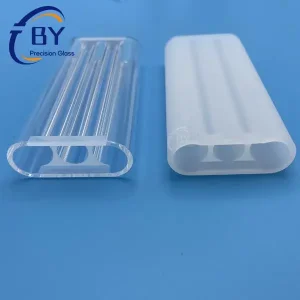
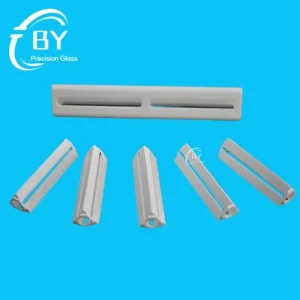
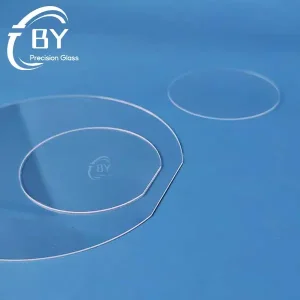
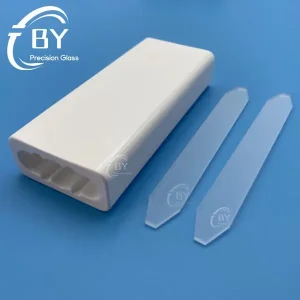
Complementary precision optics, laser cavities, doped glass assemblies, and wafer substrates engineered for high-end photonics integrations.
Request Custom Capillary DFM & Feasibility Evaluation
Submit your CAD files (.STEP, .DWG, .DXF) or technical PDF drawings. Our senior optics and glass processing engineers will return an in-depth manufacturability assessment, material grade recommendation (JGS1/JGS2/JGS3), and quotation within 24 working hours.